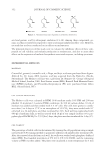
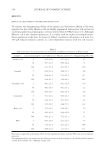
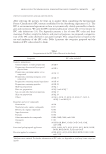
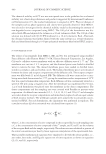
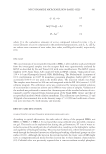
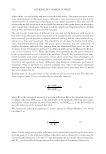
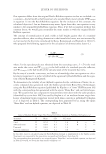
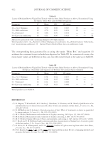
LETTER TO THE EDITOR 411 Our equation differs from the original Reich–Robbins equation in that we included—as a constant—the full width at half maximum of a standard black metal cylinder (HWstandard in equation 1) into the Reich/Robbins equation. By the inclusion of this constant, the calculated objective L has no dimension any more. Apart from this, our equation is very similar to the original Reich/Robbins equation. Thus, if we did our analysis without this constant factor, we would gain essentially the same results as with the original Reich/ Robbins equation. The concept of normalization of peak width at half height against that of a standard specular refl ector, thus avoiding dimension in the formula for luster, was not invented by us, but was for the fi rst time introduced by Keiss, Ramaprasad, and Kamath in 2004 (7), who proposed the following equation for the calculation of dimensionless luster (L): 1/2standard 1/2sample ×W ( + )×W S L= S D (3) where S is the specular peak area obtained from the scattering curve, S + D is the total area under the curve, and W1/2standard is the half width of a standard specular refl ector, and W1/2sample is the half width of the specular peak of the mounted hair tress. By the way of scientifi c correctness, we have to acknowledge that our equation to calcu- late luster (equation 1) is in fact a hybrid of the equation by Reich/Robbins and the equa- tion of Keiss/Ramaprasad/Kamath. To demonstrate the validity of our (hybrid) equation for the calculation of luster, we re- cently compared data generated with the Samba system from Bossa Nova Technologies using the Reich/Robbins equation [published by Kaplan et al. from TRI/Princeton (8)] with the corresponding data generated with the opsira “Shine Box” and our hybrid equa- tion. We assume that our comparative measurements were done with the same products (identifi ed by us via their INCI) as used by Kaplan et al. on medium brown virgin hair. Luster of medium brown virgin hair treated with shine controls as published by Kaplan et al. is depicted in Table I. The corresponding data generated by us, using the opsira “Shine Box” and our hybrid equation, are depicted in Table II. Table I Luster of Medium Brown Virgin Hair Treated with Shine Controls as Published by Kaplan et al. Treatment N Mean S.D. S.E. mean 2 in 1 25 115.3 7.1 1.4 B — — XM conditioner 25 109.3 8.2 1.6 B C — Untreated 25 108.3 8.1 1.6 — C — Leave-in conditioner 25 57.5 4.2 0.8 — — D In this table, luster is calculated using the Reich/Robbins formula as implemented in the Samba system. Treatments not connected by the same letter are signifi cantly different. Data from (5). The corresponding data generated by us, using the opsira “Shine Box” and our hybrid equation, are depicted in Table II. Overall, we obtain the same results as Kaplan et al.

JOURNAL OF COSMETIC SCIENCE 412 The corresponding data generated by us using the opsira “Shine Box” and equation (1) without the constant factor included are depicted in Table III. As a matter of course, the mean luster values are different in this case, but the overall result is the same as in Table II. Table II Luster of Medium Brown Virgin Hair Treated with the Same Shine Products as Above, Determined Using the Opsira “Shine Box” and the Hybrid Equation Treatment N Mean S.D. S.E. mean 10—2 in 1 Shampoo 10 0.79 0.08 0.025 B — — 20—XM conditioner 10 0.76 0.05 0.016 B — — 30—Untreated 10 0.86 0.05 0.016 — C — 40—Leave-in conditioner 10 0.53 0.06 0.019 — — D All hair was pretreated with a cleansing shampoo (10% SLS solution). Tested products were: 10—Pantene Ice Shine Shampoo & Conditioner 20—Herbal Essences “hello hydra- tion” moisturizing conditioner 40—Garnier Fructis Sleek & Shine leave-in conditioner cream. Table III Luster of Medium Brown Virgin Hair Treated with the Same Shine Products as Above, Determined Using the Opsira “Shine Box” and Equation (1) Without the Constant Factor Included Treatment N Mean S.D. S.E. mean 10—2 in 1 Shampoo 10 0.39 0.04 0.013 B — — 20—XM conditioner 10 0.38 0.02 0.066 B — — 30—Untreated 10 0.42 0.03 0.009 — C — 40—Leave-in conditioner 10 0.26 0.03 0.009 — — D Tested products as in Table II. REFERENCES (1) R. Hagens, T. Wiersbinski, M. E. Becker, J. Weisshaar, V. Schreiner, and H. Wenck, Qualifi cation of an automated device to objectively assess the effect of hair care products on hair shine, J. Cosmet. Sci., 62, 453–467 (2011). (2) R. McMullen and J. Jachowicz, Optical properties of hair: Effect of treatments on luster as quantifi ed by image analysis, J. Cosmet. Sci., 54, 335–351 (2003). (3) M. E. Becker, Measurement and evaluation of display scattering, SID Digest, 35, 184–187 (2004). (4) M. E. Becker, Measurement and evaluation of display scattering, J. SID, 13, 81–89 (2005). (5) M. E. Becker, Display refl ectance: Basics, measurement, and rating, J. SID, 14/11, 1003–1017 (2006). (6) C. Reich and C. R. Robbins, Light scattering and shine measurements of human hair: A sensitive probe of the hair surface, J. Soc. Cosmet. Chem., 44, 221–234 (1993). (7) K. Keiss, K. R. Ramaprasad, and Y. K. Kamath, Studies of light scattering from ethnic hair fi bers, J. Cosmet. Sci., 55, 49–63 (2004). (8) P. D. Kaplan, K. Park, J. Qi, and K. Yang, The shine problem in hair: Review of imaging methods and measures for luster, J. Cosmet. Sci., 60, 111–123 (2009).
Purchased for the exclusive use of nofirst nolast (unknown)
From: SCC Media Library & Resource Center (library.scconline.org)