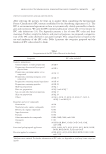
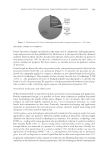
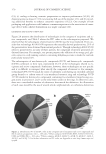
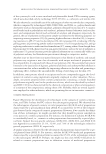
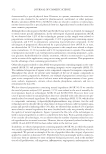
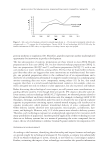
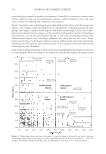
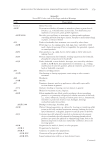
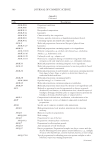
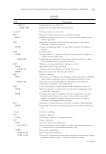
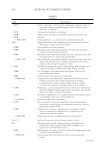
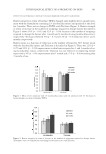
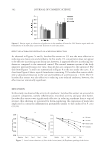
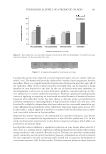
HOW COULD TECHNOLOGICAL FORECASTING HELP COSMETIC CHEMISTS 375 impacts between technologies in the same class, such as the impacts between technologies A61K 8/00 and A61K 8/18 (impacts A, B = 0.24 and B, A = 0.71) or A61K 31/00 and A61K 31/045 (Figure 4). Such impacts only mean that innovations related to cosmetic or toilet preparations (A61K 8/00) are strongly characterized by their composition (A61K 8/18). Second, we observed unidirectional impacts between cosmetic preparations charac- terized by a special physical form (A61K 8/02) and types of cosmetic preparations, such as anti-perspirants and body deodorants (A61Q 15/00 impacts A, B = 0.04 and B, A = 0.60) or tanning skin care preparations (A61Q 19/04 impacts A, B = 0.10 and B, A = 0.87). Third, we observed some unidirectional impacts of specifi c excipients and active compounds over their relative cosmetic preparations. For example, whenever monoclonal or polyclonal immunoglobulins (C07K 16/00) were employed, there was a preparation containing peptides (A61K 38/00 Figure 4). In general, these impacts are rather obvious and vaguely meaningful for the formulation practitioner. For that reason, some of those cases were not identifi ed in Figure 4. Therefore, it is necessary that one skilled in cosmetic technologies identifi es and interprets the meaningful technological impacts so that pat- ent information becomes useful for product innovation. In fact, we observed some unidirectional technological impacts with relevant information for cosmetic chemists. For instance, the impact of technology A61K 47/00 (medicinal preparations characterized by the non-active ingredients used) over technology A61K 36/00 (medicinal preparations of undetermined constitution containing naturally de- rived ingredients). This impact means that in 60% of the patents classifi ed as A61K 47/00, the ingredient that characterized the innovation was originally natural. This result refl ects the relevance of naturally derived ingredients as an alternative to innovate in cos- metic preparations. Another unidirectional impact observed was the infl uence of technology A61Q 3/02 (manicure or pedicure preparations for nail coatings) on technology A61Q 5/00 (prepara- tions for hair care). This impact is explained by the use of the same fi lm-forming polymers in preparations for nail coatings as well as for eyelash mascaras, in which the polymers are supposed to offer resistance for fragile nails or lengthening effects for eyelashes (44). Such patents also claimed for skin care activity. The relationship between these two technolo- gies elucidates the possibility of using one specifi c new raw material in many different new products to better explore either the resources or the innovative capability. In relation to bidirectional impacts, we observed the infl uence of technology C08L 83/00 (compositions of silicon-derived macromolecular compounds) on technology B32B 9/04 (layered products comprising a substance as the main or only constituent of a layer, such as surface-treated particles). This impact is related to the use of silicone polymers of dif- ferent solubility, either crosslinked or not, to improve particle dispersibility in a silicone liquid medium. These polymers could be used to treat the surface of pigments, clays, and other minerals to improve the stability of the fi nal dispersion to offer higher adhesion to the skin and to enhance transfer resistance (26), among others. This data refl ects the relevance of silicone polymers in particle surface treatment. Finally, we observed a bidirectional impact between technologies A61Q 19/04 (skin care preparations for chemically tanning the skin) and A61Q 17/00 (barrier preparations, like sun care preparations). This impact was also supported by the unidirectional impacts between technologies A61Q 19/04 and A61Q 17/04 (topical preparations for affording protection against sunlight or other radiations) or technologies A61Q

JOURNAL OF COSMETIC SCIENCE 376 19/00 (skin care preparations) and A61Q 17/00 (see Appendix). This result reinforces the suggestion of a trend toward multifunctional skin care cosmetics. In other words, a single skin care product should be designed not only to treat the skin (hydrating, cleansing, bleaching, renewing, etc.) but also to protect it from the harmful effects of sunlight. CONCLUSIONS This work proposed new discussions about the role of patent information in the cosmetic industry and presented some directions. We verifi ed that patents are relevant sources of information for technological forecasting and for the development of cosmetics. We also showed that patent surveys may help both researchers from academia and industry with the development of innovative cosmetics and raw materials, either because they allow us to identify unexplored technological fi elds or because they allow us to identify available technologies and turn them into whole new concepts. Besides, patent statistics available in the literature may provide inputs for laboratorial data banks of patented products and technologies. Further, we indicated that life cycle curves and technological cross impacts are useful tools for determining technological trends in the cosmetic industry. In terms of innovation, identifying a trend fi rst, means being one step closer to the new blockbuster or breakthrough. Several opportunities for product innovation were highlighted and illustrated through- out this paper however, some limitations must be considered. First, the short sampling period (fi ve years) does not allow us to develop a solid technological life cycle, although we managed to analyze individual patents more deeply, in order to obtain specifi c infor- mation. Second, the IPC system has some intrinsic limitations, such as: (a) it does not offer classes exactly corresponding to a particular product-related technology and (b) it allows patent examiners to classify their patents based on their own assumptions of the IPC system. In order to avoid misleading interpretation of the results, we read and ana- lyzed each patent in our sample. However, this work would be considerably exhausting for larger samples. In that case, it is possible to turn to patent analysis software or web search tools, such as Derwent database. This work also raised opportunities for future studies. First, patent surveys considering more specifi c samples, such as the use of siloxane derivatives in cosmetics, could be con- ducted. Second, different technological classifi cation systems should be proposed in order to avoid previous limitations and to aid in patent analysis. Finally, patent studies may accomplish different purposes other than the one employed in this paper. ACKOWLEDGMENTS The authors would like to thank for the scholarship granted by MCT/CNPq (Ministry of Science, Technology and Innovation/National Council for Scientifi c and Technological Development), a Brazilian public agency that promotes scientifi c and technological de- velopment. The authors would also like to acknowledge Jadir Nunes, PhD, counselor at the Brazilian Association of Cosmetology and Patrícia Maia Campos, PhD, professor at Faculty of Pharmaceutical Sciences of Ribeirão Preto, for their valuable comments. Fi- nally, the authors would like to thank the reviewers’ remarks.
Purchased for the exclusive use of nofirst nolast (unknown)
From: SCC Media Library & Resource Center (library.scconline.org)