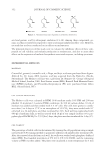
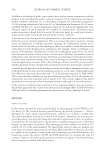
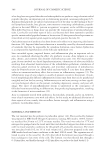
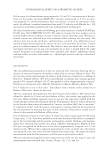
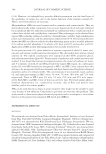
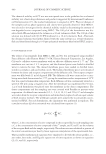
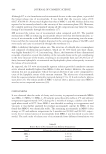
JOURNAL OF COSMETIC SCIENCE 410 of hair shine, is a real novelty and was never published before. The paper was never meant as an advertisement of the opsira device, although it may have been read in this way by representatives of competing technologies for hair shine assessment. This was also the reason why we did not provide an in-depth discussion of the opsira device in relation to other competing technologies. We want to ask all competitors’ forgiveness for not fi nding their devices mentioned or discussed in our paper. The side-by-side comparison of different hair care and styling products with regard to hair shine using the opsira device in parallel with standard panel assessment showed that the automated system provides an almost identical ranking and the same statistical sig- nifi cances as the panel assessment. The algorithms to calculate the bidirectional refl ec- tance distribution function from the point spread function (for the generation of angular-dependent refl ection data coming from the illuminated hair tress) are the core elements of our development and based on different publications by Michael E. Becker, one of our coauthors (3–5). These algorithms are responsible for the good correlation between measurements and evaluation by panelists. Overall, the automated tool com- peted favorably with panel assessments of hair shine, providing clear advantages over panelist assessment in terms of repeatability, workload, and time consumption, as well as sensitivity and specifi city to detect differences after shampoo, conditioner, and leave-in treatment. Thus, it qualifi ed as a routine screening tool. This is the major take-home message of our report, not the superiority of the opsira device over other devices, which was never claimed by us. Another topic of criticism relates to the calculation of luster in our study. The objective shine value or luster (L) was calculated by us using the equation standard specular RS×HW = RD×HW L (1) where RS is the integrated intensity of specular refl ection, RD is the integrated intensity of diffuse refl ection, HWstandard is the half width of an optimally refl ecting area (repre- senting the carrier without mounted hair tresses), and HWspecular is the half width of specular refl ection of the mounted hair tress. We erroneously referred to equation (1) as the “equation of Reich/Robbins” (6), which calculates L as (1/2) ×W S L= D (2) where S is the integrated specular refl ectance and is obtained by measuring the area of the specular peak, D is the integrated diffuse refl ectance and is obtained by connecting the scattered light intensities at 0° and 75° and measuring the area under the resulting line, and W(1/2) is the width of the specular peak at half height of the mounted hair tress.

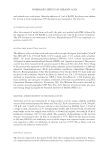
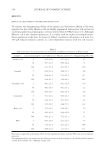
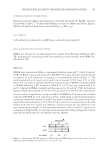
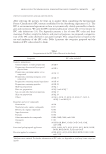
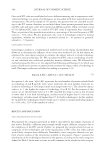
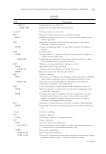
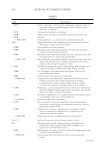
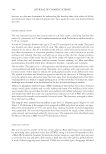
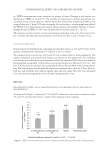
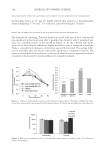
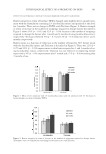
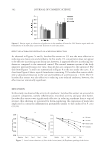
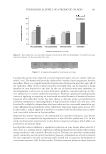
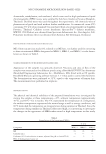
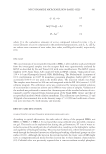
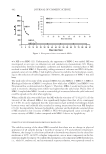
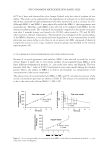
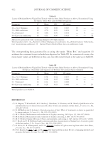
LETTER TO THE EDITOR 411 Our equation differs from the original Reich–Robbins equation in that we included—as a constant—the full width at half maximum of a standard black metal cylinder (HWstandard in equation 1) into the Reich/Robbins equation. By the inclusion of this constant, the calculated objective L has no dimension any more. Apart from this, our equation is very similar to the original Reich/Robbins equation. Thus, if we did our analysis without this constant factor, we would gain essentially the same results as with the original Reich/ Robbins equation. The concept of normalization of peak width at half height against that of a standard specular refl ector, thus avoiding dimension in the formula for luster, was not invented by us, but was for the fi rst time introduced by Keiss, Ramaprasad, and Kamath in 2004 (7), who proposed the following equation for the calculation of dimensionless luster (L): 1/2standard 1/2sample ×W ( + )×W S L= S D (3) where S is the specular peak area obtained from the scattering curve, S + D is the total area under the curve, and W1/2standard is the half width of a standard specular refl ector, and W1/2sample is the half width of the specular peak of the mounted hair tress. By the way of scientifi c correctness, we have to acknowledge that our equation to calcu- late luster (equation 1) is in fact a hybrid of the equation by Reich/Robbins and the equa- tion of Keiss/Ramaprasad/Kamath. To demonstrate the validity of our (hybrid) equation for the calculation of luster, we re- cently compared data generated with the Samba system from Bossa Nova Technologies using the Reich/Robbins equation [published by Kaplan et al. from TRI/Princeton (8)] with the corresponding data generated with the opsira “Shine Box” and our hybrid equa- tion. We assume that our comparative measurements were done with the same products (identifi ed by us via their INCI) as used by Kaplan et al. on medium brown virgin hair. Luster of medium brown virgin hair treated with shine controls as published by Kaplan et al. is depicted in Table I. The corresponding data generated by us, using the opsira “Shine Box” and our hybrid equation, are depicted in Table II. Table I Luster of Medium Brown Virgin Hair Treated with Shine Controls as Published by Kaplan et al. Treatment N Mean S.D. S.E. mean 2 in 1 25 115.3 7.1 1.4 B — — XM conditioner 25 109.3 8.2 1.6 B C — Untreated 25 108.3 8.1 1.6 — C — Leave-in conditioner 25 57.5 4.2 0.8 — — D In this table, luster is calculated using the Reich/Robbins formula as implemented in the Samba system. Treatments not connected by the same letter are signifi cantly different. Data from (5). The corresponding data generated by us, using the opsira “Shine Box” and our hybrid equation, are depicted in Table II. Overall, we obtain the same results as Kaplan et al.
Purchased for the exclusive use of nofirst nolast (unknown)
From: SCC Media Library & Resource Center (library.scconline.org)