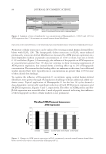
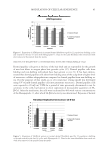
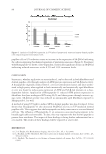
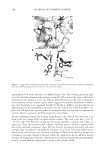
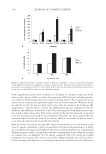
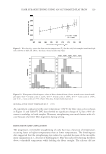
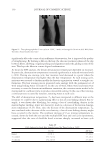
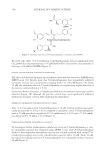
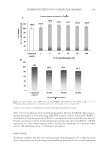
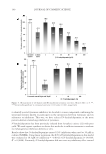
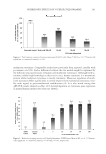
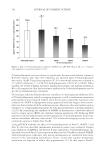
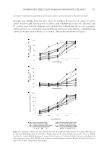
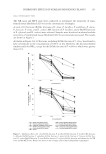
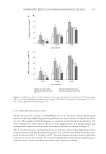
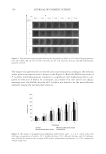
JOURNAL OF COSMETIC SCIENCE 96 Kim et al. (35) reported the extract of GE had inhibitory activity not only against mush- room tyrosinase but also against melanin synthesis in B16 melanoma cells in vitro. Liu et al. reported that 4-HBA, one of the phenolic compounds of GE extract, has an antime- lanogenic effect. This inhibitory effect of 4-HBA is due to the direct inhibition of mela- nosomal tyrosinase activity rather than a decrease in tyrosinase gene expression (36). In our study, GE extract showed about 30% inhibition of mushroom tyrosinase at the con- centration of 100 μg/ml (p 0.05). To examine the tyrosinase inhibitory mechanism of GE extract, we investigated the enzyme involved in melanogenesis and its gene expres- sion. Our results showed that GE extract can reduce the expression of both mRNA and protein of enzymes associated with melanin biosynthesis. The mRNA and protein expres- sion of tyrosinase in the cultured HM3KO melanoma cells was signifi cantly reduced (p 0.05). In addition, examination of melanogenic proteins showed that GE inhibited the expression of key proteins associated with melanin biosynthesis, such as tyrosinase, TRP- 1, and TRP-2 in cultured HM3KO melanoma cells. These results suggest that the in- hibitory effect of GE on melanogenesis is not only by inhibiting tyrosinase catalytic activity but also by inhibiting expression of melanogenic proteins at the transcriptional and translational levels. Further studies are required to elucidate the regulation of tran- scription factor involved in melanogenesis, to check the in vivo effects of GE, and to iden- tify the active component(s) of GE which will be helpful for understanding the mechanism of antimelanogenesis. Moreover, cell study has its limitations so far and we suggest that these results should be replicated in normal melanocytes or human study. ACKNOWLEDGMENT This study was funded by the program of the Kyung Hee University for the young med- ical researchers in 2007 (KHU-20071466). REFERENCES (1) A. Dorner and J. Paweleck, Dopachrome conversion: A possible control point in melanin biosynthesis, J. Invest. Dermatol., 75, 192–195 (1980). (2) J. M. Pawelek and A. M. Körner, The biosynthesis of mammalian melanin, Am. Sci., 70, 136–145 (1982). (3) V. M. Virador, J. Muller, X. Wu, Z. A. Abdel-Malek, Z. X. Yu, V. J. Ferrans, N. Kobayashi, K. Wakamatsu, S. Ito, J. A. Hammer, and V. J. Hearing, Infl uence of alpha-melanocyte-stimulating hormone and ultraviolet radiation on the transfer of melanosomes to keratinocytes, J. Invest. Dermatol., 117, 1505–1511 (2001). (4) T. Kobayashi, K. Urabe, A. Winder, C. Jiménez-Cervantes, G. Imokawa, T. Brewington, F. Solano, J. C. García-Borrón, and V. J. Hearing, Tyrosinase related protein 1 (TRP1) functions as a DHICA oxidase in melanin biosynthesis, EMBO J., 13, 5818–5825 (1994). (5) H. Ando, Y. Funasaka, M. Oka, A. Ohashi, M. Furumura, J. Matsunaga, N. Matsunaga, V. J. Hearing, and M. Ichihashi, Possible involvement of proteolytic degradation of tyrosinase in the regulatory effect of fatty acids on melanogenesis, J. Lipid Res., 40, 1312–1316 (1999). (6) V. J. Hearing and K. Tsukamoto, Enzymatic control of pigmentation in mammals, FASEB J., 5, 2902– 2909 (1991). (7) G. Battaini, E. Monzani, L. Casella, L. Santagostini, and R. Pagliarin, Inhibition of the catecholase activity of biomimetic dinuclear copper complexes by kojic acid, J. Biol. Inorg. Chem., 5, 262–268 (2000). (8) K. Maeda and M. Fukuda, Arbutin: Mechanism of its depigmenting action in human melanocyte cul- ture, J. Pharm. Exp. Ther., 276, 765–769 (1996).

INHIBITORY EFFECT OF GASTRODIA ELATA EXTRACT ON MELANOGENESIS 97 (9) C. H. Lee, P. Seib, Y. T. Liang, R. C. Hoseney, and C. W. Deyoe, Chemical synthesis of several phos- phoric esters of L-ascorbic acid, Carbohydr. Res., 67, 127–138 (1978). (10) J. Hosoi, E. Abe, T. Suda, and T. Turoki, Regulation of melanin synthesis of B16 mouse melanoma cells by 1α, 25-dihydroxyvitamin D3 and retinoic acid, Cancer Res., 45, 1474–1478 (1985). (11) A. Palumbo, M. d‘Ischia, G. Misuraca, and G. Prota, Mechanism of inhibition of melanogenesis by hydroquinone, Biochim. Biophys. Acta, 1073, 85–90 (1991). (12) J. K. No, D. Y. Soung, Y. J. Kim, K. H. Shim, Y. S. Jun, S. H. Rhee, T. Yokozawa, and H. Y. Chung, Inhibition of tyrosinase by green tea components, Life Sci., 65, 241–246 (1999). (13) K. Jones, J. Hughes, M. Hong, Q. Jia, and S. Orndorff, Modulation of melanogenesis by aloesin: A competitive inhibitor of tyrosinase, Pigment Cell Res., 15, 335–340 (2002). (14) P. Bernard and Y. J. Berthon, Resveratrol: An original mechanism on tyrosinase inhibition, Int. J. Cos- met. Sci., 22, 219–226 (2000). (15) Y. M. Kim, J. Y. Lee, H. Lee, K. R. Min, and Y. Kim, Oxyresveratrol and hydroxystilbene com- pounds. Inhibitory effect on tyrosinase and mechanism of action, J. Biol. Chem., 277, 16340–16344 (2002). (16) Y. J. Kim, J. K. No, J. H. Lee, and H. Y. Chung, 4,4′-Dihydroxybiphenyl as a new potent tyrosinase inhibitor, Biol. Pharm. Bull., 28, 323–327 (2005). (17) Y. Zhao, Q. Cao, Y. Xiang, and Z. Hu, Identifi cation and determination of active components in Gas- trodia elata Bl. by capillary electrophoresis, J. Chromatogr. A, 22, 34–40 (1999). (18) Y. S. Paik, J. K. Song, C. H. Yoon, K. S. Chung, and H. S. Yum-Choi, Anti-platelet and anti- thrombotic effects of Gastrodia elata, Korean J. Pharmacogn., 26, 385–389 (1995). (19) S. M. An, C. H. Park, J. C. Heo, P. Ja-Young, W. Sang-Uk, S. Ji-Hye, L. Mi-Soon, C. Kang-Jin, C. Hyun-Suk, S. M. Heung, and L. Sang-Han, GE Blume protects against stress-induced gastric mucosal lesions in mice, Int. J. Mol. Med., 20, 209–215 (2007). (20) N. Li, K. J. Wang, J. J. Chen, and J. Zhou, Phenolic compounds from the rhizomes of Gastrodia elata, J. Asian Nat. Prod. Res., 9, 373–377 (2007). (21) A. Ohashi, Y. Funasaka, M. Ueda, and M. Ichihashi, c-Kit receptor expression in cutaneous malignant melanoma and benign melanocytic nevi, Melanoma Res., 6, 25–30 (1996). (22) C. Jiménez-Cervantes, M. Martínez-Esparza, C. Pérez, N. Daum, F. Solano, and J. C. García-Borrón, Inhibition of melanogenesis in response to oxidative stress: Transient downregulation of melanocyte differentiation markers and possible involvement of microphthalmia transcription factor, J. Cell Sci., 114, 2335–2344 (2001). (23) T. Yokozawa and Y. J. Kim, Piceatannol inhibits melanogenesis by its antioxidative actions, Biol. Pharm. Bull., 30, 2007–2011 (2007). (24) S. Briganti, E. Camera, and M. Picardo, Chemical and instrumental approaches to treat hyperpigmenta- tion, Pigment Cell Res., 16, 101–110 (2003). (25) A. B. Lerner, T. B. Fitzpatrick, E. Calkins, and W. H. Summerson, Mammalian tyrosinase: Preparation and properties, J. Biol. Chem., 178, 185–195 (1949). (26) T. Kushimoto, V. Basrur, J. Valencia, J. Matsunaga, W. D. Vieira, V. J. Ferrans, J. Muller, E. Appella, and V. J. Hearing, A model for melanosome biogenesis based on the purifi cation and analysis of early melanosomes, Proc. Natl. Acad. Sci. USA, 98, 10698–10703 (2001). (27) J. Vachtenheim, H. Novotna, and G. Ghanem, Transcriptional repression of the microphthalmia gene in melanoma cells correlates with the unresponsiveness of target genes to ectopic microphthalmia- associated transcription factor, J. Invest. Dermatol., 117, 1505–1511 (2001). (28) T. Kushimoto, J. C. Valencia, G. E. Costin, K. Toyofuku, H. Watabe, K. Yasumoto, F. Rouzaud, W. D. Vieira, and V. J. Hearing, The Seiji memorial lecture: The melanosome: An ideal model to study cel- lular differentiation, Pigment Cell Res., 16, 237–244 (2003). (29) G. Negroiu, R. A. Dwek, and S. M. Petrescu, Folding and maturation of tyrosinase-related protein-1 are regulated by the post-translational formation of disulfi de bonds and by N-glycan processing, J. Biol. Chem., 278, 27035–27042 (2000). (30) Y. J. Kim and H. Uyama, Tyrosinase inhibitors from natural and synthetic sources: Structure, inhibition mechanism and perspective for the future, Cell Mol. Life Sci., 62, 1707–1723 (2005). (31) K. T. Lee, B. J. Kim, and J. H. Kim, Biological screening of 100 plant extracts for cosmetic use (1): Inhibitory activities of tyrosinase and DOPA auto-oxidation, Int. J. Cosmet. Sci., 19, 291–298 (1997). (32) H. J. Kim, I. K. Hwang, and M. H. Won, Vanillin, 4-Hydroxybenzyl aldehyde and 4-hydroxybenzyl alcohol prevent hippocampal CA1 cell death following global ischemia, Brain Res., 1181, 130–141 (2007).
Purchased for the exclusive use of nofirst nolast (unknown)
From: SCC Media Library & Resource Center (library.scconline.org)