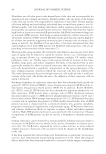
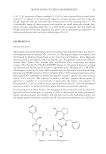
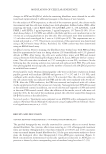
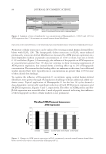
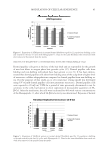
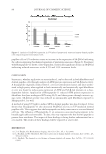
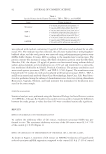
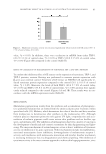
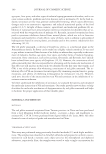
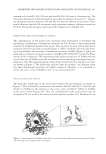
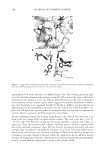
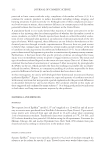
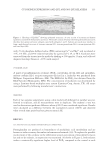
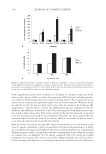
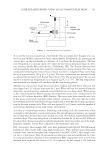
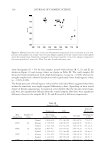
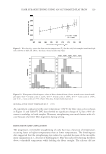
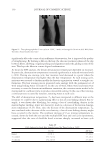
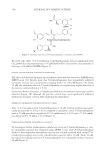
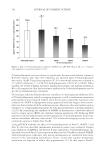
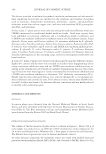
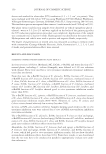
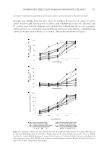
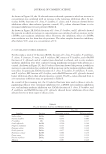
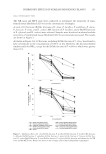
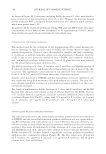
JOURNAL OF COSMETIC SCIENCE 108 superimposed VA with substrates in PyMOL (Figure 5B). The overlap prediction indi- cates that the three-dimensional position occupied by VA is almost the same as that of the substrates at the tyrosinase active core domain. Thus, VA obstructs the correct orientation of the substrates at the catalytic center, which suggests one possible mechanism of inhibi- tion (23). Sendovski et al. suggested that His57 (His60 in TyrBm) is responsible for the deprotonation of the monophenol substrate (23). The interaction of VA with His57 im- plies that VA may have a greater effect on monophenolase activity than on diphenolase activity, which is consistent with the results described above. For the modeling of molecular docking using Rosetta, the value of the total score is re- lated to the free energy of the receptor–ligand complex. The total scores were −936.57, −934.99, and −936.46 for the modeling of docking with VA, L -tyrosine, and L -dopa, re- spectively. Thus, the tyrosinase–VA complex exhibited greater stability compared with that of the substrate complexes. Thus, VA may bind to tyrosinase more easily and more strongly than monophenol and diphenol substrates. As a result, VA could inhibit tyrosi- nase activity in the presence of substrates, as shown in Table IV. In addition, because the tyrosinase–L-tyrosine complex is the least stable, the competition by the inhibitor may be stronger for monophenol substrate, which may be another reason that the monophenolase activity is lower than the diphenolase activity in the presence of VA. Figure 5. Suggested docking model for VA and tyrosinase. (A) Interaction of VA and tyrosinase in the dock- ing model. (B) Superimposition of VA with L -tyrosine and L -dopa.

INHIBITORY MECHANISM OF RED GLOBE AMARANTH ON TYROSINASE 109 CONCLUSION As a Chinese herbal medicine, red globe amaranth strongly inhibits tyrosinase activity. In addition, we identifi ed for the fi rst time that VA is a constituent of amaranth with strong tyrosinase inhibition activity. As a potential tyrosinase inhibitor, VA could in- hibit both the monophenolase and diphenolase activities of tyrosinase better than the commercial tyrosinase inhibitor arbutin. We found that VA did not change the overall conformation of the enzyme structure and did not chelate the dicopper when it inter- acted with tyrosinase. The most probable mechanism of inhibition is that VA interacts with tyrosinase more stably than the substrates. When VA interacts with tyrosinase, the path for the substrates to the enzyme catalytic center is obstructed. Therefore, the orientation of the substrates to the dicopper center is interrupted because of the hinder- ing effect, which inhibits the monophenolase and diphenolase activities of tyrosinase. However, the interaction model and molecular mechanism were predicted according to the docking algorithm, which is limited to simulating the interaction of a protein and a ligand. Protein crystallography studies may provide further insight into the molecu- lar mechanism of inhibition. ACNOWLEDGMENTS We acknowledge the fi nanci al support from the National Natural Science Fund of China (Grant Nos 31130042 and 31171630), the Fundamental Research Funds for the Central Universities, SCUT (Grant No. 2012ZG0007), and the Program for New Century Excel- lent Talents in University (Grant No. NCET-10-0362). Dr. Wei Luo is warmly thanked for excellent technical assistance. REFERENCES (1) Y.J. Kim and H. Uyama, Tyrosinase inhibitors from natural and synthetic sources: Structure, inhibition mechanism and perspective for the future, Cell. Mol. Life Sci., 62, 1707–1723 (2005). (2) S. Parvez, M. Kang, H.S. Chung, C. Cho, M.C. Hong, M.K. Shin, and H. Bae, Survey and mechanism of skin depigmenting and lightening agents, Phytother. Res., 20, 921–934 (2006). (3) G.M. Casanola-Martin, Y. Marrero-Ponce, M.T. Khan, A. Ather, K.M. Khan, F. Torrens, and R. Rotondo, Dragon method for fi nding novel tyrosinase inhibitors: Biosilico identifi cation and experimental in vitro assays, Eur. J. Med. Chem., 42, 1370–1381 (2007). (4) Y. Ryu, I. Westwood, N. Kang, H. Kim, J. Kim, Y. Moon, and K. Park, Kurarinol, tyrosinase inhibitor isolated from the root of Sophora fl avescens, Phytomedicine, 15, 612–618 (2008). (5) T.S. Chang, H.Y. Ding, S.S.K. Tai, and C.Y. Wu, Mushroom tyrosinase inhibitory effects of isofl avones isolated from soygerm koji fermented with Aspergillus oryzae BCRC 32288, Food Chem., 105, 1430– 1438 (2007). (6) L. Qiu, Q.X. Chen, Q. Wang, H. Huang, and K.K. Song, Irreversibly inhibitory kinetics of 3, 5-dihydroxyphenyl decanoate on mushroom (Agaricus bisporus) tyrosinase. Bioorg. Med. Chem., 13, 6206– 6211 (2005). (7) L. Qiu, Q.H. Chen, J.X. Zhuang, X. Zhong, J.J. Zhou, Y.J. Guo, and Q.X. Chen, Inhibitory effects of [alpha]-cyano-4-hydroxycinnamic acid on the activity of mushroom tyrosinase, Food Chem., 112, 609– 613 (2009). (8) K.H. Park, Y.D. Park, J.R. Lee, H.S. Hahn, S.J. Lee, C.D. Bae, J.M. Yang, D.E. Kim, and M.J. Hahn, Inhibition kinetics of mushroom tyrosinase by copper-chelating ammonium tetrathiomolybdate, Bio- chim. Biophys. Acta. Gen. Subj., 1726, 115–120 (2005). (9) P. Han, C.Q. Chen, C.L. Zhang, K.K. Song, H.T. Zhou, and Q.X. Chen, Inhibitory effects of 4-chlorosalicylic acid on mushroom tyrosinase and its antimicrobial activities, Food Chem., 107, 797–803 (2008).
Purchased for the exclusive use of nofirst nolast (unknown)
From: SCC Media Library & Resource Center (library.scconline.org)