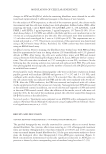
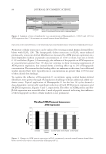
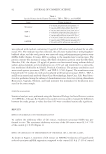
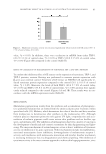
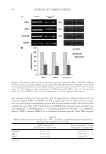
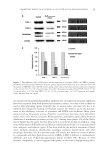
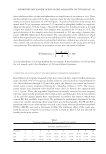
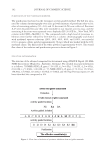
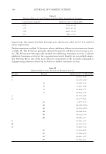
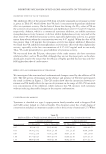
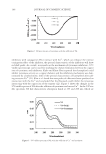
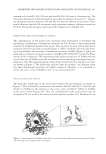
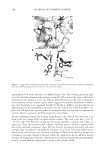
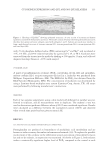
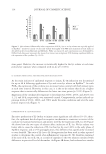
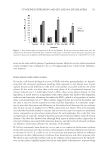
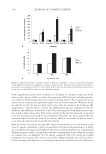
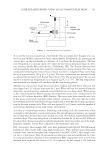
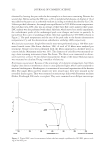
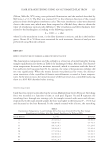
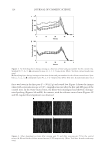
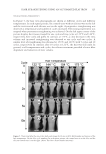
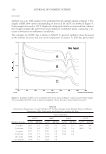
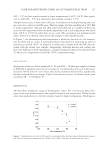
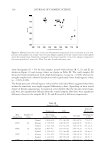
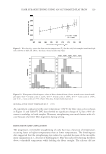
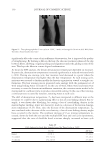
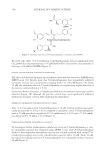
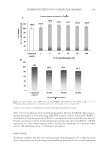
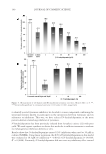
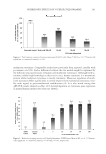
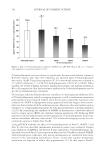
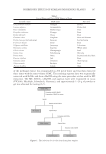
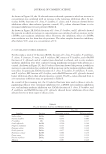
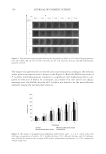
JOURNAL OF COSMETIC SCIENCE 130 signifi cantly affect the course of microfi lament denaturation, but it improved the quality of straightening. By forming a fi lm on the hair, the silicone treatment enhanced the slip between fi bers, allowing a regular packing and alignment under the gliding action of the iron. This kept the fi bers in a more aligned conformation. As shown by DSC analysis, the keratin denaturation temperature depended on moisture. In particular, denaturation temperature increased signifi cantly at reduced moisture levels (10%). During one ironing cycle, hair moisture level decreased to a point where the denaturation temperature was higher than the hair temperature. At each ironing cycle, moisture was restored to further modify the keratin organization toward a straight con- formation. The hair ironing process presented some analogy with the permanent set of wool using boiling water or steam (4). In the case of wool, where water and strain were necessary to cause the keratin microfi lament transition, the extension strain needed to be maintained for a suffi cient time to produce irreversible setting. In the case of hair ironing, a similar process occurred by iteration, restoring water at each cycle. The shift of denaturation temperature, Td, has been interpreted in different ways in the literature. It could be due to a plasticizing effect or loss of cross-linking density. For ex- ample, it was shown that bleaching, by causing a loss of cross-linking density in the matrix (higher swelling, lower wet elasticity), leads to a decrease of the keratin denatur- ation temperature (5,13). Here, since the decrease of the denaturation temperature, Td, was correlated with a decrease of the wet elasticity, a loss of cross-linking density might have occurred in the matrix. The nonlinear decrease of Td as ironing temperature in- creased, shown by both the iron and the multiple DSC heat and cool cycle experiments, suggested that the rate of disulfide bond scissions sharply increased as heat cycle Figure 11. Tress photograph after 3 iron cycles at 154°C, 1 wash, and storage for 30 min at 90% RH. {Note: Test data. Actual results may vary.} Table IV DSC Analysis for Curly Hair Samples Ironed for Three Cycles at 154°C Td (oC) ΔH (J/g) Initial 172 ± 1 5.7 ± 0.6 3× control 171.7 ± 0.2 3.3 ± 0.2 3× silicone 172.2 ± 0.5 3.7 ± 0.4

HAIR STRAIGHTENING USING AN AUTOMATED FLAT IRON 131 temperature exceeded 150°C. Disulfi de bond scissions facilitated the keratin denaturation, as suggested by Istrade (14). Therefore, the straightening occurred more rapidly at 175°C than at lower temperatures. Interestingly, at low temperature, provided the fi bers were held straight multiple times, change in the microfi lament organization (decrease of bire- fringence) and the fi ber reshaping occurred despite the low number of disulfi de scissions (small Td shift). An amino acid analysis would be useful to determine whether the scis- sion of disulfi de bonds was indeed different between the samples produced at low and high temperatures. Progressive thermal straightening may be a promising method to achieve permanent smoothing of curly hair without chemical treatment. Ironing at the onset temperature (~154°C), before substantial disulfi de bond scission occurred, seemed to be a good com- promise between process speed, straightening performance, and hair integrity (i.e., re- duced loss of cross-linking). In that transition region, the silicone increased the process effi ciency, allowing the hair to be straightened at lower temperature. REFERENCES (1) C. R. Robbins, Chemical and Physical behavior of Human Hair, 4th Ed. (Springer-Verlag, New York, 2002). (2) S. Ogawa, K. Fujii, K. Kaeyama, K. Arai, and K. Joko, A curing method for permanent straightening using thioglycolic and dithioglycolic acids, J. Cosmet. Sci., 51, 379–399 (2000). (3) W. Von Bergen, Wool Handbook, 3rd Ed. (John Wiley & Sons, New York, 1963). (4) M. Feughelman, A. R. Haly, and J. W. Snaith, Permanent set and keratin structure, Text. Res. J. 32, 913–917 (1962). (5) F. J. Wortmann, C. Springob, and G. Sendelbach, Investigations of cosmetically treated human hair by differential scanning calorimetry in water, J. Cosmet. Sci., 53, 219–228 (2002). (6) F. J. Wortmann, G. Sendelbach, and C. Popescu, Fundamental DSC investigations of α-keratinous materials as basis for the interpretation of specifi c effects of chemical, cosmetic treatments on human hair, J. Cosmet. Sci., 58, 311–317 (2007). (7) J. Cao, Melting study of α-form crystallites in human hair keratin by DSC, Thermochim. Acta, 335, 5–9 (1999). (8) J. Cao and F. Leroy, Depression of the melting temperature by moisture for a-form crystallites in human hair keratin, Biopolymers, 77, 38–43 (2005). (9) R. G. Jones, W Ando, and J. Chojnowski, Silicone-Containing Polymers (Kluwer Academic Publishers, Dordrecht, The Netherlands, 2000). (10) A. Dussaud and L. Fieschi-Corso, Infl uence of functionalized silicones on hair fi ber-fi ber interactions and on the relationship with the macroscopic behavior of hair assembly, J. Cosmet. Sci., 60, 261–271 (2009). (11) L. B. Rockland, Saturated salt solutions for static control of relative humidity between 5 and 40 C, Anal. Chem., 32, 10, 1375–1976 (1960). (12) W. C McCrone, L. B. McCrone, and J. G. Delly, Polarized Light Microscopy (McCrone Research Institute, Chicago, 1987), pp. 147–149. (13) J. M. Marsh, C. J. Clarke, K. Meinert, and R. M. Dahlgreen, Investigations of cosmetic treatments on high-pressure differential scanning calorimetry, J. Cosmet. Sci., 58, 319–327 (2007). (14) D. Istrate, “Heat induced denaturation of fi brous hard α-keratin and their reaction with various chemi- cal reagents,” PhD thesis, Aachens University, DWI (Germany), 2011.
Purchased for the exclusive use of nofirst nolast (unknown)
From: SCC Media Library & Resource Center (library.scconline.org)