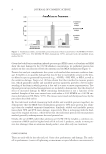
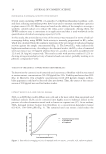
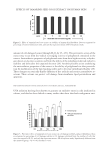
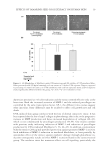
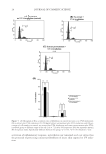
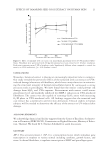
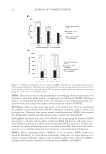
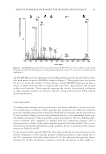
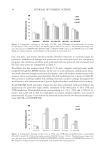
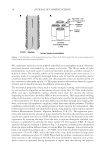
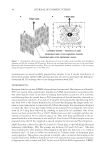
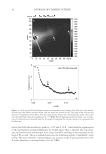
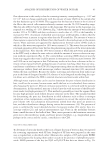
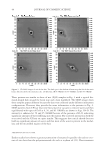
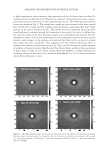
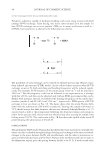
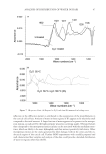
JOURNAL OF COSMETIC SCIENCE 46 HÙD EXCHANGE EFFECT OF D2O DIFFUSION INTO HAIR Polymeric substrates capable of hydrogen bonding with water when treated with D2O undergo HÙD exchange. Upon drying, this leaves some residual D in the sample. In hair, HÙD exchange can occur at pendant –NH2 (as in amino acid lysine as well as – CONH– functionalities), as shown by the following two schemes. The possibility of such exchange can be studied by infrared spectroscopy [Fourier trans- form infrared spectroscopy (FTIR) mode]. As the reduced mass increases when HÙD exchange occurs at N, both stretching and bending frequencies will be reduced signifi - cantly. For example, N–H frequency of the amine group (3219 cm−1) will be reduced to 2420 cm−1. But this frequency could not be followed in our experiments as it overlaps with that of CO2, and thus can be observed only with an FTIR spectrometer that can be fl ushed with nitrogen. Instead, we followed the bending frequencies of the amide func- tionality (amides I and II) (1632 and 1516 cm−1, respectively). FTIR spectra of HÙD exchange in hair are shown in Fig. 7A. The fi gure shows that the amide II peak shifts down with the substitution of H with D as expected. Treating this sample with water at 55°C should reverse this shift however, this was not observed although Murthy et al. (7) reported such a shift at this temperature following the deuterated amine end groups in nylon. In the present work, this reversal was observed only after treating the sample with boiling water (100°C). This can be seen in Fig. 7B that shows the upshift of the amide II peak following the substitution of D with H. CONCLUSIONS This preliminary SANS study of human hair has shown that water is present in essentially two forms: one that is adsorbed through hydrogen bonding and exchanged with amine and amide nitrogen in the spaces between the IFs and protofi laments, and the other in mesoporous re- gions as multimolecular layers and free D2O. Analysis of the interference peak due to water in the fi lamentary regions gives the spacing between the IFs to be 95 Å. A weak second-order

ANALYSIS OF DISTRIBUTION OF WATER IN HAIR 47 refl ection in the diffraction pattern is attributed to the organization of the protofi laments in the cortical cells of hair. Amount of water in these regions of IFs appears to be relatively small compared to the total amount. A larger fraction of water appears to be present in the mesopo- rous regions, as indicated by the high-intensity near-zero scattering angles. Obvious features that correspond to the mesoporous entities in hair can be associated with the medullary struc- tures, which are likely to be more hydrophilic and thus interact positively with water. Other mesoporous entities are the cracks generated by fi ber damage, both in the cortex and the en- docuticle region of the cuticle cell. Further SANS experiments with carefully prepared and well-characterized hair samples and analysis of the data could provide a detailed distribution of water in regions other than the IFs. Figure 7. IR spectra of hair. (A) Exposed to D2O, and then (B) immersed in boiling water.
Purchased for the exclusive use of nofirst nolast (unknown)
From: SCC Media Library & Resource Center (library.scconline.org)