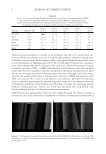
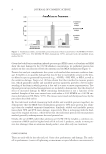
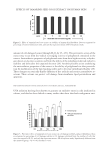
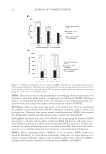
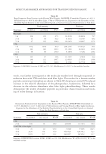
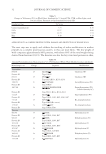
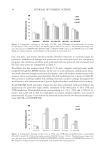
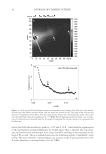
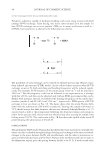
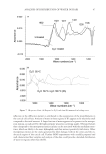
JOURNAL OF COSMETIC SCIENCE 8 Figure 4. Traditional, soluble, and insoluble protein fractions of hair treated with a 0.82 M MEA/3% H2O2 formulation (30°C) or a 0.82 M NH3/3% H2O2 formulation (30°C), measured with the modifi ed Lowry method kit (8). Given that both Fourier transform infrared spectroscopy (FTIR) cysteic acid analysis and SEM show the most damage for the 0.82 M alkalizer concentration, we performed protein loss analysis on this concentration of both the ammonia and the MEA formulations (Figure 4). Protein loss analysis complements the cysteic acid method that measures oxidative dam- age. It enables us to quantify damage that may be due to nucleophilic attack on the kera- tin fi bers by species generated by peroxide (e.g., –OOH), −OH, NH3, or MEA, as well as the oxidative damage. Naqvi et al. (9) have shown that their method to measure protein loss, which quantifi es soluble and insoluble protein separately, provides a better under- standing of the form in which protein is lost and is a more accurate representation. Tra- ditional protein loss method measurements are included to demonstrate that the observed effect of increased damage by MEA-containing formulations is not a function of the method. Samples of hair were treated once with either a 0.82 M MEA or a 0.82 M am- monia formulation (6% H2O2 30°C). The tresses were rinsed and shampooed once by the procedure described earlier. By the traditional method (measuring both soluble and insoluble proteins together), we demonstrate that the MEA-based formulation generates 40% more protein loss (dam- age) than the standard ammonia formulation. Similarly, soluble and insoluble protein losses show 58% and 85% more damage, respectively. This is in keeping with the fi nd- ings of the original reference, which shows that the traditional protein loss measurement method generally underrepresents the total protein loss. Clearly, the use of MEA rather than ammonia at 0.82 M (5% by weight), a common con- centration of MEA used for higher levels of lift in Level 3 products, results in more pro- tein loss (damage) than an ammonia-based product, even after only one treatment. CONCLUSIONS There are trade-offs for less odor in Level 3 hair color: performance and damage. The trade- off in performance (extent of lightening at maximum accepted alkalizer concentration) is

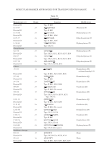
COMPARISON OF MONOETHANOLAMINE AND AMMONIA HAIR COLORANTS 9 well known. However, more concerning is that if MEA is substituted for ammonia, using cysteic acid level as a measure of damage can be somewhat misleading. However, SEM showing cuticle removal and protein loss, clearly show damage increases for unbuffered equimolar solutions of MEA chassis versus ammonia chassis. Further investigation of other in-use variables and chassis is warranted, as is determination of the specifi c protein fragments that are lost from the hair. For the time being, though, if the ammonia odor of Level 3 products is a concern, a better approach may be to minimize its volatility rather than replacing it with a potentially more damaging alkalizer. ACKNOWLEDGMENTS The authors thank Mr. Firoj Vohra for his helpful discussions of MEA-based product performance and history, Sheila Childers for her assistance with SEM, Mr. Mike Davis and Ms. Abby Newland for their assistance with measurement of protein damage, and Dr. John Gardlik for his helpful discussions of the manuscript. REFERENCES (1) W. A. Poucher, Revised by G. M. Howard, Hair Colorants, in Perfumes, Cosmetics and Soaps, 8th Ed., Vol. 3. Modern Cosmetics (Chapman and Hall, London, 1974), pp. 164–195. (2) B. P. Murphy, Hair Colorants, in Poucher’s Perfumes, Cosmetics and Soaps, 10th Ed., H. Butler. Ed. (Kluwer Academic Publishers, London, 2000), pp. 307–324. (3) J.-A. Seo, I.-H. Bae, W.-H. Jang, J.-H. Kim, S.-Y. Bak, S.-H. Han, Y.-H. Park, and K.-M. Lim, Hydro- gen peroxide and monoethanolamine are the key causative ingredients for hair dye-induced dermatitis and hair loss, J Dermatol Sci., 66 (1), 12–19 (2012). (4) J. M. Marsh and C. J. Clarke, Hair coloring compositions, U.S. Patent 7,204,861 B2 (2007). (5) H. D. Boswell, J. M. Marsh, J. S. Park, and M. A. Olshavsky, Oxidative treatment of hair with reduced hair damage, U.S. Patent 7,179,302 B2 (2007). (6) M. S. Bil and W. H. Brunner, Dyeing process and composition, G.B. Patent 1,136,659 (1966). (7) B. P. Murphy, K. C. Brown, T. M. Schultz, and A. A. Mayer, Dye compositions containing 5,6-dihy- droxyindoles and a foam generator, U.S. Patent 5492541 (1996). (8) Modifi ed Lowry Protein Assay kit supplied by Thermo Scientifi c, Pierce Protein Biology Products, Rockford, IL. http://www.piercenet.com/browse.cfm?fl dID=02020103, November 2011 (9) K. R. Naqvi, J. M. Marsh, S. Godfrey, M. G. Davis, M. J. Flagler, J. Hao, and V. Chechik, The role of chelants in controlling Cu(II)-induced radical chemistry in oxidative hair coloring products, Int J Cosmet Sci., 35, 41–49 (2013).
Purchased for the exclusive use of nofirst nolast (unknown)
From: SCC Media Library & Resource Center (library.scconline.org)