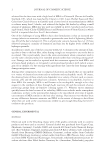
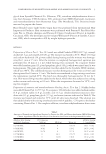
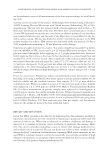
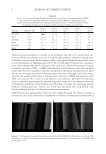
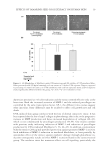
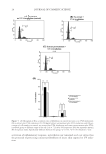
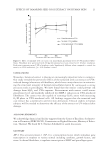
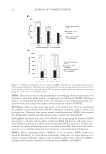
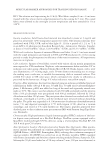
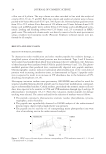
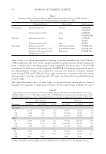
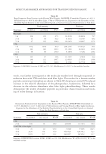
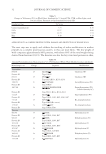
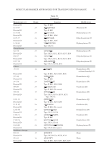
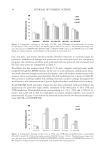
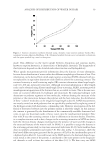
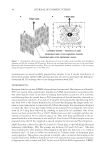
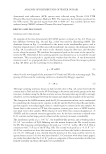
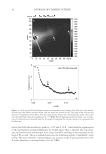
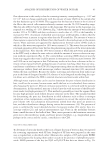
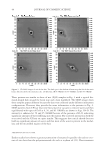
JOURNAL OF COSMETIC SCIENCE 6 There are several variables to consider as we determine the effect of a switch from am- monia to MEA as an alkalizer for Level 3 oxidation dye products, important among these is alkalizer concentration. To determine its effect, we prepared formulations without dyes at several molarities of alkalizing agent (0.27 M, 0.54 M, and 0.82 M on-tress concentra- tions, after mixing with H2O2 developer). For each level, batches were prepared using equimolar amounts of NH3 or MEA (unbuffered), and treatments were done on light brown hair. Protonic equilibria were not considered at this point because they are rapid and we are investigating extent of damage rather than rate of damage, and in the chassis we used, the ambient pH values of the equimolar solutions of MEA and ammonia with H2O2 are close (ca. ±0.1 units) at each alkalizer concentration. We used fi ve bleaching cycles to simulate approximately 6 months of product usage, and we combined this with 36 shampoo/conditioner cycles between each bleaching to mimic the grooming routine between coloring processes. Cysteic acid levels were measured after each bleach cycle (before washing) and after 36 shampoo/conditioner treatments. Table II shows that although the values are close within the given sets, there is a trend of increase in cysteic acid content that is dependent on alkalizer concentration and the number Figure 1. SEM photomicrographs obtained on a Hitachi S-3000N SEM with Oxford detector after the fi fth bleaching cycle of light brown hair treated with formulations containing 0.27 M ammonia (A) and MEA (B) for 30 min at 30°C. Table II Cysteic Acid Content of Light Brown Hair [Determined by Fourier Transform Infrared (FTIR) Spectroscopy] for Increasing Alkalizer Concentrations and Repetitive Lightening Cycles for Monoethanolamine (MEA) and Ammonia Formulations After 1–5 Bleach Treatments with 18 Shampoo/Conditioner Treatments (as Described Earlier) Between Each Cycle Alkalizer Alkalizer (M) Cysteic Acid–1 Cysteic Acid–2 Cysteic Acid–3 Cysteic Acid–4 Cysteic Acid–5 NH4OH 0.27 47 ± 3 57 ± 4 68 ± 3 78 ± 5 79 ± 4 MEA 0.27 45 ± 6 61 ± 6 73 ± 5 83 ± 5 88 ± 4 NH4OH 0.54 45 ± 6 64 ± 2 85 ± 2 90 ± 5 92 ± 3 MEA 0.54 52 ± 7 68 ± 5 86 ± 5 93 ± 6 99 ± 5 NH4OH 0.82 52 ± 6 75 ± 7 83 ± 6 96 ± 5 104 ± 7 MEA 0.82 55 ± 6 73 ± 4 88 ± 3 101 ± 4 107 ± 3

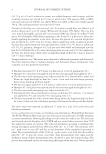
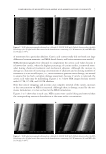
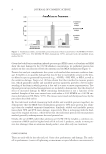
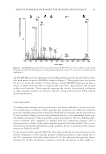
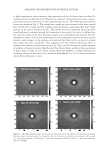
COMPARISON OF MONOETHANOLAMINE AND AMMONIA HAIR COLORANTS 7 of treatments for a particular alkalizer. Cysteic acid content really did not break out large differences between ammonia- and MEA-based chassis, and better measures were needed. SEM photomicrographs were obtained to complement the cysteic acid values because it is known that cuticle, where the highest percentage of cystine resides, is removed some- what during chemical treatments and mechanical abrasion. Although the increase in damage as a function of increasing concentrations of alkalizers and increasing numbers of treatments is as we would expect, i.e., more treatments generate more damage, we wanted to ensure that we had a complete damage assessment, because if cuticle is removed, the cysteic acid value may be misleading. Figures 1 to 3 show SEM images for hair treated with 0.27 M, 0.54 M, and 0.82 M alkalizer. Note that cuticle stripping, and in some cases complete removal of the cuticle, increases as the concentration on MEA is increased. Although there is damage caused by the am- monia formulation, it is less so than for the MEA formulation. Figures 1 to 3 show that in each case, MEA causes more cuticle lifting and removal than the corresponding ammonia formulation at the same molar concentration. Figure 2. SEM photomicrographs obtained on a Hitachi S-3000N SEM with Oxford detector after the fi fth bleaching cycle of light brown hair treated with formulations containing 0.54 M ammonia (A) and MEA (B) for 30 min at 30°C. Figure 3. SEM photomicrographs obtained on a Hitachi S-3000N SEM with Oxford detector after the fi fth bleaching cycle of light brown hair treated with formulations containing 0.82 M ammonia (A) and MEA (B) for 30 min at 40°C.
Purchased for the exclusive use of nofirst nolast (unknown)
From: SCC Media Library & Resource Center (library.scconline.org)