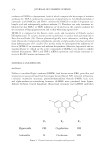
JOURNAL OF COSMETIC SCIENCE 386 manner. When B16F10 murine melanoma cells were cultured with JKTM-12, it sup- pressed melanin production, cellular tyrosinase activity, and tyrosinase protein level. We identifi ed two compounds (hyperoside and astragalin) and tested the activity in the B16F10 cells stimulated by α-MSH. Hyperoside, quercetin-3-O-β-D-galactoside pyra- nose, is a fl avonoid compound identifi ed from various plants such as Hypericum perforatum (14), Launaea procumbens (15), Zanthoxylum bungeanum (16), and Rhododendron ponticum (17). There are evidences that hyperoside has remarkable anti-infl ammatory properties (18,19) as well as anti-oxidative effects (17,20–22). Astragalin is extracted from many herbs such as Morrus alba (23), Allium ampeloprasum var. porrum (24), Fuzhuan brick tea (25), and Cassia alata (26). Astragalin has antioxidant activity (23,24) and anti-infl ammatory ef- fects (27). Hyperoside and astragalin were also isolated from the leaves of N. nucifera by high-speed counter-current chromatography (28). Ohkoshi et al. (29) reported that a 50% EtOH extract from the leaves of N. nucifera stimulated lipolysis in the white adipose tissue of mice, and they identifi ed various fl avonoids including rutin, (+)-catechin, hype- roside, isoquercitrin, quercetin, and astragalin. Nakamura et al. reported that a MeOH extract of the fl ower buds and leaves of N. nucifera inhibited melanogenesis in B16 mela- noma 4A5 cells. They also showed that 100 μg/ml fl ower buds of N. nucifera inhibited melanogenesis by 91 ± 1.8%. This research team found that the inhibitory effect of me- lanogenesis by the stamen and seeds of N. nucifera was lower than that by the fl ower buds and leaves of this plant (30). In the other report, hyperoside isolated from receptaculum nelumbinis showed obvious DPPH radical scavenging activity and ABTS radical scav- enging activity (31). According to this fi nding, we isolated hyperoside and astragalin from receptaculum nelumbinis and investigated its anti-tyrosinase activity (13). Even though components of JKTM-12 display different activities on melanogenesis in B16F10 cells, JKTM-12 inhibited tyrosinase activity and melanin biosynthesis overexpressed by α-MSH in B16F10 cells. These results were partly caused by hyperoside and astragalin that inhibit tyrosinase activity, melanogensis, TRP-1 mRNA, TRP-2 mRNA expression, cellular tyrosinase, and tyrosinase protein level. Thus, our results indicate that JKTM-12 containing hyperoside and astragalin may prove useful in the development of cosmetic source for preventing hyperpigmentation. However, it needs further studies on normal human melanocytes. ACKNOWLEDGMENTS This work was supported by Ministry of Health & Welfare “The Traditional Korean Medicine Industry Development Product R&D Program (C100001).” REFERENCES (1) M. Tsatmali, J. Ancans, and A. J. Thody, Melanocyte function and its control by melanocortin peptides, J. Histochem. Cytochem., 50, 125–133 (2002). (2) A. L. Kadekaro, R. J. Kavanagh, K. Wakamatsu, S. Ito, M. A. Pipitone, and Z. A Abdel-Malek, Cutane- ous photobiology. The melanocyte vs. the sun: who will win the fi nal round? Pigment. Cell. Res., 16, 434–447 (2003). (3) G. E. Orchard and E. Calonje, The effect of melanin bleaching on immunohistochemical staining in heavily pigmented melanocytic neoplasms, Am. J. Dermatopathol., 20, 357–361 (1998).

NELUMBO NUCIFERA AND INHIBITED TYROSINASE ACTIVITY AND MELANOGENESIS 387 (4) I. F. Videira, D. F. Moura, and S. Magina, Mechanisms regulating melanogenesis, An. Bras. Dermatol., 88, 76–83 (2013). (5) T. Kobayashi, G. Imokawa, D. C. Bennett, and V. J. Hearing, Tyrosinase stabilization by Tyrp1 (the brown locus protein), J. Biol. Chem., 273, 31801–31805 (1998). (6) V. J. Hearing and M. Jiménez, Analysis of mammalian pigmentation at the molecular level, Pigment Cell Res., 2, 75–85 (1989). (7) T. Kobayashi, K. Urabe, A. Winder, C. Jiménez-Cervantes, G. Imokawa, T. Brewington, F. Solano, J. C. García-Borrón, and V. J. Hearing, Tyrosinase related protein 1 (TRP1) functions as a DHICA oxidase in melanin biosynthesis, EMBO J., 13, 5818–5825 (1994). (8) Y. S. Lee, H. K. Kim, K. J. Lee, H. W. Jeon, S. Cui, Y. M. Lee, B. J. Moon, Y. H. Kim, and Y. S. Lee, Inhibitory effect of glyceollin isolated from soybean against melanogenesis in B16 melanoma cells. BMB Rep., 43, 461–467 (2010). (9) M. Takahashi, K. Takara, T. Toyozato, and K. Wada, A novel bioactive chalcone of Morus australis inhibits tyrosinase activity and melanin biosynthesis in B16 melanoma cells. J. Oleo. Sci., 61, 585–592 (2012). (10) P. K. Mukherjee, D. Mukherjee, A. K. Maji, S. Rai, and M. Heinrich, The sacred lotus (Nelumbo nucifera)—phytochemical and therapeutic profi le. J. Pharm. Pharmacol., 61, 407–422 (2009). (11) A. Garcia and J. E. Fulton. Jr., The combination of glycolic acid and hydroquinone or kojic acid for the treatment of melasma and related conditions. Dermatol. Surg., 22, 443–447 (1996). (12) K. Shimizu, R. Kondo, K. Sakai, S. H. Lee, and H. Sato, The inhibitory components from Artocarpus incisus on melanin biosynthesis. Planta Med., 64, 408–412 (1988). (13) H. W. Cho, W. S. Jung, B. G. An, J. H. Cho, and S. Y. Jung, Isolation of compounds having inhibitory activity toward tyrosinase from Receptaculum nelumbinis. Korean J. Pharmacogn., 44, 1–5 (2013). (14) Y. Zou, Y. Lu, and D. Wei, Antioxidant activity of a fl avonoid-rich extract of Hypericum perforatum L. in vitro, J. Agric. Food Chem., 52, 5032–5039 (2004). (15) R. A. Khan, M. R. Khan, S. Sahreen, and M. Ahmed, Assessment of fl avonoids contents and in vitro antioxidant activity of Launaea procumbens, Chem. Cent. J. 6, 43–53 (2012). (16) L. C. Yang, R. Li, J. Tan, and Z. T. Jiang, Polyphenolics composition of the leaves of Zanthoxylum bungeanum Maxim. grown in Hebei, China, and their radical scavenging activities, J. Agric. Food Chem., 61, 1772–1778 (2013). (17) Z. L. Li, J. C. Liu, J. Hu, X. Q. Li, S. W. Wang, D. G, Yi, and M. G. Zhao, Protective effects of hype- roside against human umbilical vein endothelial cell damage induced by hydrogen peroxide, J. Ethno- pharmacol., 139, 388–394 (2012). (18) S. J. Kim, J. Y. Um, and J. Y. Lee, Anti-infl ammatory activity of hyperoside through the suppression of nuclear factor-κB activation in mouse peritoneal macrophages, Am. J. Chin. Med., 39, 171–181 (2011). (19) J. Bernatoniene, S. Trumbeckaite, D. Majiene, R. Baniene, G. Baliutyte, and A. Savickas, A. Toleikis, The effect of crataegus fruit extract and some of its fl avonoids on mitochondrial oxidative phosphoryla- tion in the heart, Phytother. Res., 23, 1701–1707 (2009). (20) F. Cnforti, G. A. Statti, R. Tundis, F. Menichini, and P. Houghton, Antioxidant activity of methanolic extract of Hypericum triquetrifolium Turra aerial part, Fitoterapia, 73, 479–483 (2002). (21) M. Couladis, R. B. Badisa, P. Baziou, S. K. Chaudhuri, E. Pilarinou, E. Verykokidou, and C. Harvala, Antioxidant and cytotoxic activities of Hypericum sp. on brine shrimps and human cancer cell lines. Phytother. Res., 16, 719–722 (2002). (22) M. J. Piao, K. A. Kang, R. Zhang, D. O. Ko, Z. H. Wang, H. J. You, H. S. Kim, J. S. Kim, S. S. Kang, and J. W. Hyun, Hyperoside prevents oxidative damage induced by hydrogen peroxide in lung fi bro- blast cells via an antioxidant effect, Biochim. Biophys. Acta., 1780, 1448–1457 (2008). (23) J. Choi, H. J. Kang, S. Z. Kim, T. O. Kwon, S. I. Jeong, and S. I. Jang, Antioxidant effect of astragalin isolated from the leaves of Morus alba L. against free radical-induced oxidative hemolysis of human red blood cells, Arch. Pharm. Res., 36, 912–917 (2013). (24) N. Bernaer, D. Wouters, L. De Vuyst, D. De Paepe, H. De Clercq, E. Van Bockstaele, M. De Loose, and B. Van Droogenbroeck, Antioxidant changes of leek (Allium ampeloprasum var. porrum) during spon- taneous fermentation of the white shaft and green leaves, J. Sci. Food Agric., 93, 2146–2153 (2013). (25) Z. M. Luo, T. J. Ling, L. X. Li, Z. Z. Zhang, H. T. Zhu, Y. J. Zhang, and X. C. Wan, A new norisoprenoid and other compounds from Fuzhuan brick tea, Molecules, 17, 3539–3546 (2012). (26) S. Saito, G. Silva, R. X. Santos, G. Gosmann, C. Pungartnik, and M. Brendel, Astragalin from Cassia alata induces DNA adducts in vitro and repairable DNA damage in the yeast Saccharomyces cerevisiae, Int. J. Mol. Sci., 13, 2846–2862 (2012).
Purchased for the exclusive use of nofirst nolast (unknown)
From: SCC Media Library & Resource Center (library.scconline.org)