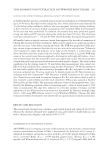
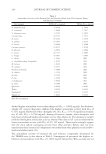
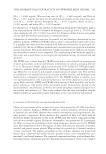
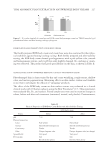
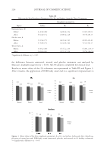
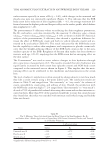
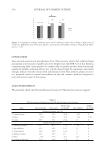
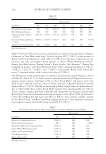
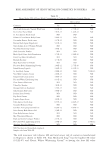
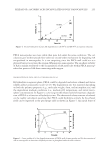
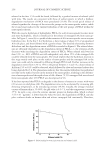
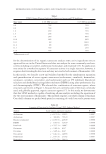
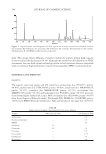
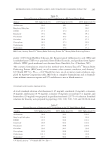
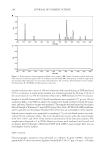
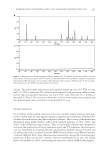
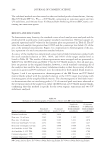
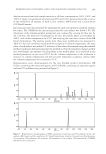
THAI AROMATIC PLANT EXTRACTS IN ANTIWRINKLE BODY CREAMS 229 surface texture especially in terms of Rz (p 0.05), while changes in the untreated and placebo area were not statistically signifi cant (Figure 3). This indicates that the EOB body cream led to reduction of skin roughness (ΔRz = −6.1, the average maximum dif- ference between the highest peaks and deepest valleys in the surface profi le, which defi nes skin roughness) (17–19). The posttreatment % effi ciency values on reducing the skin roughness parameters, Ra, Rz, and surface, were also calculated by the equation: % effi ciency value = (mean valueafter − mean valuebefore/mean valuebefore) × 100, as shown in Table IV. Statistical analysis of the posttreatment, % effi ciency data showed a signifi cant difference be- tween the effect of EOB body cream and both its vehicle (placebo cream) and un- treated on Rz and surface (Table IV). This result indicates that the EOB body cream has the capability to reduce skin roughness, and comparison to placebo cream indi- cates that the wrinkle-reducing effi cacy of the EOB body cream is due to the anti- oxidant capacity of the EOB. Roughness of forearm skin surface has been shown to increase with age, (20–21) implying that the EOB cream had an antiaging effect on the skin surface. The Corneometer® was used to assess relative changes in skin hydration through skin capacitance measurements (22). The results revealed that skin hydration was significantly increased by both cream base (placebo cream) and EOB body cream compared to the untreated area as shown in Figure 4. This implies that the mois- turizing effect can be attributed to the emollients and moisturizers in the cream base. The level of subject’s satisfaction is often assessed by asking subjects to rate how much they like a cream overall, using a fi ve-point Likert scale. The satisfaction results are shown in Table V and ranged from “like extremely” to “very much” for softness of cream, spreadability, cream gloss, and softness of skin. Overall, the satisfaction with the EOB body cream was high (77.2% ranged from “like extremely” to “very much”). A total of 70% of panelists felt relaxed after using this cream and no skin irritation oc- curred in them. More than 85% of the panelists would like to reuse this cream because they found that their skin was enriched with moisture and looked young and healthy (data not shown). Table IV The % Effi ciency Values Calculated from the Mean Values of the Skin Roughness, Ra, Rz, and Surface After 4 Weeks Application of Cream Base, EOB Cream (Untreated, Placebo, and Treated) in 29 Healthy Volunteers Topics % effi ciency values Surface Ra Rz Untreated area, N −2.90 −6.72 −6.08 Placebo area, B −2.36 −6.37 −5.88 Treated area, A −4.85* −7.76 −9.86* *Signifi cantly different from groups B and N at p 0.05.

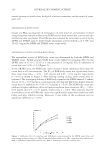
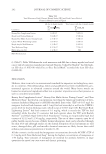
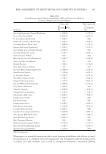
JOURNAL OF COSMETIC SCIENCE 230 CONCLUSION Four selected essential oils and absolutes from Thai aromatic plants that exhibited high antioxidant activity and acceptable odor were blended into the EOB. Use of this blend in a moisturizing body cream produced a cosmetically acceptable product with statistically signifi cant wrinkle-reducing effi cacy in a 4-week clinical study. In conclusion, our results strongly indicate that the essential oils and absolutes from Thai aromatic plants can serve as a potential source of natural antioxidants for spa and cosmetic products designed to treat and prevent signs of skin aging. ACKNOWLEDGMENTS We gratefully thank the National Research Council of Thailand for fi nancial support. Figure 4. Corneometer readings (arbitrary units) and % effi ciency values after 4 weeks of application of cream base, EOB body cream (untreated, placebo, and treated) in 29 healthy volunteers.*Signifi cantly differ- ent at p 0.05. Table V The Percentage of Satisfaction on EOB Body Cream in the Panelists Topic Like extremely Very much Nether like nor dislike Like slightly Dislike extremely Satisfaction before use (%) 1. Cream texture 20.0 53.3 24.0 2.67 0 2. Odor 7.58 42.4 45.5 3.03 1.56 3. Color 19.5 57.1 23.4 0 0 Satisfaction after use (%) 1. Softness of cream 25 65 7.5 2.5 0 2. Spreadability 44.3 40.5 15.2 0 0 3. Cream glossy 36.6 48.8 14.6 0 0 4. Softness of skin 25.3 55.7 19 0 0 5. Odor 7.81 37.5 42.2 12.5 0 6. Overall satisfaction 31.6 45.6 22.8 0 0
Purchased for the exclusive use of nofirst nolast (unknown)
From: SCC Media Library & Resource Center (library.scconline.org)