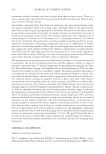
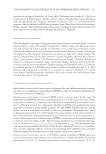
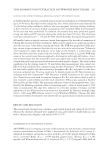
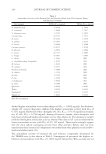
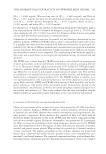
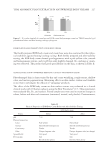
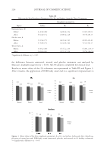
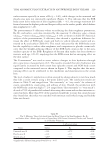
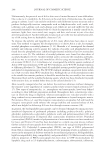
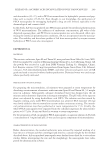
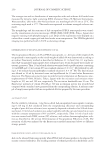
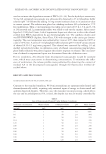
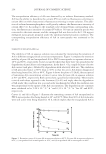
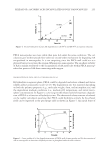
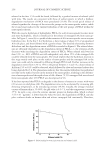
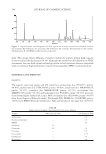
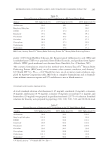
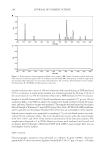
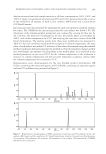
RELEASE OF L-ASCORBIC ACID ENCAPSULATED IN POLY NANOCAPSULES 255 PECA nanocapsules was more stable than pure AA under the same conditions. The cal- culations give neither pseudo fi rst-order nor second-order mechanism for degrading AA encapsulated in nanocapsules. It is not surprising since the PECA wall could act as a physical barrier to restrain the oxygen diffusing into nanocapsules. The excellent stability of AA is mainly attributed to the encapsulation of AA molecules within PECA nanocap- sules that protected AA from contacting with oxygen. DEGRADATION OF PECA AND IN VITRO RELEASE OF AA By hydrolysis in aqueous phase, PECA could be degraded and release ethanol and water- soluble poly(2-cyanoacrylic) acid (42,43). The degradation rate was reported depending on both the polymer properties (e.g., molecular weight, form, and microsphere size) and the degradation medium conditions (i.e., medium pH, temperature, and initial micro- sphere concentration). In Figure 5, curve (a) gives the ethanol yield of enzymatic degrada- tion of PECA as a function of hydrolysis time. The theoretical release amount of ethanol can be readily calculated, assuming that PECA could hydrolyze entirely. So the ethanol yield can be expressed as the percentage yield as shown in Figure 5. An initial burst of Figure 4. Second-order plots of pure AA degradation at (A) 40°C and (B) 80°C in aqueous solutions. Figure 5. Curve profi les of (a) the degradation extent of PECA wall of nanocapsules and (b) the retention of AA in nanocapsules as functions of hydrolysis time in phosphate buffered saline solution.

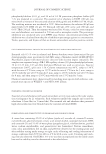
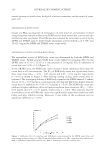
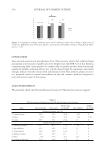
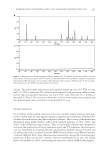
JOURNAL OF COSMETIC SCIENCE 256 ethanol in the fi rst 1.5 h could be found, followed by a gradual increase of ethanol yield with time. The results are consistent with those of earlier reports in which a biphasic degradation mechanism of PACA were postulated (33,44). The initial quick release of ethanol signifi es the cleavage of the ester side groups on the nanocapsules surface, while the second stage indicates the enzyme hydrolysis of the side groups of PECA within the nanocapsules matrix. With the enzyme hydrolysis of hydrophobic PECA, the wall of nanocapsules becomes more and more hydrophilic, which is benefi cial for the release of entrapped AA from nanocap- sules. In Figure 5, curve (b) is a profi le of the retention of AA in nanocapsules versus enzyme hydrolysis time. In the fi rst 3 h of hydrolysis, a burst release of about 61% of encapsulated AA took place, and then followed with a gentle release. The detailed relationship between AA release and the degradation extent of PECA is revealed in Figure 6. The release behav- iors are obviously dependent on the degradation extent of PECA, i.e., the retention of AA decreases with increasing the degradation extent of PECA. When ethanol yield was less than 12%, i.e., 88% of PECA was still undegraded, only about 15% of the entrapped AA could be released from the nanocapsules. The result implies that the hydrolysis reaction in this stage mainly took place on the surface of nanocapsules and the entrapped AA in the inner core could only be released by diffusing through PECA wall. Further increases in the degradation extent from 12% to 14% in the period between 1.5 and 3 h, a burst release of AA from 15% to 61% could be observed, which followed by slow and sustained release after being degraded for 3 h. The phenomena indicate that the enzyme hydrolysis was performed not only on the surface but also in the matrix of the nanocapsules, resulting in the deforma- tion of nanocapsules and the rapid release of AA. Almost 72.5% entrapped AA was released from nanocapsules after 16% PECA was decomposed in 9 h. It has been reported that PECA can degrade in the absence of esterase in contact with water (45) or even in solid phase (46). The degradation rate can be accelerated by increasing pH, elevating temperature, or by introducing esterase (34,43). Usually, the average moisture content of human skin is 35–60%, the pH value is 6.5–7.4, and the temperature is around 37°C. In such a case, even the esterase amount present in human skin, which is about 3.55 × 10⁻⁴ μg/mm2, is lower than the value we used, the degradation of PECA can take place without doubt on human skin and release entrapped AA continually. Therefore, Figure 6. Relationship between AA retention and ethanol yield.
Purchased for the exclusive use of nofirst nolast (unknown)
From: SCC Media Library & Resource Center (library.scconline.org)