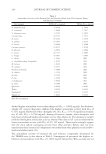
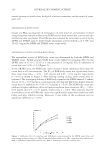
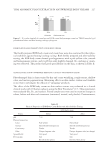
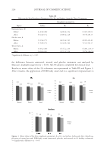
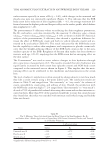
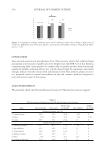
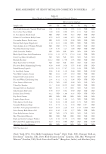
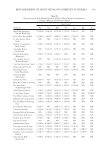
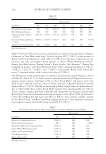
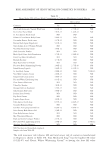
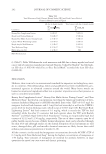
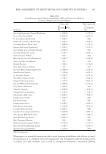
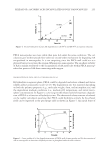
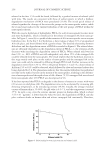
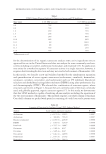
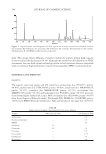
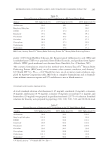
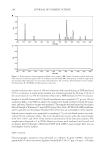
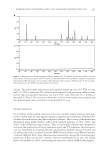
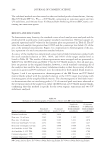
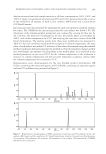
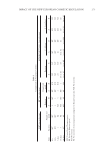
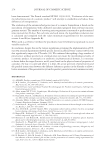
DETERMINATION OF SUNSCREEN AGENTS AND ULTRAVIOLET STABILIZERS USING UPLC 269 Figure 5. Representative chromatograms of UPLC separation of sunscreens and UV stabilizers in (A) color cosmetic (BB Cream) and (B) cream/lotion (UV Shield) formulations. Analytes: (A) ensulizole, (B) oxybenzone, (C) octocrylene, (D) avobenzone, (E) octinoxate, (F) homosalate A, (G) octisalate, (H) homosalate B, (J) DESM, and (K) butyloctyl salicylate. Analyte recovery from both sample matrices at all three concentrations (50%, 100%, and 160% of target concentration) were between 96% and 102%, demonstrating the accuracy of the method for all analytes in both a color cosmetic (BB Cream) and a cream/lotion (UV Shield) matrix. Injection precision was measured by analyzing the mid-concentration standard solution fi ve times. The %RSD for the injection precision for each analyte was below 1.00. The robustness of the chromatographic parameters was evaluated by varying the fl ow rate by ±0.1 ml/min, the detection wavelength by ±5 nm, the mobile phase acid modifi er by ±20%, and column temperature by ±5°C and assaying the sunscreen content of the BB Cream formulation. The analysis results from these assay modifi cation are presented in Table VI. For each condition tested with the exception of column temperature, the assay value of each analyte was within 5% (relative) of the values determined using the nominal method conditions demonstrating that the method is robust for moderate changes in fl ow rate, wavelength, and amount of acid modifi er in the mobile phase. It is indicated in the method parameters to not exceed 50°C for the column temperature as the resolution is sensitive to column temperature and did not meet robustness acceptance criteria when the column temperature was increased to 55°C. Representative assay chromatograms for the two fi nished product formulations, BB Cream, containing two sunscreen agents, and UV Shield, containing six sunscreen agents and two UV stabilizers are presented in Figure 5.

JOURNAL OF COSMETIC SCIENCE 270 CONCLUSIONS We have demonstrated the validation of a UPLC method for the identifi cation and quan- tifi cation of seven organic sunscreens (avobenzone, ensulizole, homosalate, octinoxate, octisalate, octocrylene, and octinoxate) and two UV stabilizers (butyloctyl salicylate and DESM). Our results show that this method is selective, precise, accurate, and suitable for measurement of all nine analytes on a UPLC system. The method utilizes core-shell col- umn technology so it may also be used on conventional HPLC instrumentation. REFERENCES (1) Y. Matsumu and H. N. Ananthaswamy, Toxic effects of ultraviolet radiation on the skin, Toxicol. Appl. Pharmacol., 195, 298–308 (2004). (2) H. Torma, B. Berne, and A. Vahlquist, UV irradiation and topical vitamin A modulate retinol esterifi ca- tion in hairless mouse epidermis, Acta. Derm. Venereol., 68, 291–299 (1988). (3) M. Iannacone, M. Hughes, and A. Green, Effects of sunscreen on skin cancer and photoaging, Photodermatol. Photoimmunol. Photomed., 30, 55–61 (2014). (4) U.S. Department of Health and Human Services, Public Health Service, National Toxicology Program, Report on Carcinogens, 13th Ed., 2014, accessed March 18, 2014, http://ntp.niehs.nih.gov/pubhealth/roc/ roc13/index.html%20%20 (5) M.A. Pathak and T. B. Fitzpatrick, “Preventive Treatment Of Sunburn, Dermatoheliosis, and Skin Cancer with Sun-protective Agents,” in Dermatology in General Medicine, 4th Ed., T. B. Fitzpatrick, A. Z. Eisen, K. Wolff, I. M. Freedberg, and K. F. Austen. Eds. (McGraw-Hill Publishers, New York, 1993), pp. 1689–1717. (6) A. Green, G. Williams, R. Neale, V. Hart, D. Leslie, P. Parson, G. Marks, P. Gaffney, D. Battistutta, C. Frost, C. Lang, and A. Russel, Daily sunscreen application and betacarotene supplementation in prevention of basal-cell and squamous-cell carcinomas of the skin: A randomised controlled trial, Lancet, 354, 723–729 (1999). (7) Source: © Euromonitor International, a market research provider. http://www.euromonitor.com/citation- policy, accessed April 14, 2015. (8) U.S. Food and Drug Administration. Sunscreen drug products for over-the-counter human use fi nal rules and proposed rules, Fed. Regist., 76, 35619–35665 (2011). (9) J. Staton, Sunscreen test methods—working for world harmonization [Abstract], in Florida Society of Cosmetic Chemists’ Sunscreen Symposium, September 18–21, 2013, Orlando, FL. (10) European Union, Cosmetics Directive (76/768/EEC), Explanatory Brochure. The European Cosmetic Toiletry and Perfumery Association, January 2006. (11) United States Pharmacopeia and National Formulary (USP 30-NF 25). (United States Pharmacopeia Con- vention, Rockville, MD, 2007), Vol. 2, pp. 1553–1554. (12) D. Jarrett, S. Countryman, and J. Layne, “Optimized Sunscreen Method Used For Impending 2012 Enforcement of FDA Regulation In Characterizing Their Active Ingredients,” in LCGC: The Application Notebook. (2011), http://www.chromatographyonline.com/LCGC-Application-Notes. (13) Hygienic Standard for Cosmetics (GB 7916-1987), Standardization Administration of the People’s Repub- lic of China, October 2004. (14) N. Chang, M. Yoo, and S. Lee, Determination of fourteen sunscreen agents in cosmetics using high- performance liquid chromatography, Int. J. Cosmet. Sci., 37, 175–180 (2015). (15) S. M. Lee, H. J. Jeong, and I. S. Chang, Determination and validation of six sunscreen agents in sun care products by UPLC and HPLC. J. Cosmet. Sci., 59, 469–480 (2008). (16) Determination of ten active ingredients in sunscreen-containing products in a single injection. Dionex Application Note 223 (2009), http://www.dionex.com/en-us/webdocs/70977-AN223-10ActIngred- Sunscreen-19Mar09-. (17) U. Osterwalder, M. Sohn, B. Herzog, Global state of sunscreens. Photodermatol. Photoimmunol. Photomed., 30, 62–80 (2014). (18) R. Brice, X. Zhang, and L. Colón, Fused-core, sub-2 micron packings, and monolithic HPLC columns: a comparative evaluation. J. Sep. Sci., 32, 2723–2731 (2009). (19) J. DeStefano, S. Schuster, J. Lawhorn, and J. Kirkland, Performance characteristics of new superfi cially porous particles. J. Chromatogr. A., 1258, 76–83 (2012).
Purchased for the exclusive use of nofirst nolast (unknown)
From: SCC Media Library & Resource Center (library.scconline.org)