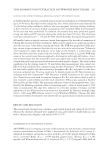
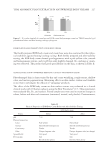
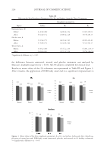
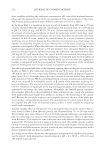
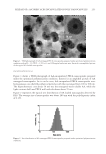
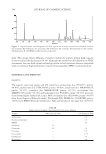
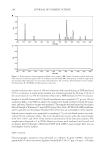
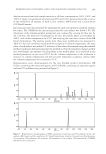
RELEASE OF L-ASCORBIC ACID ENCAPSULATED IN POLY NANOCAPSULES 253 ENCAPSULATION OF AA Figure 1 shows a TEM photograph of AA-encapsulated PECA nanocapsules prepared under the optimized polymerization condition. Inserted is an amplifi ed picture of AA entrapped nanocapsules. As it can be seen, AA-encapsulated PECA nanocapsules were homogeneous core-shell-like spherical particles with the size ranged from 100 to 300 nm. The hyperchromatic core about 50 nm was the entrapped water soluble AA, while the light contrast shell was PECA wall with thickness about 70 nm. Figure 2 represents the typical size distribution of AA loaded nanocapsules detected by DLS. The average size of nanocapsules was about 280 nm with the polydispersity index of 0.153. Figure 1. TEM photograph of AA entrapped PECA nanocapsules prepared under optimized polymerization condition with pH = 2.0, W/O = 1/50 (v/v), and 108 mg/ml surfactant mix. Inserted is an amplifi ed picture of the typical AA loaded nanocapsules. Figure 2. Size distribution of AA entrapped PECA nanocapsules prepared under optimized polymerization condition.

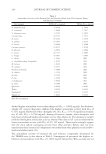
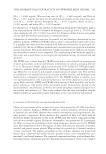
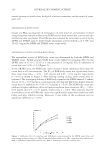
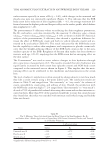
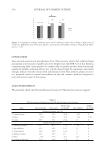
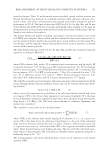
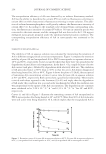
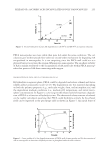
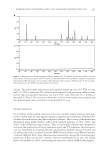
JOURNAL OF COSMETIC SCIENCE 254 The encapsulation effi ciency of AA was detected by an indirect fl uorimetry method. AA has the ability to deoxidize the cerium (IV) ion with no fl uorescence emitting to cerium (III) ion with characteristic fl uorescence emitting in water solution. The addi- tion of sodium hexametaphosphate could greatly enhance the fl uorescence intensity of cerium (III) (31). According to the standard curve obtained from corresponding solu- tion, the fl uorescence intensity of cerium (IV)-AA at 340 nm in emission spectra was converted to the mass amount, and the entrapped AA was detected to be 0.116 mg per milligram nanocapsules prepared under the optimized polymerization condition. The corresponding encapsulation effi ciency of AA in nanocapsules was estimated to be 87.5%. STABILITY OF ENCAPSULATED AA The stability of AA in aqueous solution was evaluated by monitoring the retention of AA in different storage periods at various temperatures. Figure 3 compares the retention stability of pure AA and encapsulated AA in PECA nanocapsules in aqueous solution at 40°C and 80°C, respectively. Curves (a) and (b) show that there were two periods for the degradation of pure AA at each temperature. In the fi rst 4–6 h, a rapid decrease of active AA content took place, followed by degradation with relatively slow rate. The oxidation of AA proceeded faster at 80°C than at 40°C so that the active AA almost disappeared after being heated for 24 h at 80°C. Figure 4 shows the plots of 1/[AA]t (the reciprocal of remaining AA concentration at time t) versus time for pure AA in aqueous solution at 40° and 80°C, respectively. Both curves show a good linear relationship. These results coincide with those reported in the literature (39–41) and imply that the degradation of AA under this condition was a second-order mechanism for which the oxidation rate was proportional to the square of the AA concentration. The degradation rate constants were calculated to be 5.28 × 10⁻⁴ %−1·h−1 and 6.32 × 10⁻³ %−1·h−1 for 40° and 80°C, respectively. Curves (c) and (d) in Figure 3 illustrate the remaining content of AA encapsulated in PECA nanocapsules after being heated at 40° and 80°C. More than 90% of AA molecules were still active even being heated for 36 h, which implies that the encapsulated AA in Figure 3. Retention curves of (a) pure AA in aqueous solution at 40°C, (b) pure AA in aqueous solution at 80°C, (c) encapsulated AA in nanocapsules at 40°C, and (d) encapsulated AA in nanocapsules at 80°C.
Purchased for the exclusive use of nofirst nolast (unknown)
From: SCC Media Library & Resource Center (library.scconline.org)