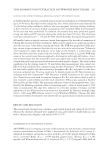
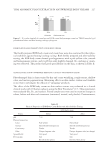
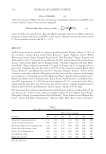
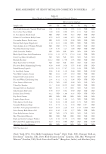
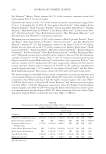
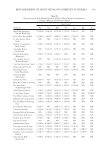
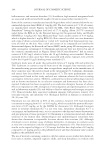
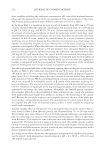
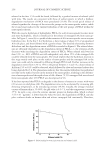
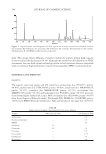
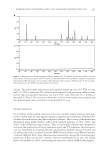
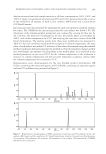
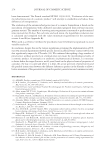
DETERMINATION OF SUNSCREEN AGENTS AND ULTRAVIOLET STABILIZERS USING UPLC 267 Figure 4. Representative chromatograms of blank cream/lotion (UV Shield) (A) matrix spiked with stan- dard solution of sunscreen agents and UV stabilizers and (B) blank UV Shield matrix. Standard compounds: (A) ensulizole, (B) oxybenzone, (C) octocrylene, (D) avobenzone, (E) octinoxate, (F) homosalate A, (G) octisalate, (H) homosalate B, (J) DESM, and (K) butyloctyl salicylate. column. The mobile phase solutions used for gradient separation were 0.1% TFA in water and 0.1% TFA in methanol. The solutions were degassed using sonication under vacuum, and the step-wise gradient separation was run at 50°C with a fl ow rate of 1.5 ml/min as described in Table I. The injection volume was 1 μL for both samples and standards and the chromatograms were recorded at a wavelength of 315 nm. METHOD VALIDATION For validation of the method, dilutions of the nine standard analyte mixtures were sepa- rated as outlined and the least-squares regression equations and correlation coeffi cients (R2) calculated for each analyte using Microsoft Excel software. The accuracy of the method was determined using blank matrices spiked with standard mixtures at 50%, 100%, and 160% of the formulation target content. Three accuracy spike solutions were prepared at each level and analyzed for all of the sunscreen agents and UV stabilizers. Injection preci- sion was determined by analyzing the mid-concentration standard solution fi ve times and calculating the relative standard deviations (RSD) for each analyte using Waters Empower 3 software (Milford, MA). Assay robustness was evaluated by varying the chromatographic parameters of fl ow rate by ±0.1 ml/min, detection wavelength by ±5 nm, and mobile phase acid modifi er by ±20%, and assaying the sunscreen content of BB Cream samples.

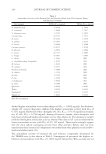
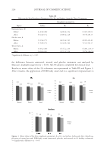
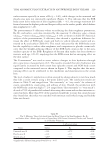
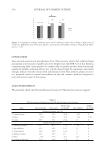
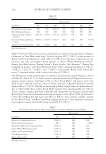
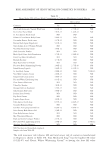
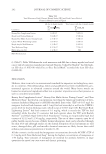
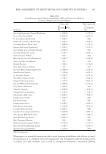
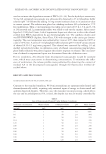
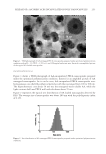
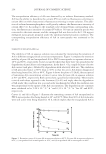
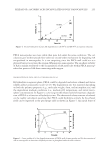
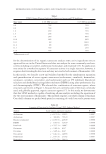
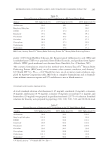
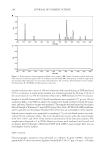
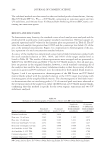
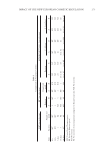
JOURNAL OF COSMETIC SCIENCE 268 Table VI Robustness of Chromatographic Parameters as Shown with BB Cream Analysis Method conditions Ensulizole results (%w/w) Octinoxate results (% w/w) Ensulizole % difference from nominal conditions Octinoxate % difference from nominal conditions Nominal conditions 2.070 5.010 – – Flow rate: 1.4 mL/min 2.042 5.180 1.362 3.337 Flow rate: 1.6 mL/min 2.008 5.105 3.041 1.878 Detection wavelength: 310 nm 2.072 5.082 0.097 1.427 Detection wavelength: 320 nm 2.071 5.098 0.048 1.741 Acid modifi er: 0.08% TFA 2.090 5.144 0.962 2.639 Acid modifi er: 0.12% TFA 2.069 5.100 0.048 1.780 Column temperature: 45°C 2.016 5.146 2.643 2.678 Column temperature: 55°C 2.143 5.456 3.465 8.523 BB Cream, Artistry Exact Fit™ Beauty Balm Perfecting Primer Fit™ Beauty Balm Perfecting Primer. The validated method was then tested on the two fi nished product formulations, Artistry Men UV Shield SPF 50+ PA+++ (UV Shield), containing six sunscreen agents and two UV stabilizers, and Artistry Exact Fit Beauty Balm Perfecting Primer (BB Cream), con- taining two sunscreen agents. RESULTS AND DISCUSSION To demonstrate assay linearity, the standard curves of each analyte were analyzed and the results plotted as peak area counts against standard concentration. The least-squares re- gression equations and R2 values for the linearity plots are presented in Table II. The R2 value for each analyte was greater than 0.9995 and the y-intercept was below 2% of the area at the nominal concentration. Figure 2 is a representative chromatogram of the ana- lyte separation of a mid-concentration standard solution. Accuracy of the method was determined using matrix blank formulations spiked with the stock standard solution at 50%, 100%, and 160% of the target analyte level as listed in Table III. The results of three experiments were averaged and are presented in Table IV for the BB Cream and Table V for the UV Shield matrices. Not all nine ana- lytes are present in the original formulas however, a stock standard containing all of the analytes was used for the accuracy validation studies so that the recovery of all the sunscreen agents and UV stabilizers were determined for both spiked blank matrices. Figures 3 and 4 are representative chromatograms of the BB Cream and UV Shield matrix blanks spiked with the standard solution at the 100% target level along with chromatograms of the unspiked blank matrix. The chromatograms of the blank matri- ces demonstrate that no interfering peaks (1% of nominal peak area) were observed at the retention times of the analytes in either the BB Cream or UV Shield matrix blanks, confi rming that this method is specifi c for the seven organic sunscreens and two UV stabilizers analyzed.
Purchased for the exclusive use of nofirst nolast (unknown)
From: SCC Media Library & Resource Center (library.scconline.org)