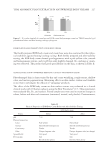
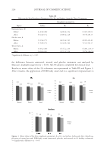
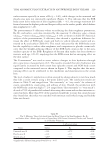
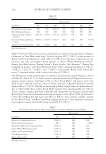
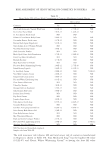
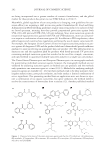
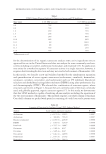
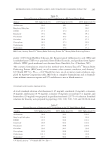
DETERMINATION OF SUNSCREEN AGENTS AND ULTRAVIOLET STABILIZERS USING UPLC 263 for the determination of six organic sunscreens analyzes some active ingredients not yet approved for use in the United States and does not analyze for some commonly used sun- screens including octocrylene, oxybenzone, homosalate, and ensulizole (15). An application note exists for a method to separate 10 sunscreen actives in a single injection however, it requires dual-wavelength detection and may not resolve both isomers of homosalate (16). In this article, we describe a new and validated method for the simultaneous separation and quantifi cation of seven organic sunscreens (avobenzone, ensulizole, homosalate, octinoxate, octisalate, octocrylene, and oxybenzone) and two UV stabilizers [butyloctyl salicylate and diethylhexyl syringylidene malonate (DESM)] using ultra-performance liq- uid chromatography (UPLC). We selected this combination of sunscreen agents, whose structures can be seen in Figure 1, because they are currently some of the most commonly used, and globally approved, organic sunscreen agents (17). In this study, we demonstrate that this UPLC method is capable of resolving all nine analytes including the separation of the two stereoisomers of homosalate. This method employs core-shell column technology. Core-shell columns are packed with particles consisting of a solid core and a porous outer Table I UPLC Column Elution Gradient for Sunscreen Agents and UV Stabilizers Time (min) 0.1% TFAa in water 0.1% TFA in methanol 0.0 75% 25% 0.9 75% 25% 1.0 25% 75% 1.5 25% 75% 7.0 20% 80% 10.0 10% 90% 10.1 0% 100% 11.2 0% 100% 11.3 75% 25% 12.5 75% 25% a Trifl uoroacetic acid. Table II Linearity of Detection for Analytes Using UPLC Analysis Method Analyte Least-squares regression equation R2 value Avobenzone y = 1179.5x - 1305.3 0.9997 Avobenzone y = 488.85x - 755.29 0.9997 Butyloctyl salicylate y = 1059.3x - 429.09 0.9998 DESM y = 1059.3x - 429.09 0.9998 Ensulizole y = 2337.1x - 1988.7 0.9998 Octinoxate y = 3485.4x - 8347 0.9998 Octisalate y = 3485.4x - 8347 0.9998 Octocrylene y = 1412.2x - 1465.8 0.9998 Oxybenzone y = 1834.5x - 24.582 0.9997 Homosalate y = 579.24x - 3641.9 0.9998

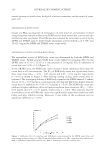
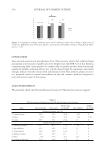
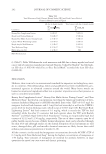
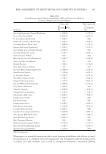
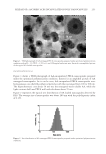
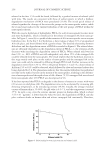
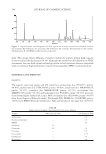
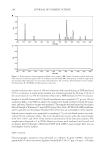
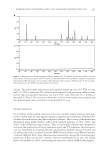
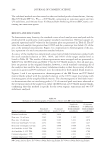
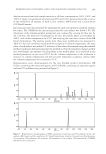
JOURNAL OF COSMETIC SCIENCE 264 Table III Target Sunscreen Agent Concentrations for Accuracy Analysis Analyte BB Cream (% w/w) UV Shield (% w/w) Avobenzone – 3.0 Butyloctyl Salicylate – 2.5 DESM – 4.0 Ensulizole 2.0 – Octinoxate 5.5 2.5 Octisalate – 5.0 Octocrylene – 0.75 Oxybenzone – 4.5 Homosalate – 9.0 shell. This design limits diffusion of analytes within the particle giving high-capacity factors at reduced back pressures (18,19). Although the method was developed on an UPLC instrument, the core-shell column technology results in back pressures that are compatible with conventional high-performance liquid chromatography (HPLC) instrumentation. MATERIALS AND METHODS REAGENTS The organic sunscreen agents and UV stabilizers, avobenzone (lot: P500073, purity: 99.9%), oxybenzone (lot: STBC0800V, purity: 99.9%), ensulizole (lot: MKBP8062V, purity: 99.1%), octisalate (lot: MKBK1099B, purity: 99.7%), octocrylene (lot: MKBP5033V, purity: 99.5%), and homosalate (lot: P500085, purity: 99.9%), were pur- chased from Sigma-Aldrich (St. Louis, MO) octinoxate (lot: A0299866, purity: 99.8%) from Acros Organics (Fisher Scientifi c, Pittsburgh, PA) DESM (lot: 2166E1MR, purity: 100%) from EMD Chemicals (Gibbstown, NJ) and butyloctyl salicylate (lot: 5032970, Figure 2. Representative chromatogram of UPLC separation of mid-concentration standard solution: (A) ensulizole, (B) oxybenzone, (C) octocrylene, (D) avobenzone, (E) octinoxate, (F) homosalate A, (G) octisalate, (H) homosalate B, (J) DESM, and (K) butyloctyl salicylate.
Purchased for the exclusive use of nofirst nolast (unknown)
From: SCC Media Library & Resource Center (library.scconline.org)