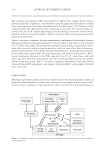
JOURNAL OF COSMETIC SCIENCE 174 of G′ with fi ber diameter or rather polar moment of inertia. This analysis enabled to obtain estimates for the torsional storage moduli of cuticle and cortex through nonlinear curve fi tting and extrapolation. The results of the analysis supported the hypothesis that the torsional storage modulus of the cuticle is signifi cantly higher than that of the cortex. Though the absolute value for the modulus of the cortex was too low compared to litera- ture values, plausible changes of cuticle and cortex moduli were determined after cos- metic treatments. This part of the investigation now is focused on the logarithmic decrement Λ, as a measure of energy loss in the fi ber and as one of the primary variables from a torsional pendulum experiment. The loss modulus G″, as primary physical variable, is determined indirectly from the logarithmic decrement Λ and the torsional storage modulus G′ for an individual measurement. G′ is proportional to the energy stored and G″ to the energy lost during a torsional oscillation. The objective is to investigate whether the structure-based, basic core/shell model approach for G′ (3) is also applicable for G″. This includes estimates of the loss moduli of cuticle and cortex as well as the effects of cosmetic treatments. The potential as well as the specifi c limitations of the approach are discussed. MATERIALS AND METHODS THEORETICAL BACKGROUND Free torsional oscillation, e.g., of a fi ber in a torsional pendulum apparatus (2,4, 5), yields the complex torsional modulus G* as: G* = G′ + iG″ (1) where G′ and G″ are the storage and loss modulus, respectively. G′ is given by: = ′ 2 2 4π J l G I T (2) where J is the moment of inertia of the pendulum, l the length of the fi ber, I the polar moment of inertia of the fi ber, and T the time taken for one oscillation. The cross-section of a hair fi ber is generally assumed to be best described as elliptical so that the polar moment of inertia is given by: I = (π/4) (a3b + b3a) (3) where a and b are the semiaxes of the ellipse. The use of the polar rather than the torsional moment of inertia (6) assumes the limiting case that no warping of the test specimen occurs (7), which is plausible for small deforma- tions and low resonance frequencies (8), as realized in this study. The situation is certainly different for combinations of high tensile and torsional strains (9). The approach was furthermore chosen to provide better comparability of data with previous investigations

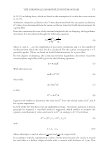
THE TORSIONAL LOSS MODULUS IN HUMAN HAIR 175 (4,10,1 1) including those, which are based on the assumption of circular hair cross-sections (1,12,1 3). Arithmetic means for oscillation time T were determined from fi ve successive oscillations. G′ values were determined from the mean oscillation times for fi vefold measurements for a given fi ber. From the continuous decrease of the torsional amplitude due to damping, the logarithmic decrement Λ is determined through the following equation: =1 = 1 ln Λ n i Ai n A1+i (4) where Ai and Ai + 1 are the amplitudes of successive oscillations and n is the number of oscillation from which the value for Λ is calculated. For the current investigation, n = 5 generally applies. Values are based on fi vefold determinations for a given fi ber. For low degrees of damping, the connection between logarithmic decrement Λ and the torsional phase angle δ as tanδ is given by the following equation: Λ = π tanδ (5) With the loss factor: tanδ = G″/G′ (6) this yields: Λ = π G″/G′ (7) so that G″ = Λ G′/π (8) Equation (8) enables to determine the value for G″ from the related values of G′ and Λ for a given experiment. In view of the fact that hair is not an uniformly isotropic, viscoelastic material, as may in principle be required, a core/shell model is suggested, which enables to estimate the separate contributions of cortex and cuticle to G″, in analogy to G′ (3) as follows: G″ = (G″co Ico + G″cu Icu)/I (9) with I = Ico + Icu (10) where subscripts co and cu relate to cortex and cuticle, respectively. In accordance with the experimental evidence for the material used, the cuticle is treated for each fi ber as a hollow, elliptical shaft with a constant wall thickness of 3 μm. This
Purchased for the exclusive use of nofirst nolast (unknown)
From: SCC Media Library & Resource Center (library.scconline.org)