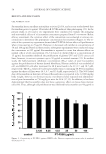
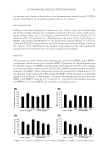
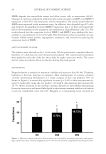
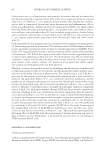
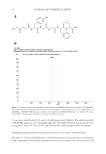
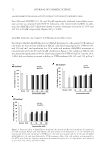
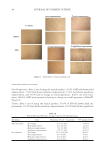
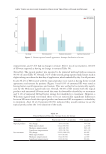
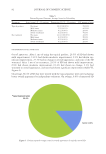
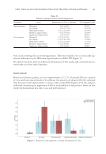
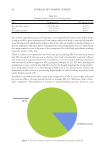
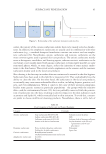
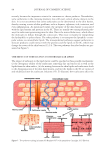
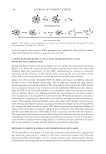
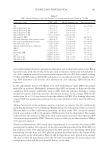
JOURNAL OF COSMETIC SCIENCE 60 MMPs degrade the extracellular matrix a nd allow cancer cells to metastasize (40,41). Chung et al. (42) have studied the inhibitory effect of fucoxanthin on MMP-2 and MMP-9 expression in B16-F10 cells (metastatic murine melanoma). The results showed that the MMPs were expressed at the metastasis stage. In addition, they degraded type IV colla- gen however, fucoxanthin decreased MMP-9 expression. Liu et al. have investigated the effects of fucoxanthin on the migration and invasiveness of glioblastoma cells (31). The results showed that the expression levels of MMP-2 and MMP-9 were inhibited by fuco- xanthin at concentrations of 25 and 50 μM. This demonstrates that fucoxanthin can suf- fi ciently inhibit tumor growth, angiogenesis, metastasis, and invasion by reducing the expression levels of MMPs. SAFETY ASSESSMENT OF CREAM The subjects were selected on day 1 of t he study. All the participants completed the test therefore, 21 valid data sets were obtained and analyzed. The control and test products were applied to each side of the face twice daily for eight consecutive weeks. The cream did not cause any adverse effects on the skin during the study period. SKIN MOISTURE Proper hydration is essent ial to maintai n a healthy and attractive skin (43,44). Therefore, hydration is the basic function of cosmetics. Most manufacturers of cosmetic products consider moisturizing formulations as a major category of skin care products (45). As shown in Figure 4, a statistically signifi cant increase (p 0.05) in skin moisture was ob- served 4 weeks after using the test product. At week 8, skin moisture had increased by 16.7%. Water retention in the stratum corneum depends on intracellular moisturizing factors in corneocytes and intercellular lipids in the stratum corneum, which act as barriers to prevent transdermal water loss (46). Filaggrin is a moisturizing factor essential for Figure 4. Moisture content of the skin. Skin moisture was evaluated by measuring capacitance and express- ing it in arbitrary units. Statistical signifi cance (p 0.05) was calculated in comparison with the initial value.

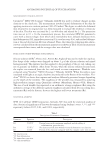
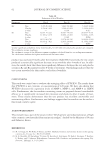
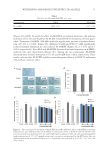
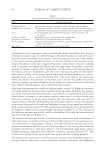
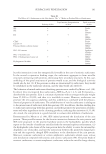
ANTIAGING POTENTIAL OF FUCOXANTHIN 61 maintaining homeostasis in the epidermal layer. It plays an important role in the barrier function of the skin after its incorporation into the lipid envelope (47). In addition, it promotes the release of free amino acids, which are natural moisturizing factors (47). It has also been reported that fi laggrin plays a major role in the barrier protection effect of the skin (46). The low level of fi laggrin caused by genetic mutation has been linked to severe eczema and dry skin in adults (48). Furthermore, Matsui et al. (49) showed that fucoxanthin re- stores downregulated fi laggrin expression and alleviates UV-induced sunburn. In addition, they showed that fucoxanthin stimulates fi laggrin promoter activity in a concentration- dependent manner (47). Our data and those obtained by Matui et al. suggest that fucoxan- thin maintains the moisture content of the skin and protects against transdermal water loss by promoting skin barrier function via inducing fi laggrin expression. SKIN ELASTICITY The skin tends to resume its original shape after an applied stretching force is released. Skin elasticity is one of the biggest factors that determine apparent age. When collagen and elastin levels in the skin reduce, the skin eventually becomes saggy and wrinkles ap- pear. These make the skin look older than it actually is. In the in vitro experiment, PT- FX50 increased procollagen amount and reduced MMP expression. As shown in Table II, net skin resilience (R5) signifi cantly increased after 4 and 8 weeks of treatment with the test product. The Cutometer® was used to determine several parameters such as immedi- ate recovery (UR), immediate extensibility (UE), and viscoelastic deformation. The ex- periment involved using a noncontact optical measuring system. The skin was drawn into the aperture of the probe and released again. R5 was calculated as UR/UE. The results showed that the test cream improved skin elasticity and had a beauty-enhancing effect. EVALUATION OF WRINKLES The effect of the cream on wrinkles was assessed by performing a replica image analysis. No statistically signifi cant changes in wrinkles were observed at the site where the control Table II Skin Elasticity Measurements Parameters Day 0 Day 28 Day 56 R2a 0.5225 ± 0.0600 0.6037 ± 0.0446 0.5880 ± 0.0791 p valueb — 0.177 1.000 Change rate (%) — 3.65 0.95 R5c 0.5203 ± 0.0257 0.5426 ± 0.0352 0.5708 ± 0.0450 p value — 0.001 0.001 Change rate (%) — 4.29 9.71 R7d 0.3235 ± 0.0302 0.3299 ± 0.0235 0.3372 ± 0.0488 p value — 0.464 0.333 Change rate (%) — 1.96 4.21 a R2: gross elasticity. b p value: signifi cant probability, linear mixed model, p 0.05 when test and placebo products are compared. c R5: net elasticity. d R7: skin recovery. Change rate (%) = [(Dx – D0)/D0] × 100, calculated as a mean value (D0, Day 0 Dx, Day 28 or 56).
Purchased for the exclusive use of nofirst nolast (unknown)
From: SCC Media Library & Resource Center (library.scconline.org)