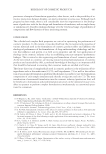
JOURNAL OF COSMETIC SCIENCE 472 RHEOLOGY Rheology is an important parameter when it comes to cosmetic formulations. The viscos- ity of a formulation is often used as a control parameter. Beauty and personal care prod- ucts are often exposed to a varied range of shear rates during processing, packaging, and fi nally when used by the consumer. This makes it vital to control the rheological proper- ties of a cosmetic product across the shear rate range. In addition to their functional properties like fi lm formation, biopolymers are often added as viscosity modifi ers in cos- metic formulations (153–155). The viscoelastic properties of chitosan have been widely studied (156–158). Hwang and Shin (156) explored the effect of polymer concentration on the rheological response of chitosan solutions. They recorded an increase in the bulk viscosity as the concentration of chitosan was increased. Furthermore, they also reported that the chitosan solution exhibited greater shear thinning fl ow at greater chitosan concentrations. They attributed this to the fact that at increased polymer concentrations, the movement of the individual polymer chains becomes more restricted. Thus, the time taken to create new entanglements to replace the ones initially deformed increases, making it more pseudoplastic (156). In another study, Chen and Heh (153) observed the impact of the molecular weight of chitosan on the rheological properties of moisture creams. The bulk viscosity of the creams increased when chitosan of greater molecular weight was added to the formula- tion. Also, the viscosity of the moisture cream with 0.5 wt% chitosan was found to be greater than that of the same moisture cream formulation with 2 wt% of a traditional viscosity modifi er like glycerol monostearate. The bulk rheological properties of xanthan gum depend on the average molecular weight as well as the acetate and pyruvate contents which in turn vary depending on the operational conditions during processing. Casas et al. (154) determined the effect of temperature and other parameters like fermentation time on the molecular structure of xanthan gum pro- duced as well as their rheological properties. At low temperatures, the synthesized xan- than gum had high molecular weight, and thus exhibited high viscosity. On the other hand, high processing temperatures (34°C) resulted in low viscosity polymers. At a con- centration greater than 0.3 wt%, the viscosity of xanthan solution is independent of salt, making it excellent for viscosity building in ion-containing solutions (159). Xu et al. (160) studied the shear thinning properties of xanthan gum in aqueous solutions which was due to the disruption of the polysaccharide aggregates at high shear rates. An increase in the apparent viscosity of the polymer solution was observed with increasing polymer concentrations. Xanthan gum solutions of high concentrations have a yield stress which makes it ideal as a suspending agent in various cosmetic formulations. This yield stress arises from the numerous hydrogen bonds present in the helix structure of the bio- polymer. Xanthan solutions have a dominant elastic fl ow behavior which makes them ideal rheology modifi ers (85). Carboxymethyl cellulose is another polysaccharide that is extensively used to modify rheo- logical properties in cosmetic applications in various creams, lotions, or toothpastes (155). Carboxymethyl cellulose exhibits shear thinning behavior through a mechanism similar to those mentioned previously in this section. Edali et al. (161) generated hyster- esis loops of the shearing cycles by fi rst increasing the shear stress to a fi xed value, and then holding the stress constant at the maximum value, followed by reducing the shear

BIOSURFACTANTS AND BIOPOLYMERS 473 stress to evaluate the thixotropic properties of carboxymethyl cellulose. Carboxymethyl cel- lulose solutions showed excellent thixotropic behavior. Furthermore, this time dependence of viscosity increased at greater carboxymethyl cellulose concentrations. This was explained by the different rates of disentanglement and re-entanglement of the polymer chains when a shear is applied (162). Because of its thixotropic behavior, carboxymethyl cellulose has found widespread use in cosmetic products such as nail polish. Studies on the rheological effects of biosurfactants are few. One study carried out by Abbas et al. (163) discussed the rheology of the biosurfactant synthesized by Pseudomonas aeruginosa—in other words, RLs from food industry by-products. Rheological measure- ments were carried out using viscosity-shear, strain, and frequency sweep tests. The bio- surfactant displayed a linear viscoelastic region of less than 1% on carrying out the strain sweep test. The viscosity tests revealed shear thinning behavior, and the frequency sweeps revealed a dominant storage (G′) modulus throughout the range, where the modulus was frequency dependent. When the sample was subjected to a constant shear rate, it displayed thixotropic behavior with respect to time. A nother study by Jain et al. (164) studied the rheology of biosurfactant produced by an alka- line environment preferring bacterium Cronobacter sakazakii which was extracted from waste- water polluted by oil. This biosurfactant is a heteropolysaccharide–protein complex which is also emulsifying in nature. Viscosity measurements were carried out for the sample. The fl ow sweep revealed that the biosurfactant was a pseudoplastic, or, in other words, it was shear thin- ning in nature. The viscosity was 0.429 Pa/s at 0.01 1/s shear rate and decreased from there onward with an elevation in the shear rate. Another biological emulsifi er produced from Halomonas eurihalina also displayed similar pseudoplastic behavior (165). F inally, Xu and Amin (15) carried out mechanical rheometry to study the effect of RLs on sodium lauryl ether sulfate and CAPB—which are common synthetic surfactants. The addition of RLs to the SLES/CAPB system lowered the viscosity at low shear rates. The viscoelastic behavior was Maxwellian—where before crossover, the loss modulus (G″) was dominant. As more RLs were added, the crossover shifted to shorter relaxation times, which is always inversely proportional to the frequency. Micro rheological tests were also performed to understand the rheological properties of the ternary system at higher frequencies. From the tests, one could construe that with the addition of RLs, the long micelles broke into shorter micelles because of weaker entanglements. This explained the reduction in viscosity. Fu rther research on biosurfactant and bioemulsifi er effects on rheology would make for an interesting long-term study on the development of novel rheological textures in cosmet- ics and cosmeceuticals. FU TURE TRENDS AND CHALLENGES Sh ifting into the realm of sustainability has become a necessity for the sustenance of cos- metic companies. This transition, although advantageous in terms of environmental consid- erations, comes with its own challenges. The most consequential challenge that is faced in today’s market scenario is the existence of a supply–demand paradox, where low demand has led to diffi culty in quelling market prices of green cosmetic commodities. This can be addressed by systematically increasing the percentage of sustainable ingredients in cosmetic formulations and continually funneling these into the market for consumer accep-
Purchased for the exclusive use of nofirst nolast (unknown)
From: SCC Media Library & Resource Center (library.scconline.org)