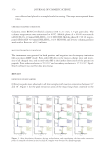
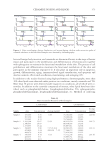
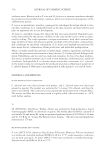
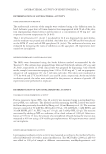
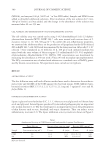
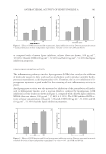
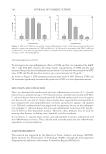
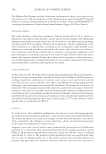
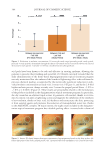
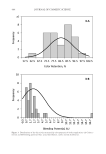
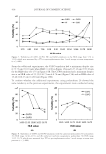
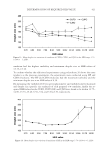
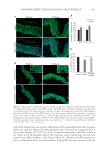
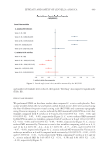
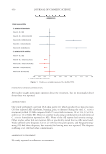
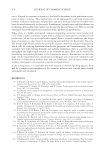
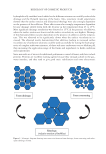
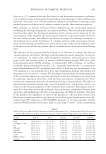
JOURNAL OF COSMETIC SCIENCE 382 ANTI-INFLAMMATION ACTIVITY To investigate the anti-infl ammatory effects of COH and SA, we stimulated the RAW 264.7 cells with LPS, treated cells using various concentrations of COH and SA, and measured the production of infl ammatory mediators. Cell survival was measured by MTT assay. COH and SA did not show toxicity up to concentrations of 50 μg ml-1. As shown in Figure 3, LPS treatment produced high levels of NO. However, COH and SA treatment signifi cantly decreased the production of NO in a dose-dependent manner. DISCUSSION AND CONCLUSION Here, we identifi ed the antibacterial and anti-infl ammatory activities of C. offi cinale plant extracts, prepared using a 70% ethanol solvent, and then partitioned with Hex. C. offi cinale hexane fraction and senkyunolide A showed antibacterial activity against test bacteria (P. acne and M. furfur). Some studies have reported that senkyunolide A has cytoprotective and antiproliferative activities and protects against cell injuries (14). NO and cytokines have been implicated as important factors in the infl amma- tory pathway. C. offi cinale hexane fraction and senkyunolide A decreased the produc- tion of NO in a dose-dependent manner. Therefore, these products may be used for treating skin diseases including acne, dandruff, and skin erythema. In conclusion, C. offi cinale plant extract and senkyunolide A possess antibac terial and anti-infl ammatory activities. They could be used as antibacterial and anti-infl ammatory ingredients in various industries. ACKNOWLEDGMENTS This research was supported by the Ministry of Trade, Industr y, and Energy (M OTIE), Korea Institute for Advancement of Technology (KIAT), through the Encouragement Program for the Industries of Economic Cooperation Region (P0002162). Figure 3. Effects of COH fraction and SA on anti-infl ammatory activity. Cells wer e pretreated with tested samples (various concentrations of COH and SA) for 1 h, followed by treatment with LPS (1 μM) and incubation for 24 h. Data are presented as mean ± standard deviation of three independent experiments. *p value 0.05. (A) COH, (B) SA.

ANTIBACTERIAL ACTIVITY OF SENKYUNOLIDE A 383 REFERENCES (1) M. T. Chomnawang, S. Surassmo, V. S. Nukoolkarn, and W. Grits a napan, Ant i microbial effects of Thai medicinal plants against acne-inducing bacteria, J. Ethnopharmacol., 101(1–3), 330–333 (2005). (2) W. R. Heymann, Dialogue in dermatology: toll-like receptors in acne vulg a ris, J. Am. Acad. Dermatol., 55, 691–692 (2006). (3) S. J. Jang, S. H. Lim, J. H. Ko, B. H. Oh, S. M. Kim, Y. C. Song, S. M. Y im, Y. W. Lee, Y. B. Choe, and K. J. Ahn, The investigation on the distribution of Malassezia yeasts on the normal Korean skin by 26S rDNA PCR-RFLP, Ann. Dermatol., 21, 18–26 (2009). (4) P. E. Pochi and J. S. Strauss, Endocrinologic control of the development and activity of the human se- baceous gland, J. Invest. Dermatol., 62, 191–201 (1974). (5) B. Singh, T. K. Bhat, and B. Singh, Potential therapeutic applications o f some antinutritional plant secondary metabolites, J. Agric. Food Chem., 51(19), 5579–5597 (2003). (6) T. I. Mbata, L. U. Debiao, and A. Saikia, Antibacterial activity of the c rude extract of Chinese green tea (Camellia sinensis) on Listeria monocytogenes, Afr. J. Biotechnol., 7(10), 1571–1573 (2008). (7) F. C. Tenover, J. R. Moellering, and C. Robert, The rationale for revisin g the Clinical and Laboratory Standards Institute vancomycin minimal inhibitory concentration interpretive criteria for Staphylococcus aureus, Clin. Infect. Dis., 44(9), 1208–1215 (2007). (8) C. D. Zheng, Y. Q. Duan, J. M. Gao, and Z. G. Ruan, Screening for anti-l i pase properties of 37 tradi- tional Chinese medicinal herbs, J. Chin. Med. Assoc., 73, 319–324 (2010). (9) Y. Bustanji, A. Issa, M. Mohammad, M. Hudaib, K. Tawah, H. Alkhatib, I. A lmasri, and B. Al-Khalidi, Inhibition of hormone-sensitive lipase and pancreatic lipase by extract and selected phenolic constitu- ents, J. Med. Plants Res., 4, 2235–2242 (2010). (10) I. M. Lyckander and K. E. Malterud, Lipophilic fl avonoids from Orthosip h on spicatus as inhibitors of 15-lipoxygenase, Prostag. Leukot. Essent. Fatty Acids, 4, 159–166 (1992). (11) C. Ruiz, S. Falcocchio, E. Xoxi, L. Villo, G. Nicolosi, F. J. Pastor, P . Diaz, and L. Saso, Inhibition of Candida rugosa lipase by saponins, fl avonoids and alkaloids, J. Mol. Catal., 40(3–4), 138–143 (2006). (12) S. Higaki, Lipase inhibitors for the treatment of acne, J. Mol. Catal., 22(5–6), 377–384 (2003). (13) M. Yimam, B. P. Burnett, L. Brownell, and Q. Jia, Clinical and preclini c al cognitive function improve- ment after oral treatment of a botanical composition composed of extracts from Scutellaria baicalensis and Acacia catechu, Behav. Neurol., 2016, 1–9 (2016). (14) L. F. Bjeldanes and I. S. Kim, Phthalide components of celery essential oil, J. Org. Chem., 42(13), 2333– 2335 (1977).
Purchased for the exclusive use of nofirst nolast (unknown)
From: SCC Media Library & Resource Center (library.scconline.org)