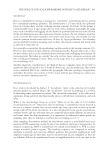
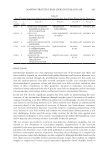
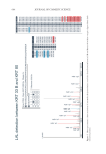
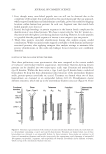
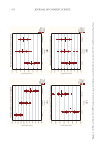
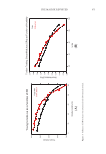
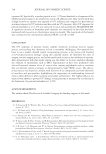
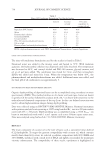
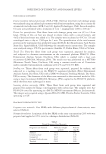
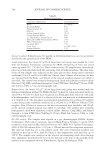
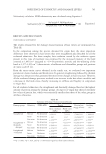
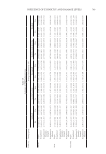
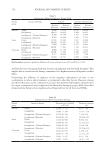
750 JOURNAL OF COSMETIC SCIENCE and bleached or to the group with hair that was straightened and thermally damaged. This implies that a certain level of damage contributed to a higher retention of fragrance on hair fibers. Considering the influence of ethnicity on the fragrance substantivity on hair, it was cumbersome to infer a global tendency as compared to the other factors. However, among the three ethnicities, on dry conditions, Caucasian hair presented the highest substantivities for virgin, straightened, and straightened and thermally damaged groups, while Asian hair showed similar behavior for straightened and bleached hair for all the tested FRMs. Table VI Substantivity of Sulfurol Versus Hair Swelling Ethinic group Group of damage Substantivity of sulfurol at T0 (%) Diameter variation (%) African Virgin 12.728 ± 1.711 9.07 ± 1.30 Straightened 23.081 ± 2.285 12.55 ± 2.20 Straightened + Thermal Damaged 12.374 ± 2.210 7.33 ± 1.76 Straightened + Bleached 10.609 ± 1.276 19.98 ± 3.62 Asian Virgin 17.010 ± 0.981 8.85 ± 1.01 Straightened 22.494 ± 5.361 12.32 ± 2.53 Straightened + Thermal Damaged 13.864 ± 2.296 5.02 ± 1.98 Straightened + Bleached 13.580 ± 0.390 23.09 ± 6.30 Caucasian Virgin 16.562 ± 0.979 9.18 ± 1.26 Straightened 19.818 ± 3.718 12.35 ± 1.97 Straightened + Thermal Damaged 13.284 ± 4.307 6.01 ± 1.38 Straightened + Bleached 12.801 ± 0.991 18.30 ± 2.42 Table V Substantivity Differences Between T0 and T24 h Ethinic group Group of damage Sulfurol Gamma undecalactone Absolute difference Relative difference (%) Absolute difference Relative difference (%) African Virgin 9.358 73.516 0.727 24.500 Straightened 18.674 80.905 3.209 50.024 Straightened + Thermal Damaged 8.228 66.498 1.554 35.569 Straightened + Bleached 9.622 90.694 1.323 27.163 Asian Virgin 11.565 67.992 1.813 39.298 Straightened 13.160 58.507 1.359 23.075 Straightened + Thermal Damaged 7.182 51.802 0.515 12.642 Straightened + Bleached 10.591 77.991 1.790 30.071 Caucasian Virgin 8.508 51.368 0.219 6.281 Straightened 10.781 54.396 3.196 50.455 Straightened + Thermal Damaged 6.377 48.004 0.331 7.348 Straightened + Bleached 11.616 90.742 0.988 21.468 Bold numbers represent significant differences between substantivities in T0 and T24 (p 0.05).

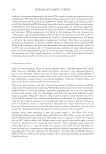
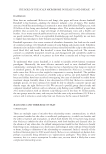
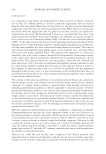
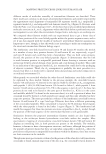
751 INFLUENCE OF ETHNICITY AND DAMAGE LEVELS CONCLUSIONS All the evaluated factors showed some degree of influence on the FRMs substantivity on hair. The polarity of FRMs can affect their distribution in surfactant systems, which are generally used in cosmetics for hair care, such as shampoo formulations, influencing their availability and interaction with the hair fibers. The level of hair damage was also an important factor influencing FRMs substantivity on hair, with high damage levels resulting in smaller sulfurol substantivities on hair fibers, and intermediate levels of damage resulting in the highest substantivities observed for all FRMs apart from ethnicity. The influence of hair ethnicity on FRM substantivity was more relevant for dry hair than wet hair, with Caucasian or Asian hair presenting the highest substantivities in this condition depending on the damage group. ACKNOWLEDGMENTS The authors would like to thank Symrise’s support for this project. AJM is thankful for the support provided by grants from the Brazilian Agency São Paulo Research Foundation (FAPESP, Brazil, process 2018/07978-0). REFERENCES (1) A. McDougall, The future of haircare, styling & colour: 2020. Global annual review: what’s now and what’s next for the haircare market. Mintel (2020), accessed July 13, 2021, https://clients.mintel.com/ report/the-future-of-haircare-styling-colour-2020. (2) Mintel, Hábitos do consumidor de produtos de Beleza – Brasil – Fevereiro 2021. Atributos mais importantes em produtos de beleza e cuidados pessoais. Mintel (2021), accessed September 15, 2021, https://reports.mintel.com/display/1041707/?fromSearch=%3Ffreetext%3Dhabitos%2520do%2520consu midor%2520brasil&resultPosition=6. (3) R. Di Gesu, A year of innovation in haircare, 2020 (2020), accessed July 23, 2021, https://clients.mintel. com/report/a-year-of-innovation-in-haircare-2020. (4) K. Takada, A. Nakamura, N. Matsuo, A. Inoue, K. Someya, and H. Shimogaki, Influence of oxidative and/or reductive treatment on human hair (I): Analysis of hair-damage after oxidative and/or reductive treatment. J. Oleo. Sci., 52(10), 541–548 (2003). (5) A. C. Nogueira, A. K. Nakano, and I. Joekes, Impairment of hair mechanical properties by sun exposure and bleaching treatments. J. Cosmet. Sci., 55(6), 533–537 (2004). (6) R. D. Sinclair. Healthy hair: What is it? J. Invest Dermatol, 12(2), 2–5 (2007). (7) C. R. Robbins, Chemical and Physical Behavior of Human Hair. 5th Ed. Springer, New York, 2012. (8) A. Medice, C. Lourenço, R. Gasparin, A. Nakano, and A. J. Marsaioli. Fragrance retention in virgin and bleached caucasian hair. J. Cosmet. Sci., 69(5), 363–370 (2018). (9) J. Strassburger and M. M. Breuer, Quantitative Fourier transform infrared spectroscopy of oxidized hair. J. Soc. Cosmet. Chem., 36(1), 61–74 (1985). (10) M. Joy and D. M. Lewis, The use of Fourier transform infra-red spectroscopy in the study of the surface chemistry of hair fibres. Int. J. Cosmet. Sci., 13(5), 249–261 (1991). (11) K. S. Kim and H. K. Park, Analysis of aging effects on chemical property of human hair by Fourier transform infrared spectroscopy. Skin Res. Technol., 19(1), e325–331. (2013). (12) A. J. Grosvenor, S. Deb-Choudhury, P. G. Middlewood, A. Thomas, E. Lee, J. A. Vernon, J. L. Woods, C. Taylor, F. I. Bell, and S. Clerens, The physical and chemical disruption of human hair after
Purchased for the exclusive use of nofirst nolast (unknown)
From: SCC Media Library & Resource Center (library.scconline.org)