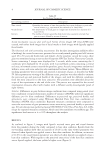
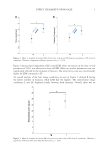
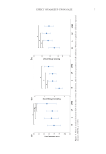
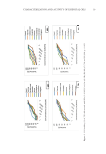
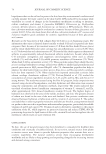
Figure 8. Repeated measures correlations between gaze parameters and (A) attractivity, (B) perceived health, or (C) perceived age. 9 EFFECT OF MAKEUP UPON GAZE

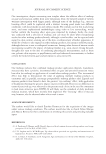
10 JOURNAL OF COSMETIC SCIENCE makeup products (LF +LFM), which resulted in a concomitant increase in the perception of attraction. Lipstick and mascara products were found to have the greatest impact on eye-tracking movements. This is most likely due to increased color contrast between key facial features (lip and eye area) that is delivered by the application of makeup (1). Eye and lip areas have both been noted as among the most observed zones and targets for a “first fixation” by observers versus other areas of the face (8,9), which could explain the “catchy” effects of mascara and lipstick application on gaze. Moreover, some preliminary work using an eye tracker confirmed that the eyes received the most attention, though makeup can redistribute the attention toward the lower part of the face (10). The “boosting” effect of mascara was replicated and confirmed with a different panel of viewers, irrespective of whether volunteers were wearing facial masks or not. Nonetheless, no amplification of the mascara effect was observed when facial masks were worn, as hypothesized, since more viewing time would be available to focus on the eye area and thus notice worn mascara. It could be speculated that the presence of a facial mask may have been a distraction by itself and did not necessarily free up viewing time for the upper part of the face. Our results also indicate that the application of makeup had a positive impact on perceived health. The key contributing product was the foundation, as it functions to homogenize skin tone. This is in line with findings by Nash et al., which show that women were judged to be healthier while wearing makeup versus without (4). Previous studies conducted on Caucasian and Chinese women highlighted that uneven pigmentation was crucial to signal healthy skin (11,12). In addition, Samson et al. demonstrated that the smoothening of uneven skin color distribution had a positive effect on female health perception (13). In addition, the potential benefits of foundation application can also be linked to the covering of imperfections. The images used in the present study featured a wide age range of female volunteers (aged 19 to 60). We can assume that some of these women displayed Figure 9. Mean ± standard deviation (SD) of time viewed of LF versus LFM conditions, without a mask (left) or with a facial mask on (right). *Denotes a significant difference (paired t-test, p 0.05).
Purchased for the exclusive use of nofirst nolast (unknown)
From: SCC Media Library & Resource Center (library.scconline.org)