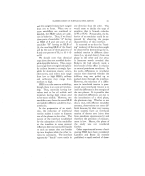
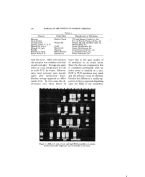
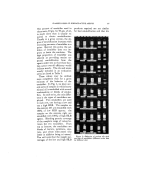
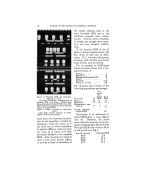
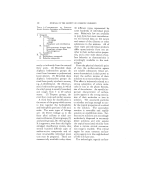
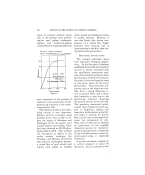
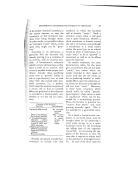
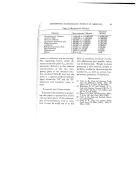
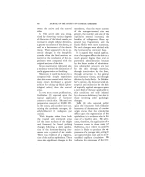
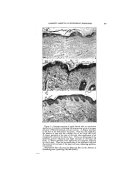
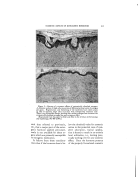
COSMETIC ASPECTS OF ESTROGENIC HORMONES 413 Figure 3.--Absence of cutaneous effects of systemically absorbed estrogen. ,4, Anterior surface of thigh after inunction of 484 international units of estrogen per gram. Regeneration and thickening of the epidermis have taken place B, skin of opposite thigh after inunction with estrogen-free ointment only. There is no perceptible change, showing that neither estrogen-free ointment nor systemically absorbed estrogen has any cutaneous effect. (Reproduced from the paper by' Eller and Eller in the ,4rchi•es of Dermatology and $yphilology, 59, 449 (1949).) with that referred to previously, v/z., that a major part of the estro- genic hormone applied percutane- ously is not available for those or- gans which are primarily susceptible to estrogenic medication. It follows from these considera- tions that if the hormone dose is be- low the threshold value for systemic action in the potential case of com- plete absorption, topical applica- tion is bound to result in an entirely local utilization, i.e., leaving prac7 tically nothing over for any systemic effect. Since the hormone potency of the properly formulated cosmetic

414 JOURNAL OF THE SOCIETY OF COSMETIC CHEMISTS hormone cream is of an order of magnitude answering the above de- scription, only a local and no sys- temic action might be expected. There is direct evidence in sup- port of the latter contention. Ei- delsberg (17) carried out a series of experiments on a cosmetic hormone cream (of 7500 I.U. per ounce of natural estrogenic substance) with the specific purpose of ascertaining the existence of any variations in the estrogen content of the urine, and in the appearance of vaginal smears following the use of such a cream. He employed fourteen subjects who ranged in age from 18 to 56 years. The hormone cream, as well as a hormone-free control cream were applied nightly for three to four months. At the end of the ex- periment, no difference was found between the two groups with re- spect to the over-all pattern of uri- nary estrogen and of the vaginal smears. From this Eidelsberg con- cluded that in the amounts used and by the method applied, the estro- genic hormones did not produce any systemic effect. Eller and Eller (5) whose work has been referred to previously, also report insignificant variations in the appearance of the vaginal smears of their subjects from this they draw the conclusion that under the condi- tions of their procedure the absorbed estrogen affects the cutaneous epi- thelium directly, rather than via the s. ystemic' route. The postulate as to a direct, local action is borne out also' by an ad hoc experiment in which the hormone cream was ap- plied to one thigh, and the hormone- free excipient to the other regener- ation and thickening of the epider- mis took place only in the former in- stance (Fig. 3). Davis (18), too, is convinced that a cosmetic hormone cream contain- ing around 7500 to 10,000 I.U. per ounce of estrone is unlikely to exert systemic action in view of the fact that the amount of estrogen ab- sorbed by the skin is far below the level required to produce such an effect. Of course, where the estrogen po- tency employed is substantially higher (as, e.g., in the several in- stances mentioned in the chapter headed "Supplementary Illustrative Data") the probability of combined topical and systemic effects must be considered. In such cases, how- ever, the pertinent formulations are no longer of a cosmetic character instead, they assume therapeutic functions in connection with the treatment of the particular patho- logical conditions involved. Parenthetically, it might be added at this point that while the topical application of estrogens produces spectacular results in a number of instances, there exists a valid physio- logical and embryological reason for this phenomenon since the several varieties of tissue susceptible to the action of estrogens have the same embryonic derivation. Thus, while the vaginal mucosa or the endome- trium is affected causally by estro- gens it must be kept in mind that the skin represents but another de- velopmental form of the same basic
Purchased for the exclusive use of nofirst nolast (unknown)
From: SCC Media Library & Resource Center (library.scconline.org)