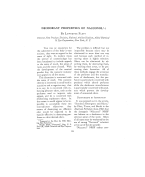
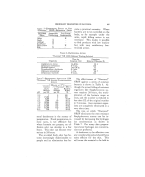
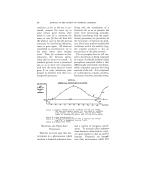
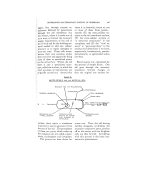
SURFACE-ACTIVE AGENTS may not be low enough for long- term stability of the emulsion. By using a combination of the two types of agent, it is possible to achieve quick effective emulsification and yet high stability. The low molecular-weight agent acts quickly to lower the interfacial tension moderately, and thus helps to dis- perse and temporarily stabilize the emulsion. On aging, the preferen- tially sotbed high molecular weight agent largely displaces the other from the interface, thus yielding a very low final tension. EvruLsIoN It is important to distinguish be- tween breaking and creaming of an emulsion.' Thus in an O/W emul- sion, the oil droplets may actually coalesce and float to the top as a free oil layer. This is breaking. However, the oil droplets will float toward the top even if they do not coalesce. After a time, a clear aqueous layer may be seen at the bottom and a concentrated emul- sion cream at the top. This is creaming. Since the emulsion has not broken, it can be redispersed uniformly by very slight agitation. As has been noted, creaming can promote breaking by forcing the droplets into contact with each other. However, if an effective emulsifier is used, the cream may re- main unbroken for a long time. If a sufficiently aged emulsion cream is drawn off and allowed to stand, it will show little or no tendency to further creaming. The emulsified IN COSMETIC INDUSTRY 343 droplets are already packed as closely as possible, approximating the theoretical calculated packing. Advantage has been taken of this effect to produce unusually stable emulsions by emulsifying 76 per cent of the inner phase with 24 per cent of the outer phase. The point is that close-packed uniform spheres occupy 76 per cent of their contain- ing volume. Of course the 76:24 ratio is not exactly correct, since the droplets are of different sizes and since they can be deformed from their spherical shape under the forces of buoyancy. Nevertheless, emulsions made in this way often show very little or no creaming. An emulsion in which the inner phase is more than about 76 per cent of the total volume is apt to be very stiff, since the droplets are distorted from their spherical shape and can inter- lock instead of rolling past each other. COMBINATIONS OF FoRcEs It is essential for best results that the physico-chemical and the me- chanical factors in emulsification be combined properly. For instance the use of homogenizers or other powerful mechanical disintegrators to form emulsions may actually be harmful if the emulsifying agent is inefficient or insufficient. Many droplets which are uncoated or in- completely coated with emulsifier are formed, and these coalesce rapidly. Less effective agitation would have formed a rather coarse but tolerably stable emulsion. This happens.

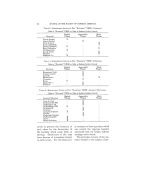
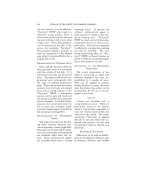
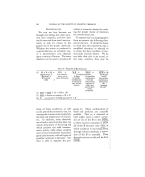
344 JOURNAL OF THE SOCIETY OF COSMETIC CHEMISTS On the other hand, if the emulsi- fier is a very effective stabilizer 'but does not rapidly yield a low inter- facial tension for a freshly formed interface, then the use of the homo- genizer or colloid mill may be highly desirable. Otherwise the droplets will not be as fine as they should be, and the emulsion will appear coarse and will tend to cream, if not to separate. In some cases the work can be done physico-chemically in- stead of mechanically. Combining oils plus free fatty acid with water plus alkali, as discussed, is an ex- ample. USE OF ANTAGONISTIC EMULSIFIERS It is frequently taught that emul~ sifters which form O/W emulsions, for instance soaps and the water- soluble anionic and non-ionic agents, are-antagonistic to those which form W/O emulsions, for instance lanolin, cetyl alcohol, and many oil- soluble surface-active agents. The logical .conclusion would be that it was always wrong to use such op- posed emulsifiers together. That this is not necessarily true is at- tested by. many useful formulas. Although an emulsifier sometimes breaks an emulsion stabilized by an antagonistic emulsifier, it is often found that a limited amount of a correctly chosen antagonistic emul- sifier aids in stabilizing an e•mulsion. This may be due to the formation of a dual interfacial film,' with one emulsifier-film more deeply in the water phase and the other more deeply in the oil phase. This would make the transition at the interface more gradual and would also in- crease the thickness of the emulsify- ing layer. It is therefore not uncommon for limited proportions of lanolin or fatty alcohols such as cetyl or stearyl to be used along with soap or sodium lauryl sulfate in stabilizing O/W emulsions. A combination of an oil-soluble and a water-soluble non-ionic agent is sometimes a bet- ter emulsifier than either one alone. One of the largest manufacturers of non-ionic agents recommends use of such combinations in formulas for skin creams, sun-tan lotions, hair dressings, and other cosmetic prep- arations. DIsPEl•SIOr/ OF So•.II•S The dispersion of solids will not be discussed in detail. Solid par- ticles, unlike liquid droplets, cannot ordinarily coalesce completely. They can and do group together, under certain conditions, to form loosely attached flocs. It is much easier to break a floc into its con- stituent particles than to break up the particles themselves. How- ever, to do either is useless if the particles will coalesce into riocs again the moment agitation has ceased. Dispersing agents owe their effectiveness to sorption at the in- terface between solid particles and liquid, thus preventing the par- ticles from flocculating. Here again it is necessary to integrate the me- chanical and the physico-chemical factors or the product will be less satisfactory than desired, and money
Purchased for the exclusive use of nofirst nolast (unknown)
From: SCC Media Library & Resource Center (library.scconline.org)