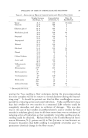
A'STUDY OF THE SWELLING OF HAIR IN THIOGLYCOLATE SOLUTIONS AND ITS RESWELLING* BY D. H. POWERS and G. BARNETT [d/arner-Hudnut Co., Inc., New York, N.Y. IN TaEIR P^PER on the swelling of hair published this year (1) Valko and Barnett studied the effect of nearly one hundred compounds in con- centrated and dilute aqueous solutions on the rate and degree of swelling of human hair. After a review of various methods available for studying swelling they chose the centrifuge method as the leas• tedious and the best suited to give well-defined and reproducible values. Using this technique, a single operator could turn out more than fifty measurements a day. The value obtained for water showing 31 q- 1 per cent swelling was surprisingly close to the value of Chamberlain and Speakman (2) who found a swelling value for hair of 31.18 per cent when working at 100 per cent humidity. Some of the compounds studied are listed in Table 1. While swelling usually came to equilibrium quickly in dilute aqueous solution, when con- centrated solutions were used it frequently took two weeks to four months to reach equilibrium. It was possible to show that swelling alone did not damage the hair althongh care had to be taken to avoid bacterial attack or hydrolyric action. When this type of fiber destruction was avoided the swelling was completely reversible even when the hair was swollen for six months. It was further shown that swelling that would cause a fiber to hold more than 100 per cent of its weight• of solution after centrifuging rarely occurred unless reduction or hydrolysis had occurred. When either hydrolysis, reduction, or oxidation of the hair occurred during swelling, the process was no longer reversible. This swelling proved to be sur- prisingly independent of pH change and was constant from a pH of 4.0 to a pH of 10.0. An excellent study of swelling of single human hair fibers was made by Milton Eckstrom, Jr. (3). He mounted single hairs in a clear Lucite cell under a microscope and measured the rate of increase of diameter when im- mersed in thioglycolate waving lotion and then its rate of deswelling when neutralized in potassium bromate solution. He suggested that in cold * Presented at the December 11, 1952, Meeting, New York City. 92

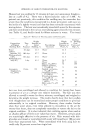
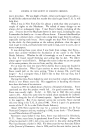
SWELLING OF HAIR IN THIOGLYCOLATE SOLUTIONS 93 TABLE 1--SWELLING OF HAIR IN CONCENTRATED AND DILUTE SOLUTIONS Weight Increase Concentration Days for Compound (Swelling), % of Solvent, % Equilibrium -- Water 31.5 100 15 (min.) Glycerin 12.0 100 3 35.0 75 3 Ethylene glycol 46.0 100 3 33.0 50 1 Diethylene glycol 30.0 100 60 34.0 50 1 Propanol 18.0 100 14 3O .0 5O 1 lsoprop anol 14.0 100 7 24.0 5O 1 Ethanol 18 0 100 3 25 0 5O 3 Methanol 16.0 100 14 22 0 50 14 Phenol 70.0 90 3 52.0 6 3 Chloral hydrate 95 0 75 14 42.0 10 1 Acetic acid 55 0 100 3 48.0 5O 3 Trifluoroacetic 220.0 100 3 acid 50.0 25 3 Ethanolamine 270* 100 7 35 5 3 1)iethanolamine 12' 100 3 38 5 3 Triethanolaminc 12* 100 3 45 25 7 Ethyl amine 160' 72 7 320 25 3 Lithium bromide 100 90 60 38 25 l * Decomposition noted. waving the "less swelling a fiber undergoes during the processing period, the more complete will be its return to normal diameter during the neutral- izing step." It should be pointed out that his fiber swelling[was accom- panied by a reducing action and some hydrolysis. Valko and Barnett show that hair swollen for two months in a saturated LiBr solution could be completely deswollen and show no evidence of damage. This was also true in the case of hair swollen in perfiuorobutyric acid or swollen for four months in ethylene glycol, since in all these cases there was no evidence of reducing action of hydrolysis so that completely reversible swelling and de- swelling could be obtained. Richard Steele at the Textile Research Insti- tute at Princeton, N.J., points out (4) in T•IE JotrP,$.•n OF THE SOCIETY OF COSVtETIC C•IEMISTS that LiBr swelling is completely reversible and "no permanent chemical change in the fiber occurs."
Purchased for the exclusive use of nofirst nolast (unknown)
From: SCC Media Library & Resource Center (library.scconline.org)