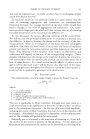
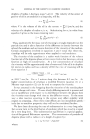
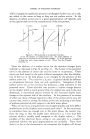
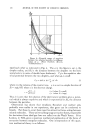
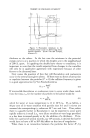
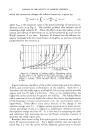
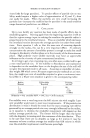
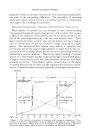
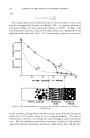
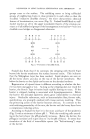
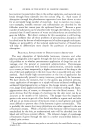
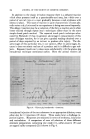
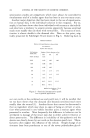
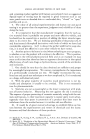
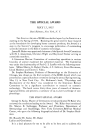
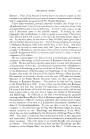
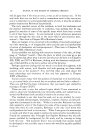
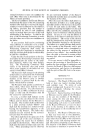
THEORY OF EMULSION STABILITY 171 If one were to have an instantaneous picture of the nuclei and the elec- trons in a nonpolar molecule, say carbon tetrachloride, one would observe a spacial distribution of the electrons and the positive nuclei such that the center of gravity of the positive and negative charges were separate. Thus, in this instantaneous picture the molecule is not nonpolar but has a dipole-- a positive and a negative end. Since electrons move very rapidly this picture changes rapidly and with it the magnitude and orientation of the dipole. In the case of a nonpolar molecule the superposition of the series of pictures for any appreciable time gives a zero dipole. However, to a neighbor molecule, which is quite as shifty an entity itself, this instantane- ous nonzero dipole is observable. The momentary dipole in the first mole- cule induces in the second a dipole in the opposite direction which is thus attracted to the first dipole. In this way a force of attraction is engendered in the entire system. The magnitude of the force between the molecules depends on the polarizability, or ease with which a dipole is induced, of the molecules and some natural frequencies of the molecules. Upon the latter depends the ability of an individual pair to "jitter" together and thus main- tain this temporary bond for a long time. When two droplets are in collision or close together, that is when the distance between them is small compared to their radii the potential energy of the London-van der Waals attraction is given approximately by 1 r •'• = - i5 • •o (8) in which .4 is a constant taking into account the polarizability and jitter factors. It is to be noted that the attraction potential is, under these circumstances, inversely proportional to the first power of the distance between the droplets. It is only when dealing with very large droplets, when compared with molecules, that the dependence on distance is of so low an order. This comes about because of cooperation among the induced dipoles near the quite fiat, compared to molecular radii of curva- ture, collision regions of the droplets. The total potential energy of the interaction is given by the sum •' = •,,• + •,• (9) This summation is shown diagrammatically in Fig. 5 for one set of values of the various parameters. A small set of summation curves for different values of the surface potential •0 for a 1 micron radius particle and assum- ing reasonable values for the other parameters is given in Fig. 6. Inspection of Fig. 6 shows that in the system involved one can have two types of interactions. Where •b0 is below a certain value, 23 millivolts in this case, the barrier in the potential rs. i•aterparticle distance curve always lies below kT. There is then enough thermal energy present to allow drop- lets to come right together at a rapid rate. This is exemplified by the two

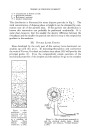
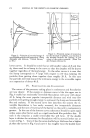
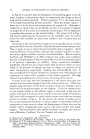
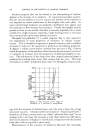
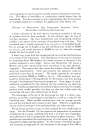
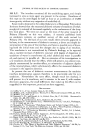
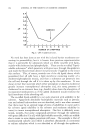
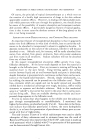
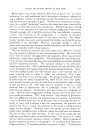
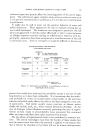
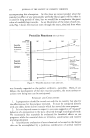
172 JOURNAL OF THE SOCIETY OF COSMETIC CHEMISTS •ooj ß __ o .... -50 Figure 5.--Variation of potential energy of two colloidal particles with separation. (From Alexander and Johnson, "Colloid Science," p. 116.) Figure &--Potential energy of interaction for two identical oil globules, as a function of the distance between the surfaces, at low values of the surface potential. (From Van den Tempel, reference 3.) lower curves. It should be noted that at still smaller values of Z and thus •b0, there need be no hump in the curve so that the droplets will be drawn together regardless of thermal energy. In the other curves it is seen that the hump corresponds to //large with respect to kT thus keeping the particles from getting closer together than roughly 20 •. In this case the particles will tend toward the minimum energy in the accessible region at a separation of about 40 fk. IV. FLOCCULATION AND COALESCENCE The nature of the processes taking place in coalescence and fiocculation are now clearer. If the energy rs. distance curve is like the upper one in Fig. 6 stable but moderately reversible fiocculation will occur with about 45 A. being the most popular interparticle distance and with very few particles ever getting enough energy to surmount the hump and irreversibly fioc and coalesce. If the second curve best describes the system the re- versible fiocculation is less easily reversed, the interparticle distances smaller, and the rate of traversal of the barrier on the path to coalescence is greater. In the case of the bottom curve coalescence should be quite rapid unless some other factor such as a rigid interfacial film prohibits this. If such is the situation a stable irreversible fioc will form. If the double layer is thicker the minimum for fiocculation will be moved further out as is seen in Fig. 7. Curve 2 has the same double layer thickness but a higher •0 than the curves in Fig. 6 and curve 1 has roughly twice the double layer
Purchased for the exclusive use of nofirst nolast (unknown)
From: SCC Media Library & Resource Center (library.scconline.org)