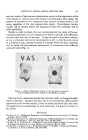
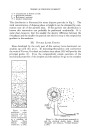
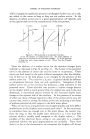
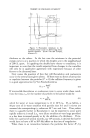
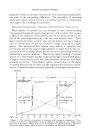
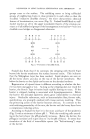
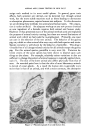
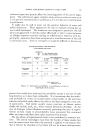
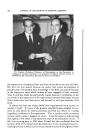
EFFECTS OF TOPICAL AGENTS UPON THE SKIN 163 rate and extent of percutaneous penetration varies in skin specimens which were excised at various times (few hours to several days) after death, the pattern of absorption of a substance from various ointment bases is the same, regardless of the time elapsed after death. Nevertheless, further studies will be needed, before the adequacy of this new technique will be fully established. Similar to older methods, this new method permits the study of the per- cutaneous penetration of any substance for which a suitable and sufficiently sensitive spot test may be devised. It may be used to determine whether or not a substance penetrates the epidermis at all to find the derivatives of a substance (e.g., among the salts of a metal) which are best absorbed and to study the percutaneous penetration of substances from different ointment bases (Fig. 1). VA S. LAN. , i! ' ......... '%.... • .. --' •.:.•..: ....... . ..... •..... Figure 1.--Ferric chloride spot testing of the percutaneous penetra- tion of salicylic acid from vaseline (1.) and lanolin (r.) bases. The new in vitro techniques permit the objective study of changes brought about in the skin. Because the skin, due to its accessibility, offers unique opportunities for in vitro studies, it may be safely predicted that the scope and application in dermatology of such techniques will greatly increase in the future. REFERENCES Van Scott, E. J., "Mechanical Separation of the Epidermis from the Corium," 5•. Investig. DermatoL, 18, 377 (1952). Flesch, P., and Sarahove, A., "Method for Separation of Human Epidermis into Cellular and Keratinous Components," Proc. Soc. Exp. BioL Med., 85, 483 (1954). Van Scott, E. J., and Flesch, P., "Sulfhydryl Groups and Disulfide Linkages in Normal and Pathological Keratinization,"/Irch. DermatoL and SyphiloL, 70, 141 (1954). Van Scott, E. J., and Lyon, J. B., "A Chemical Measure of the Effect of Soaps and Detergents on the Skin," )e. Investig. DermatoL, 21, 199 (1953).

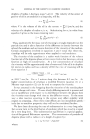
THEORY OF EMULSION STABILITY* By HAROLD L. GREENWALD Rohm & Haas Company, Philadelphia 5, Pa. As EMULSION IS ^ system consisting of one liquid phase dispersed as droplets in another liquid phase. Two types of emulsions are possible with a given pair of incompletely miscible liquids--A dispersed in B and B dispersed in A. Water as one phase and some organic compound, referred to as an oil, as the other phases are by far the most common constituents of emulsions. The present discussion will be confined, principally, to oil-in- water emulsions. I. INTRODUCTION Since most of you are more familiar with the preparation of emulsions than I am only a few comments will be made on this aspect of emulsions. The energy input in the formation of an emulsion is the energy required to form the new interface and is given by: E = ?•zt (l) where q'i is the interfacial tension and At is the area of interface formed. If the spherical droplets formed are all of equal radius, r, and if the dis- continuous phase volume is F this becomes: E - (2) Thus the energy required to form a liter of emulsion containing 10 per cent of the discontinuous phase in droplets 0.1 micron in diameter where the interfacial tension is 1 dyne per centimeter (or erg per square centimeter) is 3 X 10 7 ergs or 0.7 calorie. This value is quite low compared with the energy necessary to heat the emulsion one degree. Our usual concern is with the stability of emulsions. In some applica- tions we wish to have maximum stability and in others, where emulsions are undesirable, minimum stability. A stable emulsion is one which exhibits (1) no sedimentation or creaming of the discontinuous phase, (2) no aggregation or flocculation of the droplets and (3) no coalescence of droplets. Borrowing a term from those studying the structure of liquids * Presented at the September 23, 1954, Seminar, New York City. 164
Purchased for the exclusive use of nofirst nolast (unknown)
From: SCC Media Library & Resource Center (library.scconline.org)