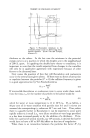
THEORY OF EMULSION STABILITY 165 this may be rephrased as: A stable emulsion has an unchanging droplet radial distribution function. In emulsions which are not perfectly stable it is quite evident that the rates of creaming, aggregation and coalescence are interdependent. Creaming decreases the average interparticle distance which should then lead to changes in the rates of aggregation and coalescence. Or, coales- cence produces larger particles which will then increase the rate of creaming provided the densities of the two phases are different, etc. In this discussion the factors affecting creaming will be covered first. We will see that the principal determinants in creaming are particle size, the difference in density between the phases and the viscosity of the con- tinuous phase. Then an investigation of the forces between oil droplets will show that there are both forces of attraction and forces of repulsion present and that the interaction between particles depends on the sum of these. The behavior of the emulsion with respect to fiocculation and coalescence will depend on the sum of the corresponding energies. These energies will depend on the charge on the emulsion droplets, the concentra- tion and valence of the ions present, the particle size and what seems like a host of other factors. In a final section specific effects of surface active agents will be discussed and it will be found, alas, that most of the equa- tions and graphs used throughout the discussion cannot be trusted quantita- tively but are in qualitative agreement with observations. II. SEmMENT^T•O•r The sedimentation rate of a single droplet is given by Stokes' Law as: 2gr=(d- d') (3) where: u = rate of fall of droplet g = gravitation constant d = density of oil d' = medium (roughly the emulsion) density . = viscosity of medium (roughly that of the emulsion) r = droplet radius This law is applicable to dilute emulsions although even here there is a small uncertainty in the significance of the term "droplet radius" as will be seen in the subsequent discussion. In the case of concentrated emulsions, including the cream of dilute emulsions, the exact form of the equation will be changed. Nonetheless the qualitative dependence of the sedimentation rate on the variables will probably be maintained. Ordinarily one is interested in the mass rate of creaming or, if you will, the motion of the center of gravity of the oil phase. In the absence of fiocculation and coalescence the system can be described as consisting of n•

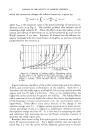
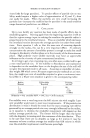
166 JOURNAL OF THE SOCIETY OF COSMETIC CHEMISTS droplets of radius ri having a mass 4/3•-ri3d. The velocity of the center of gravity of oil in an emulsion in a long tube, will be: where F is the volume of the oil in the system = Y•,(4/8)rr•an• and the velocity of a droplet of radius r• is u•. Substituting for u• its value from equation 3 gives as the mass creaming rate: i Thus, qualitatively the mass rate of creaming is strongly dependent on the particle size and is also a function of the difference in density between the oil and the medium and an inverse function of the viscosity of the medium. Certain assumptions involved in equations 3 and 5 mean that these rela- tionships will be only approximate when applied to real emulsions. The viscosity of the emulsion is a rather weak function of the volume fraction (4•) of the disperse phase at low concentration but becomes a strong function at high oil concentration. At a low concentration of oil phase the viscosity will be approximately that of water and if the oil is in droplets 0.1 micron in radius and has a density of 0.8 the rate of creaming will be from equation 3 2-980(10--*)•(0.8 -- 1.0) --5-10 -7 cm./sec. u = 9'0.009 = or 2'10 -8 cm./hr. b'or a 1 micron drop this becomes 0.2 cm.jhr. At higher concentrations of oil phase a modified Einstein equation (1) or a Mooney type equation (2) can be used to compute the viscosity. It was assumed in the foregoing that the viscosity of the outside phase did not change with time. If some slowly diffusing material is present and not at equilibrium with respect to its distribution between the phases then the viscosity may change with time as the diffusion occurs. In the same way a slow reaction occurring in the system may affect stability with respect to creaming. Since these time effects•tvemot instabilities pecu!-• iarly due to emulsion properties they will not be considered further. We have been discussing the rate of sedimentation in a very long tube. Let us now turn to the distribution of emulsion which has stood in a vessel for a very long time. This sedimentation equilibrium is a special applica- tion of the general Boltzmann equation. The concentration of particles of disperse phase with a radius r•-at a height h is given by: ,•, = v, oe-4•rr?(d- d')gh/3kT (6) where
Purchased for the exclusive use of nofirst nolast (unknown)
From: SCC Media Library & Resource Center (library.scconline.org)