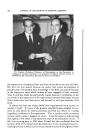
THE SPECIAL AWARD 217 Socx•.T¾. First of all, because I realize that to be asked to speak on this occasion is in itself an honor and second, because I am permitted to address and to congratulate my good friend, Dr. Stephen Rothman. I have often wondered, perhaps somewhat wistfully (but I hope not at all jealously) how it was that he was always so far in advance of me in his accomplishments and in his contributions. It wasn't until a day or so ago that I discovered some of the possible reasons. In looking up some biographic data on Rothman, in order to speak to you today, I found two facts which I think will account in the main for his being always ahead of me. In the first place, he was born on Sept. 10 1894, which gives him a full six months' head-start over me. And in the second place, he was born in Budapest, Hungary, while I was merely born in New York. And while it may not be true as some have said, that "just to be a Hungarian is enough," in Rothman's case the place of his nativity and the cultural and scientific background which he received could not fail to help in the de- velopment of his talents. He was a physiologist even before he was a dermatologist, having been Assistant in Physiology at the University of Budapest from the year 1918 to 1920. He also had the invaluable opportunity to study with the masters of biochemistry of the time, including such renowned men as Hoffmeister and Spiro of Strassburg, as well as von Furth of Vienna. In 1920 he came to the Department of Dermatology and Syphilology of the University of Giessen, then under the direction of the famous Professor Albert Jesionek. He remained on Jesionek's faculty until the year 1928 when he became Director of the Public Health Insurance Clinic for Skin and Venereal Diseases, in Budapest, Hungary. This position he held until his coming to the United States in 1938. It was in that year that I first met Rothman personally and that year marked the beginning of our great friendship. Of course I had known of his work f'or many years previously, and he had been a great name to me ever since I began my studies in Dermatology and Syphilology. In 1929 just at the time I was finishing my graduate training under Bruno Bloch, in Ziirich, Rothman together with Fritz Schaaf, the biochemist of Bloch's institute, published their fundamental chapter on the chemistry of the skin in J. Jadassohn's Encyclopedic Handbuch der Haut & Geschlechtskrankheiten. So you see that it was by no means a neophyte in this field that was writing when Rothman began his monu- mental textbook on the "Physiology and Biochemistry of the Skin," which has now been published by the University of Chicago Press in May, 1954. This book is indeed the most authoritative work in this important and timely field. I have heard no adverse criticisms of it, with possibly one minor exception. One critic wrote in an entirely friendly vein and about as follows: "This book should have been entitled 'Physiology and Bio- chemistry of the Human Skin,' not just of the Skin." I think that you

218 JOURNAL OF THE SOCIETY OF COSMETIC CHEMISTS will all agree that if this was an error, it was an all too human one. If the only fault that one can find in such a tremendous work is this very minor one of a somewhat too anthropomorphic point of view, it must be an almost perfect treatise that Rothman has produced. The truly essential nature of this textbook, to both the biochemist and the chemist interested primarily in cosmetics, may perhaps best be sug- gested by mention of some of the specific items which have been covered in all of their basic facets. Is one interested in how substances penetrate into and through the skin and in the entire field of percutaneous pene- tration ?--Then look at Chapter III in Rothman's book. Does one happen to be concerned with problems of too much sweating or too little sweating, or of disagreeable odors and the uses and mechanisms of action of deodorants and antiperspirants?--Then turn to Chapters VI, VII, and VIII of Rothman's book. Is your problem one dealing with excessive dryness of the skin, of chap- ping, of "dishpan" hands ?--Then the place to which you must go to get the fundamentals about what is known and what can be done is to Chapters XII, XIII, and XVI of Rothman, dealing with the chemistry and physiol- ogy of the lipid film at the skin's surface and of the keratins. Perhaps questions dealing with too much or too little skin pigment, with freckling, with suntan, with bleaches and with graying, are those which concern you at the moment ?--You will find what you need about the basic physiology and chemistry of skin and hair pigments in Chapter XXII of Rothman. Is your concern today with the question of excess hair or of too little hair, or, as is more likely, of too much hair in one place and too little in others ?- Then you will find the basic information that you need to get started by turning to Chapter XXVI. These are only a very few selected topics which I have mentioned in order to show how fundamental, how diversely useful, and indeed how es- sential this Rothman book actually is found to be at every turn. This textbook is one that must be used, not to say studied, by every serious minded dermatologist, biochemist, cosmetic chemist, and physiol- ogist who is interested in the skin. While it is true that Rothman has been ably assisted in a few of the chapters by some of the younger men, notably those who were his own students, Rothman is the only one I know who could produce this book in its entirety. When I was given the manuscript to study and when I was asked to express my opinion before its publication, I made the statement that I thought that Stephen Rothman was the only person qualified by background, by life work, and by training to bring forth this text. And moreover that it was not likely that anyone would be developed in the next fifty years or more who would be equally qualified to do so.
Purchased for the exclusive use of nofirst nolast (unknown)
From: SCC Media Library & Resource Center (library.scconline.org)