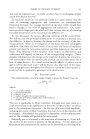
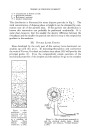
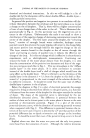
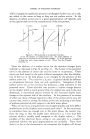
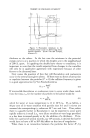
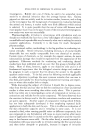
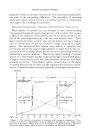
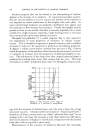
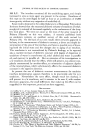
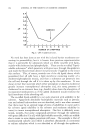
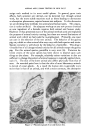
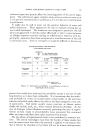
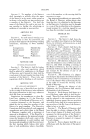
THEORY OF EMULSION STABILITY 169 will be changed the qualitative picture is unchanged if other ions, say a salt, are added to the water as long as they are not surface active. In the absence of surface active ions to a good approximation /x/,' depends only on the species and not on the concentration of the ions present. oil •,at• oil l•,at•r oit watef A • c Figure &--The potential at an oil-water interface. (a) In the absence of surface-active ions. (b) After addition of soap ions, in solution of very low ionic strength. (c) In the presence of soap ions and a large amount of salt. (From Van den Tempel, reference 3.) Upon the addition of a surface active ion the situation changes quite radically as indicated in Fig. 3b and Fig. 3c. The former is the potential curve in the absence of excess salt and the latter in its presence. These curves are both based on the quite artificial assumption that the distribu- tion of the ions in the bulk phases is not changed by the presence of the surface active ion. The scales for a, b, and c in general should be different so comparisons between them are only qualitative. Adsorption of the surface active ion at the interface has produced a deep minimum in the potential curve. These adsorbed ions produce a surface change density on the droplet which is much greater than the original one and, in the case illustrated, is neutralized almost entirely by the increased double layer charge on the aqueous side of the interface. In the presence of an excess of other ions those of charge opposite to that of the surface active ions, the counter ions, nestle in among the surface active ions producing a thin layer of uniform potential 4,0 with respect to the bulk water phase. What are the forces acting between two charged droplets and their diffuse double layers as the droplets move toward each other? In the usual cases in emulsions there are enough ions in the water phase, the counter ions from the soap, so that the double layer thickness, I/g, is less than 0.01 microns which is usuall'y small compared to the droplet radius, r. The problem of the electrical forces acting is not amenable to a complete analytical solution but good approximations are available. These show that in so far as the electrostatics are concerned the droplets will always

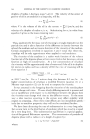
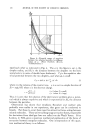
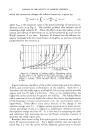
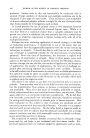
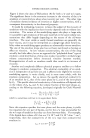
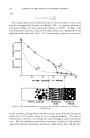
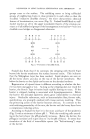
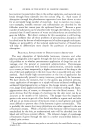
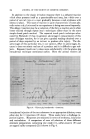
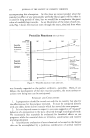
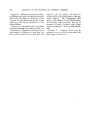
170 JOURNAL OF THE SOCIETY OF COSMETIC CHEMISTS 02 03 o Figure 4.--Potential energy of repulsion between two spherical particles for different values of a. (From Overbeek (Kruyt), "Colloid Science.") repel each other as indicated in Fig. 4. The a in this figure is our r, the droplet radius, and H0 is the distance between the droplets (so the hori- zontal axis is in units of double layer thickness). /zR is the repulsive elec- trical potential between the two droplets, and when •b0 is small r _•2e_KH ø (7) /7n = 4.62 X 10 -6 • where v is the valence of the counter ions. 3' is a not too simple function of Z(= Ve•o/kT) where e is the electron charge. eZ/2 -- 1 (= 0 when Z is small) 3' -- eZ/2 q- 1 (= 1 when Z is large) Thus it is seen that the solution of the electrostatic problem gives a poten- tial which is always repulsive and which is exponential in H0, the distance between the particles. Observation has shown that emulsions flocculate and coalesce and, probably even earlier in our experience, that gases can be condensed to liquids. For these to occur there must be attractive forces acting between neutral molecules. These universal long range attractive forces, responsible for deviations from ideal gas laws are called van der Waals' forces. Fritz London, in 1932, gave a quantum mechanical explanation of the forces of attraction between nonpolar molecules. One interpretation of this quan- tum mechanical theory is as follows:
Purchased for the exclusive use of nofirst nolast (unknown)
From: SCC Media Library & Resource Center (library.scconline.org)