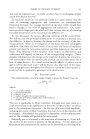
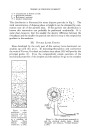
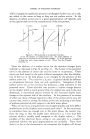
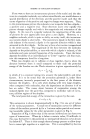
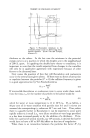
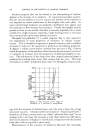
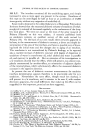
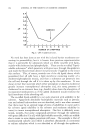
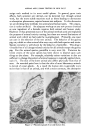
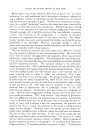
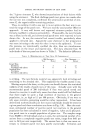
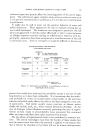
THEORY OF EMULSION STABILITY 173 •T I00 50 Figure 7.--Secondary minimum in the potential energy curve at fairly large inter- particle distance. (From Van den Tempel, reference 3.) thickness as the others. In the last case the minimum in the potential energy curve is at a position in which the droplets are in the neighborhood of 200 A. apart. In applying the double layer theory to emulsions, it is important to note that the results expected from changes in the variables will only be in qualitative agreement with experiment because of other factors to be discussed later. Next comes the question of how fast will flocculation and coalescence occur in the several cases given above. If there were no forces of attraction or repulsion between the particles (F = 0) the collision frequency is given to a good approximation by Von Smoluchowski as 8nokT Gv--o - 3r/ (10) If irreversible fiocculation or coalescence were to occur under these condi- tions the time, tl/2, for the number of particles to be halved would be tl/• - 4kT no which for water at room temperature is (2 X 10n)/n0. If, as before, a 10 per cent oil in water emulsion with particle sizes 0.1 and 1 micron are assumed the corresponding t•-2 values are 10 -8 sec. and 1 sec. Thus, unless there is a goodly barrier to fiocculation it can be expected to occur quite rapidly unless n0 is small (i.e., very dilute emulsion or very large particles) or rt has been increased greatly as by the addition of a thickener. If sta- bility for a period of several months, say 10 7 seconds, is desired the barrier would have to have a 10 7 to 10 •ø fold effect on the time of coagulation. When there is an interaction between the particles the factor //?, by

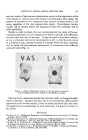
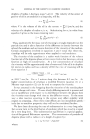
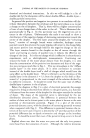
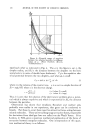
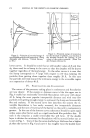
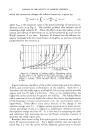
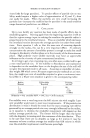
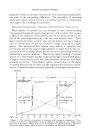
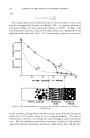
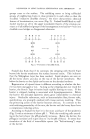
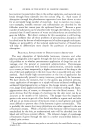
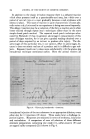
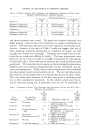
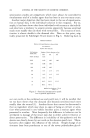
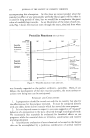
174 JOURNAL OF THE SOCIETY OF COSMETIC CHEMISTS which the interaction changes the collision frequency, is given by: Gr_-o __ 14 / = 2r eV,/k T dHo 1 eVm•/KT (12) Gv -- r Ho 2 • where//,•,, is the maximum value in the potential energy of interaction rs. distance curve as in Fig. 6. The stability problem then becomes one of obtaining a high value for/4/. Thus, the effects of particle radius, concen- tration and valence of electrolyte (as ,), surface potential •k0, and van der Waals' constant d are seen. Equation 10 showed that the collision fre- quency increased with the concentration of droplets, no, and was inversely proportional to the viscosity, v. o ooof oof 002 0.05 o.1 02 0.5 I 2 $ Io 20 50 1oo IOOO ---• co•tcenfrafJon Jn mmø•fer Figure 8.--Conditions of limiting stability (flocculation values) for two values of the London-van der Waals constant a/ and the valencies z = 1, z = 2, and z = 3. Left and top = stable, right and bottom = unstable. (From Overbeek (Kruyt), "Colloid Science," p. 304.) Figure 8 indicates the effects of the surface potential •0 and of the valence, Z here, and concentration of electrolytes on the stability. Each line is a boundary with the stable region, with high/gz, left and top, and the unstable region, with low//F, right and bottom. Thus, as was implied before, the higher the surface potential the greater the stability. The Schulze-Hardy rule is seen here in that the higher the valence the further the displacement of the boundary to lower concentrations (n.b. the concentration scale is logarithmic). These effects came about because of the change in the repulsive energy term//•e. A higher surface potential and a lower concen- tration and charge of ions (i.e., higher l/K, double layer thickness) increase the repulsive energy and thus//F. It is also seen by comparing the dash and solid lines that increasing the van der Waals' attraction constant A decreases the stable region area. Boundary lines drawn in Fig. 8 are quite typical of those for any stability factor//F and any particle size. For a higher stability than the value for which Fig. 8 is true the curves will be displaced upward and to the left
Purchased for the exclusive use of nofirst nolast (unknown)
From: SCC Media Library & Resource Center (library.scconline.org)