184 JOURNAL OF THE SOCIETY OF COSMETIC CHEMISTS essentially a teamwork proposition involving cosmetic chemists, pharma- cologists, and dermatologists. The most important aspect is a careful delineation of the objective which is being sought and a recognition of the limitations of whatever methods are being applied, whether to animals or to humans. Certainly most species have their place in the over-all program. We strongly recommend the use of animals for all of the preliminary screening and evaluation phases. This applies to irritation, sensitization and preliminary cosmetic aspects. To do otherwise poses an unnecessary hazard to the human test subject and severely limits the scope and volume of the screening which can be completed. In effect, our view is to know the advantages and limitations of each group of subjects and to use the animal wherever the use is practical, since if the cosmetic industry is to make the advances which the progress of chemistry has made available to it, both animal and human resources must be used to the ultimate maximum capacity. There is much work to be done with each species, and each has its place in the over-all program. TOWARD EMULSION CONTROL* By SYr)•E¾ Ross Rensselaer Polytechnic Institute, Troy, N.Y. ONLY WHEN THE control of any physical process is assured, when we are aware at all times of what is taking place, and can alter it at will, can we derive maximum utility from its application. In the field of emulsion technology we can report progress but we are still far from this ultimate goal. I propose to review briefly for you the methods that we can now summon to help us learn what is taking place during the formation and subsequent aging of emulsions. This is still only half the story, but we certainly cannot go on to effect alterations at will unless we first know the situation. A grand step forward in the control of emulsion formation was the recog- nition by Bancroft that the continuous medium will be the one in which the stabilizing agent is more soluble. This rule has recently been made quantitative by Griffin, with the introduction of the HLB system of choosing emulsifying agents (1). The very first question, that of emulsion type, is thus brought under control. There are still left many other pos- sible variables. The nature of the interface, the emulsion composition, Presented at the September 23, 1954, Seminar, New York City.

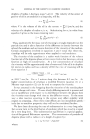
TOWARD EMULSION CONTROL 185 and the droplet size all affect the ease of formation and the subsequent stability of emulsions. We must find methods and instruments to inves- tigate those factors, or phenomena related to them. What is desired are physical properties that are chiefly or solely dependent on a single variable, so that by direct measurement one can obtain information about the extent or the effects of one parameter at a time. SURFACE TENSION AND SURFACE FREE ENERGY AT THE INTERFACE There exists at the surface of every pure liquid a thin layer that has a lower density than that of the bulk liquid. This condition is caused by the unbalance of the intermolecular forces of attraction at the surface, which exert a net inward force on every molecule in the surface layer. At equilib- rium, this force is balanced by the outward diffusion potential that is called into being by the lack of molecules near the surface. The presence of a less dense film at the surface of a pure liquid, itself gives rise to observable phenomena, of which the most significant is the state of tension that must exist in the surface layer as long as equilibrium is maintained. Another effect is the reduced cohesion that exists in the surface layer, since the mole- cules are further apart than in their normal liquid arrangement. Here we see the origin of Rayleigh's dictum that pure liquids do not foam the sur- face layers lack the normal cohesion by means of which they can support themselves in the form of thin films. Surface tension is a readily observable phenomenon, since the tendency of the surface to resist extension can be made to manifest itself by a variety of means: a soap film can support a weight the surface of water supports small, dense objects, such as certain water bugs, or hydrophobic powders, or an oiled needle. In measuring surface tension one can make use of this property by finding what force is required to pull a platinum ring out of the surface of a liquid. Since surface tension manifestly exists, and it is therefore necessary to perform work (i.e., expend energy) in order to extend a surface, the new surface thus created contains the energy expended. From this argument it follows that surfaces contain a "surface energy" over and above other forms of intrinsic energy already present. From the viewpoint of thermodynamics, the surface energy is numerically equal to the function called Gibbs' free energy, which, by definition, at constant temperature, is: 1 where q• is the surface tension and z/is the surface area. Free energy per unit area and surface tension per unit length in a liquid surface are there- fore mathematically equivalent. These rather abstract arguments have an application to the practical questions of emulsion fortnation and stability. The equation AF =
Purchased for the exclusive use of nofirst nolast (unknown)
From: SCC Media Library & Resource Center (library.scconline.org)