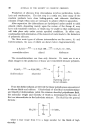
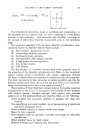
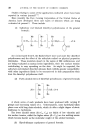
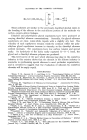
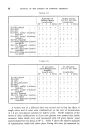
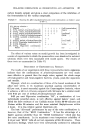
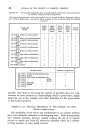
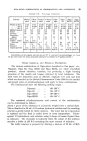
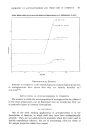
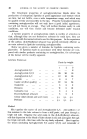
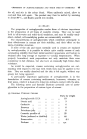
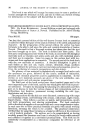
NIPA-ESTER COMBINATIONS AS PRESERVATIVES AND ANTISEPTICS 39 TABLE Vii. ]•ercentage $ol•bililies Solvent Methyl Ethyl Propyl n Butyl Nipa- Nipa Nipa Nipa ester ester ester ester sept 64 82121 82123 Water at 20 ø C. 0.25 0.07 0.032 0.0225 0.2 0-03 0.14 0'08 .... 25 ø C. 0.3 0.075 0.04 0-025 0-25 0.033 0.17 0-1 .... 80 ø C. 3-5 1'0 0-39 0-135 1.8 0.145 0.39 0.35 Methyl alcohol 35 45 50 70 55 90 65 65 Ethyl ,, 35 40 40 70 50 90 60 60 Acetone .. 35 40 50 60 50 90 60 60 Propylene glycol .. 20 15 20 40 20 90 35 35 Benzene 1 1 3 30 1 70 3 3 Carbon tetra' Less Less chloride .. than 0.1 than 0'1 0.1 5 0'1 30 0-4 0'4 Ether .. 10 15 25 30 20 80 35 40 Glycerol .. 1 0.5 0-4 0-4 2 0.4 5 1 Liquid paraffin Less Less Less Less Less Less Less than 0.1 than 0' 1 than 0-1 than 0.1 than 0-1 0.1 than 0.1 than 0.1 (Solubilities in all organic solvents are at 25 ø C. and are true percentages, i.e., by a 25 per cent value we mean 25 grams substance is soluble in 75 grams solvent.) OTHER CHEMICAL AND PHYSICAL PROPERTIES The various combinations of Nipa-esters described in this paper, viz., Nipasept, Nipa 64, Nipa 82121 and Nipa 82123, are white crystalline powders almost odourless, tasteless, but producing a slight burning sensation of the mouth and tongue, followed by local numbness. The limit tests for impurities such as chloride, sulphate, free acid and lead which are described in the British Pharmaceutical Codex 1954 for the methyl and propyl esters of p-hydroxybenzoic acid apply to these combinations. The combinations have the following melting ranges: Nipasept ...... 80-120 ø C. Nipa 64 ...... 50- 65 ø C. Nipa 82121 ... 60-120 ø C. Nipa 82123 ... 60-110 ø C. The combined p-hydroxybenzoic acid content of the combinations can be determined as follows: About 1 gram of the substance is accurately weighed into a conical flask. This is dissolved in 25 ml. of N sodium hydroxide solution and the resulting solution is gently boiled for thirty minutes. The water lost by evaporation is replaced and the flask is cooled down to room temperature. Titrate against N hydrochloric acid solution using 3 drops of bromo thymol blue as indicator. The end-point is indicated when the colour of the solution matches a buffer of pH 6.5 containing the same amount of indicator. The buffer solution is prepared by diluting a mixture of 25 mi. of M/5

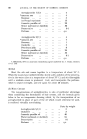
40 JOURNAL OF THE SOCIETY OF COSMETIC CHEMISTS potassium dihydrogen phosphate and 15.2 ml. of N/10 sodium hydroxide solution to 100 ml. If x mi. is the volume of N hydrochloric acid used in the titration, then the volume of sodium hydroxide used for the hydrolysis of the ester mixture is (25--x) mi. of N sodium hydroxide. 1 mi. of N sodium hydroxide solutions0.1381 grams of p-hydroxybenzoic acid. The combined acid content of the various combinations are: Nipasept ...... 87.3-88.3% Nipa 64 ...... 70.5-71.5% Nipa 82121 ... 84-85% Nipa 82123 ... 77.5-78.5% SUMMARY 1. The favourable effect of the simultaneous use of a combination of two or more of the esters of p-hydroxybenzoic acid as preservatives is discussed in detail. 2. The desirable properties of a preservative for cosmetic products are listed and some recommendations for the use of Nipa-ester combina- tions are made. The methods by which more powerfully antimicrobial ester combinations can be prepared are discussed. 3. Reference is made to the findings of other workers in such widely different fields as the preservation of simple syrup, procaine penicillin and ophthalmic preparations and the treatment of moniliasis. Experimental results are given showing the increased activity of Nipa-ester combinations against a wide range of micro-organisms. 4. The results of these experiments are discussed. 5. The solubilities of Nipa-esters in a number of solvents, and the chemical and physical properties of the combinations discussed in the paper are given. REFERENCES • Sabalitschka, Th., and Boehrn, E., Arch. Pharmaz. Ber. dtsch. pharmaz. ges., 267, 272 (1929). 2 Boehm, E., La Parfumerie .$ioderne, 27, 373, and 478 (1933). a Boehm, E., l•iechsto•ndustrie und I•osmetik., 8, 7 (1933). 4 Boehm, E., 2V/anuf•uring C•emist, 4, 282 (1933). • Boehm, E., The JDru• and Cosmetic Industry, 32, 510 and 591 (1933). • Littlejohn, O. M., and Husa, W. F., Journal of American Pharmaceutical Associa- tion, Scient. Edit., xliv, 305 (1955). ? Warner, M. E., and Gee, A. H., "Parahydroxybenzoates as Preservatives for Parenteral Drugs." Paper presented on October 27th, 1955, at the Annual Meeting of the Parenteral Drug Association, New York, N.Y. •Lawrence, C. A., Journal of the American Pharmaceutical Assoc., Scient. Edit., xliv, 457 (1955). • Klein, M., iViillwood, E. G., and Walther, W. W., Journal Pharm. and P•ar•col., 6, 725 (1954) Lanc•, No. xxi, 1063 (1954). •o Schimmel, J., and Husa, W. J., Journal of the American Pharmacezctical Assoc., Scient. Edit., xlv, 204 (1956). •x Sabahtschka, Th., Arzneimittelforschung, 5, 259 (1955).
Purchased for the exclusive use of nofirst nolast (unknown)
From: SCC Media Library & Resource Center (library.scconline.org)