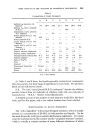
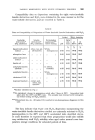
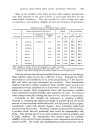
LANOLIN DERIVATIVES WITH DILUTE HYDROGEN PEROXIDE 371 Data on the stability of the H,,.02 in these eight emulsion formulations were then obtained in the same manner as previously described for the water-soluble derivatives. They are recorded in Table 4 along with data on consistency and emulsion stability, at room and incubator temperatures. Table 4 Stability Data on Emulsified H•O 2 Lotions Lotion Appearance (42 days)* Initial H•O• Stability Stability Stability at at Formula Consistency room temp. 43øC pH H•O• 100øC ** 66øC ** % % % A medium excellent fair 3-95 6-34 63-1 95.5 B medium .... 3.90 5.74 64-6 97.1 C medium ,, poor 3-90 5.85 72.3 98-8 D heavy ,, exc. 3-95 5.83 69.8 97.9 E heavy ,, fair 3.95 5.13 78.2 96-8 F heavy ,, exc. 3.90 5-82 73.9 95-7 G heavy .... 4'00 6.18 90.0 95-1 H medium .... 4.00 6-08 84.9 95-9 *No change in colour and no development of odour occurred. **All emulsions stratified during the 66øC and 100øC tests. They were remixed before analysis and after mixing have remained stable at room temperature. The data indicate that all eight emulsified lotions exhibit very satisfactory H•O• stability values in tests run at 66øC for 7 days. Although the 100øC test results are not satisfactory in six of the preparations, it is felt that the 66øC test values are more meaningful for emulsions. These formulations could be expected to exhibit satisfactory H•O,. stability under normal room temperature storage conditions for at least twelve months. All the formu- lations are opaque, white preparations which still demonstrate excellent room temperature emulsion stability after ageing for six weeks. No colour or odour changes took place during that time even at incubator temperatures. Incubation at 43øC brought out weaknesses in emulsion stability. Formula C, containing the highest percentage of mineral oil and the lowest amount of water-insoluble lanolin derivative, was the poorest in this respect. Consistencies varied with formula changes those containing multi-sterol extracts being the heaviest. Formula F contains lanolin alcohols ricinoleate, a product which had not previously been tested for compatibility with H•03. This formula proved to be quite satisfactory, both in emulsion, and in H•O,., stability. The preparations were checked again for emulsion stability at the end of 12 weeks of ageing at room temperature and in the in- cubator at 73øC. The results were unchanged from those reported in Table 4.

372 JOURNAL OF THE SOCIETY OF COSMETIC CHEMISTS CONCLUSIONS From the results of the hydrogen peroxide stability tests it is apparent that very little reaction between lanolin derivatives and hydrogen peroxide takes place. This is confirmed by the very low degree of oxiderive changes which take place in lanolin products on ageing. There is a direct correlation between the results of the accelerated ageing tests carried out at 100øC and 66øC, and stability on the shelf at room tem- perature. A product which retains 90 per cent of its hydrogen peroxide in either of the tests could be expected to retain at least 90 per cent for 12 months on the shelf. As the stability approaches 100 per cent by these procedures, as it has in some of the data presented, the room temperature shelf-stored products could also be expected to approach 100 per cent retention of activity for at least a year. (Received: 4th July 1962) REFERENCES • yon Schr6tter, A., Ber. 7 980 (1874) z Goldemberg, R. L., Drug and Cosmetic Ind. 89 446 (1961) a Cass, G. S., Am. Perturner A•'omat. 68 25 (1956) (1) 4 French Pat. 946,665 5 Benk, E., Seifen-(•le-Fette-Wachse 75 481 (1949) 0 Spanish Pat. 207,526 ? Becco Bulletin No. 42 (FMC Corporation, N.Y.) s Conrad, L. I., iVfotiuk, K., and Maso, It. F., J. Soc. Cosmetic Chemists 11 415 (1960) 9 Gillam, BI. W., Australian Chemical Institute Journal and Proceedings 14 361 (1947) •0 Kitchen, G. F. and Clark, E. W., Pharm. Industrie 22 5 (1960) • Muirhead, G. S. et al., y. Pharm. and Pharmacol. I 762 (1949) BOOK REVIEW ANGEWANDTE CHEMIE. International Edition in English. Monthly. Academic Press Inc. (London), Ltd., London. Annual Subscription--oe5 7s. 6d., plus postage. Academic Press, Inc., New York. Verlag Chemie, G.m.b.H., Weinheim/Bergstr, Germany. The journal Angewandte Chemie will need no introduction to most chemists and the publication of an International Edition in English, available from the beginning of 1962, will be generally welcomed. Each issue of the new edition will contain a series of review articles drawn from all fields of chemistry, together with selected papers from the affiliated journal Chemie- Ingenieur-Technik. At the same time, issues will also include Communica- tions on chemical research, Reports on European Conferences in the form of abstracts of lectures covering unpublished results, plus Selected Abstracts from the International Chemical Literature and Book Reviews.
Purchased for the exclusive use of nofirst nolast (unknown)
From: SCC Media Library & Resource Center (library.scconline.org)