j. Soc. Cosmetic Chemists 16 3-14 (1965) ¸ 1065 Society of Cosmetic Chemists of Great Britain / Band Shape on Dyed Paper as a Method of Chromatography for Oils and Fats D. W. POXON* Presented at the Symposium on "Preservatives and Antioxidants", organised by the Pharmaceutical Society of Great Britain and the Society of Cosmetic Chemists of Great Britain, in London on 77th November 7964. Synopsis--Certain dyes, containing surface active groups, profoundly influence the shape of a chromatographic band in • manner related to the composition of the material being chromatographed. Using paper impregnated with such dyes, together with the length of outline per unit area as a measure of the shape of the band, a method of chromatography has been evolved having a completely standardized development technique for all mixtures. This outline/unit area index varies with temperature according to the nature of the polar groups of the compounds present in the mixture being chromatographed, and with the concentration of the individual compounds. A three-dimensional diagram may therefore be constructed, having as axes temperature, concentration and index, which will be absolutely characteristic of a particular experimental material, and which does not require actual separation of the constituents of that material. In the present investigation this method of chromatography has been applied to some materials likely to be of interest to the cosmetics industry. INTRODUCTION Although much progress has been made in the chromatographic examination of widely differing types of material, such an examination of complex mixtures of high molecular weight compounds still presents many difficulties. This is particularly so if it should be necessary to follow or detect changes, which may not be very extensive, resulting from manu- facturing operations, oxidation, or deterioration of any type. *Department of Industrial Chemistry, Loughborough College of Technology, Loughborough, Leics.

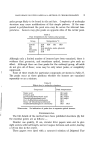
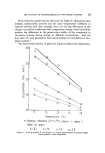
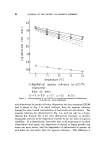
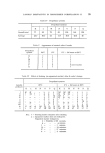
JOURNAL OF THE SOCIETY OF COSMETIC CHEMISTS Since the complexity of the material to be examined may mean that all the components are not known, may not be separable by any one technique, or may be sensitive to such conditions as high temperature, type of column packing, etc. it is desirable to have a method of chromato- graphy in which such factors are not of prime importance. Certain azo dyes, of which Dispersol Fast Scarlet B. (C.I. Disperse Red 1.11110) has been found to be most suitable, have been shown to have a pronounced effect upon the shape of the chromatographic band of oils when the chromatography was carried out on paper impregnated with the dye, using petroleum ether as the eluting liquid. At certain temperatures, characteristic of the polar group of the com- pound being examined, a sharp increase in the length of the outline of the band per unit area (the Outline/Area Index) was found (2,3,4). All substances are not, of course, chromatographed by petroleum ether, and to overcome this difficulty the experimental material was dissolved in oleic acid which itself gives a single peak at 17.6øC. It was found that characteristic peaks were still obtained, but in many cases these were rather small. The addition of a small amount of a saturated acid to the oleic acid markedly increased the size of the peaks without altering their appearance at characteristic positions along the temperature axis. Although most saturated acids have this effect, palmitic acid gave the most satisfactory results and a solution of 2% palmitic acid in oleic acid (the carrier) was finally used. The use of such a carrier allowed the effects of concentration to be assessed. It was found that each compound had a critical concentration at which the index peak was a maximum. Thus, by making use of both the temperature and concentration effects it was possible to construct a diagram giving classification along the temperature axis and individual compounds along the concentration axis with peak height as a third dimension, and without separating the com- ponents of the mixture. The third parameter, peak height, appears to be related chiefly to surface activity and, to a more limited extent, to concentration. With regard to surface activity, compounds more surface active than oleic acid suppress the carrier peak which remains intact for compounds less surface active, though here again, concentration, within the limits of the critical concentration, appears to play a minor role. Table I gives the temperatures at which peaks are given by the main
Purchased for the exclusive use of nofirst nolast (unknown)
From: SCC Media Library & Resource Center (library.scconline.org)