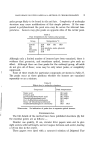
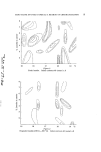
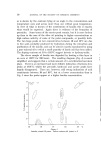
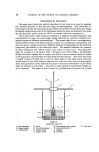
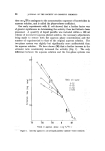
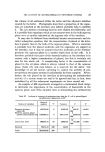
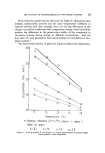
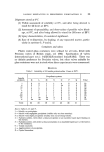
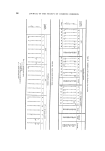
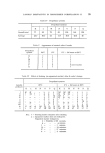
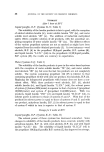
BAND SHAPE ON DYED PAPER AS A METHOD OF CHROMATOGRAPHY the tabs dip into the petroleum ether. Development takes place in less than 5 rain so that there is no difficulty in maintaining the temperature, even with quite a crude type of thermostat, to within 0. IøC. The rod is then pulled up again, the paper removed, and the band pencilled in. The dye used is Dispersol Fast Scarlet B which has a -CH•..CH•.OH side chain attached to the amino group. This group is essential for the production of these large changes in band shape. If the -OH group is phenolic in character the changes are not produced. I have used this dye because it gives the simplest effect with the carrier mixture that I use, i.e. one single peak 85 units high at I?.0øC. Other dyes having a similar structure give multiple peaks. In addition to the work described in the paper we have tried various phenols, all of which give a peak of I&8øC whatever their nature. I am not suggesting that the method would detect such compounds present as antioxidants. I would not claim that it is so sensitive, and I think that the sensitivity, in fact, increases with the surface activity of the compounds present in the mixture. We made a series of fairly complicated molecules and one of the things we found was that if one has compounds with several polar groups, e.g. carboxyl, widely spaced over the molecule the peaks become flattened. The same thing happens When using dyes having surface active groups widely spaced in the molecule. Although, using known compounds, the peak height is only about 85-40 units, irradiateion of oils g{ves quite enormous peaks 80 to 90 'units high. This means, of course, that a band of 1 in 2 area would have an outline 80 to 90 in long. These are quite large changes. One may think that the measurement of the outline and area of the band is not very accurate on such small bands and, of course, this is true, but I do not consider that the accuracy is any less than that involved in estimating the Rs value by orthodox chromatography. In most cases, the effects are so large, that there is no doubt where the actual peak occurs. One can exactly pinpoint the temperature and concentration at which the peak occurs, and one can reproduce it. I think that the ease of reproducing is shown by the fact that students after a few days' practice have no difficulty whatever. DISCUSSION MR. E. W. CLARK : Highly degraded or autoxidised lanolin invariably has greatly increased acid and peroxide values. Yet Figs. 4 and 5 show reduced peaks for peroxides and for acids. Does this indicate that the method is not highly specific for the various group configurations and that it is more dependent on surface activity or some interaction between the sample and the carrier? THE LECTURER The point about surface activity is, I think, to a certain extent true, but the lanolin was degraded at 100øC and I think I am correct in saying that most peroxides decompose below this temperature. You will therefore get the decomposition products of the peroxides rather than the actual peroxides themselves. MR. E. W. C•-ARK : Yes, but when the peroxide is decomposed, additional free fatty acids are formedland one might have expected that the peak due to the carboxyl group would then have been even more marked. THE LECTURER: One of the peaks which is due to carboxyl groups occurs at 18. IøC. In Fig. 4, which is the degraded material, there is one sloping peak which covers the temperature 18.1øC, and two other peaks further up the diagram which are also at 18.1øC. It is true that one can get four peaks with carboxylic acids, but these do not always show for a particular acid one or the other of them may predominate.

14 JOURNAL OF THE SOCIETY OF COSMETIC CHEMISTS MR. E. W. CLARet: Have you any comments to make on the small peak for peroxides in Fig. • ? T• L•CTUR•R: The fact that the peak is right at the top of the diagram indicates that the concentration of peroxide is rather low. If one has a high concentration of peroxide, the peak will appear at the bottom of the diagram, but as the con- centration fails the peaks move up the concentration axis. Even though this lanolin has been stored for ten years it suggests that there is no high concentration of peroxide. MR. E.W. C•-ARK: Was the sample taken from the surface layer, or deep down ? T• L•CTUR•R: If the surface layer had been taken there would probably have been a much higher concentration of peroxide. MR. J. D. C•w. SHIR•: Do you think that your method for group classification has any advantages for a laboratory already equipped with I.R. spectrophometers? Tn• L•CTUR•R: Yes, for a preliminary examination. If one is faced with a new sample, or a sample of a mixture which is suspect in any way, the method would be very useful when taken in conjunction with I.R. examination. I am not putting up this method as better in any way than established procedures where the analysis is straightforward. It does involve rather a lot of work as I have mentioned towards the end of the paper, and therefore would not be justified except in a particularly difficult case.
Purchased for the exclusive use of nofirst nolast (unknown)
From: SCC Media Library & Resource Center (library.scconline.org)