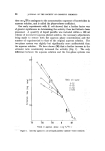
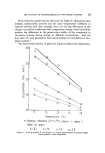
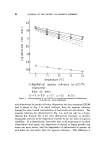
THE ACTIVITY OF ANTIBACTERIALS IN TWO-PHASE SYSTEMS 29 THE LECTURER: There are some guiding rules when one starts looking for a suit- able preservative. If you plot phase volume ratio against the reciprocal of the fraction of preservative in the aqueous phase you get a linear regression line the slope of which depends upon the partition coefficient. If the partition coefficient is low, a change in oil/water ratio will not materially alter the proportion of preservative in the aqueous phase. If you have selected a preservative with a very low slope you can assume that you are going to have some activity in your product. But if you went to the other extreme, and selected a preservative with a high partition coefficient, as you change your phase volume ratio the proportion of preservative in the aqueous phase falls very rapidly. I presume you would start off in selecting a preservative with the aid of a graph and then calculate the con- centration in the aqueous phase because the activity resides there. Your final product can be tested by inoculating and including a dye, which changes colour with changes in metabolic by-products from the organism, or just with a change of oxidation reduction potentials. After 18 hr some change in the indicator colour in the system could be seen long before it is possible to detect growth by inspection. With a semi- solid cream it might be perhaps several weeks before one detected mould growth. MRS. D. WEDDERBURN: Short term product inoculation tests can be misinter- preted, for although they will reveal those preservatives which are not likely to be active, they cannot be used to predict those which will be effective. I say this because it is known that over a long period of storage certain organisms, particularly the Pseudomonads, can adapt themselves to their environment. I have experience of this. On one occasion, during a prolonged product inoculation test, for the first four or five months the preservative seemed to be holding the inoculation in a quiescent state, but after six months vigorous growth began and deterioration of the emulsion set in. For this reason I see no substitute for long term tests which provide the oppor- tunity for adaptation to be detected. DR. J. B. M. COPPOCK: May I draw attention, from the food field in synthetic creams and even margarines and butter, that freeze-dried organisms do not necessarily behave, indeed often multiply faster, than organisms in their natural habitat. Thus I would not accept tests on o/w, or other systems, using freeze-dried organisms alone but would still require the more classical "suck it and see" experiment more related to practical conditions. MR. G. SYKES : I agree wholly with Mrs. Wedderburn. This is one of the occasions in which the microbiologist must not be rushed. Short term tests will give an approximate result, but this is not good enough for commercial products. Adapta- tions can take place rapidly in a generation or two, or very slowly during several weeks, and it is the latter which one has to watch. It can only be controlled by long term observations. There is also the question of the types and strain of organism which may be involved. MR. I). W. POXON: It does strike me that of the factors you were talking about, the interfacial phenomena were of considerable importance. If your micro-organisms are absorbed at the interface, surely the antibacterial, which was also strongly absorbed at the interface would be most effective. THE LECTURER: This is correct.

30 JOURNAL OF THE SOCIETY OF COSMETIC CHEMISTS Me. D. W. PoxoN: Is there any relationship between surface activity and anti- bacterial activity? THE L•CTUR•R : We are not quite sure how the molecules are orientated at the interface, but we shall assume that the polar portion of the molecule is in the water, and the non-polar is in the oil. They will only be measurable in 2kngstroms whereas your cell is going to be microns in diameter. The organism is going to project into the aqueous phase very much further than the molecules, and it would seem that possibly only a portion of the cell surface is in contact with the higher concentration of bactericide or preservative. It is possible and, indeed very likely, that absorption of preservative molecules does also occur at the cell-water interface.
Purchased for the exclusive use of nofirst nolast (unknown)
From: SCC Media Library & Resource Center (library.scconline.org)