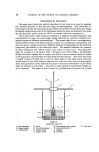
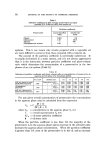
THE ACTIVITY OF ANTIBACTERIALS IN TWO-PHASE SYSTEMS 27 factor. Phenol or preservative molecules are absorbed at the interface together with bacteria, and also emulgent particles, otherwise no emulsion would be obtained. Exactly what will happen to the activity is uncertain especially as some of the surface active molecules will be absorbed on the bacterial surface. At the bacteria/ water interface there will be a build up of micelies and some of the preservative may go into a solution in the interior of the micelies thereby changing its availability to the micro-organism. At the moment it is very difficult to see how all these factors are going to interact. DR. E. E. BoEaM: In page 10 there is the statement "it has long been known that phenols dissolved in oils and fats possess no antimicrobial activity except when the oil is in contact with the water". This statement is not in agreement with the experimental results obtained by Sabalitschka and Priem (89) where it was shown that a 10•o solution of phenol in oil, in the absence of water, kills Staphylococci within 7 hr. On mixing with g •o water the same organism was killed within 50 min. Under otherwise similar conditions a solution of g • phenol in water killed this. organism within 5 min. In fact, phenol dissolved in oil in the absence of water was about gO times less effective, and in the presence of traces of water about 10 times less effective than an aqueous solution of phenol. Resorcinol in oil, under similar test conditions, appeared to be about 10 times weaker than an aqueous solution of the same concentration, but after mixing with g •o water was twice as strong as an aqueous solution of the same concentration. The authors explained this in terms of the different distribution of both phenols between the oil and water. TaE L•CTUR•R: Our observations are in no way different from those of Sabalitschka the difference lies in the interpretation. Prof. Sabalitschka grew his organisms on agar and they were not dried organisms. There was a proportion of water there and the preservative in the oil was partitioning into this small quantity of water. When he added water to g •o the activity increased, which is absolutely compatible with• the statement made in our paper. He reduced the phase volume ratio, and therefore. increased the preservation concentration in the aqueous phase indicating that he . was using a system in which the partition coefficient was high. DR. N. D. HARRIS: It seems to me that one of the real problems in this discussion is whether one can decide what the antibacterial activity of materials is in oil? Ta• Lv, CTURv, R: Yes, of course, this is one of the difficult things, which no one has solved satisfactorily so far. I think Professor Bullock was getting very near it- but he had to use a factor to allow for a very high mortality in his organic solvents. MR. R. SMART: We have infected arachis oil by spraying a water suspension of' spores or cells into air, and "sampling" volumes of the air by a slit-sampler. If the. usual nutrient agar plate is replaced by a plate containing a membrane filter moistened_ with oil, the cells adhere to the oil layer. The cells can be taken into a volume of oil by inverting the membrane in a filter holder and washing with more oil. To estimate the number of viable cells on a membrane filter the latter is placed in the filter holder the right way up, washed with about 10 ml polyethylene glycol 800 10 • v/v solution in water and cultured in the usual way. The number of cells impinging on the membrane can be estimated in the slit sampler by counting the colonies produced on a nutrient agar plate in the same area as the membrane filter. (39) Sabalitschka, T. and Priem, A. Fette Seifen Anstrichrnittel 46 277 (1939). 4

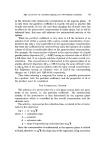
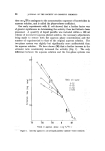
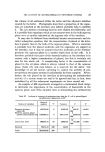
JOURNAL OF THE SOCIETY OF COSMETIC CHEMISTS PROF. M. DOg,ROW: The materials dealt with are all of a semipolar nature and might be expected to dimerise in the oil phase, so that the partition coefficient would not be constant. This does introduce the problem of calculating partition coefficients •or each concentration and each phase volume which is being studied. T•. L•c•u•R: In the aqueous phase one is likely to have dissociation, and association is likely to occur in the oil phase. If association were occurring in the oil then our partition coefficient would have been wrong and therefore our estimate of the phenol in our aqueous phase would have been wrong because a greater quantity would have gone into the oil. We would have picked this up by the position of our time survivor curves because the kill would have been very much slower than we had anticipated. In fact, our estimates of extinction time came very close to the observed extinction times. As for dissociation in the aqueous phase, we know that the pKa of these phenols is in the region of 10. We were working at •bout pit 6.5--? so there was not much dissociation. MR. A. H. F•oN: Have you considered the addition of a material such as propylene glycol which, when added to the aqueous phase, would increase the con- centration of the preservative? T• L•CTUR•R: We have examined a number of systems in which additives both increase and decrease the partition coefficient. The activity goes roughly as one would expect. We have looked at glycols and at the effect of salts, because the latter is of interest in sterilisation. The process of heating with a bactericide depends in part upon the shift of the partition coefficient in fayour of i•creased concentration of bactericide in the bacterial cell. MR. J. T. R•s: You state that cream formulations must be approached, from the start, from the points of both physical and microbiological stability. We have seen that the partition coefficient effect is only one of several factors which will influence preservative efficiency. These other factors may in fact be stronger than the above partition coefficient effect. The method of packaging, and the type of pack •employed, will also influence the rate of microbial growth. A point is reached, however, when the preservative of choice must be tested. Such testing should relate to conditions closely approximating those found in practice. To be of use to the development chemist the tests should also yield the required information in a short time. The method should also be simple to operate. Serial dilution methods have been described by several authors. Conditions here, however, can hardly be described as relating to those found in the cream itself. The agar cup-plate method is also well known the cream, containing the preservative, is placed in a central cavity in a seeded agar plate. These conditions again do not approximate closely to the true ones. A water soluble preservative may diffuse from the cream into the surrounding agar. The oxygen balance of the system must also differ markedly from that found in a normal cream jar or collapsible tube. Other authors have proposed inoculating the sample itself with the test organisms, incubating, and later plating the samples for colony counts. This method is both lengthy and complicated. I agree that cream development should embrace both physical and microbiological testing from the start but I am not sure that present test methods are always appropriate.
Purchased for the exclusive use of nofirst nolast (unknown)
From: SCC Media Library & Resource Center (library.scconline.org)