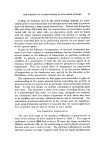
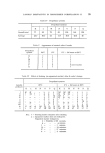
THE ACTIVITY OF ANTIBACTERIALS IN TWO-PHASE SYSTEMS Cutting oil emulsions used in the metal-working industry are parti- cularly prone to microbial attack and attempts have been made to preserve them and eliminate a large annual financial loss. Pivnick and Fotopoulos (33), and others (34) found that the concentration of preservative needed varied with the oil:water ratio, an observation which must be linked with the larger bacterial population which can develop in cutting oil emulsions (1). Obviously the effectiveness of a preservative in an emulsion must be controlled both by its partitioning between the two phases, and the phase-volume ratio since both factors will determine the concentration in the aqueous phase. Studies on the influence of temperature on chemical sterilization pro- cesses have been confined to aqueous solutions, but the literature reveals several studies on the influence of temperature on partition coefficients (31,35). In general, a rise in temperature produces an increase in the solubility of a preservative in both the oily and aqueous phases of an emulsion, but the partition coefficient must be presumed to change with temperature. Thus the overall effect of temperature on preservative activity in o/w systems will be determined, (i) by the normal influence of temperature on the disinfection rate, and (ii) by the alteration in the distribution of the preservative between the two phases. The experiments described in this paper were undertaken to gain an understanding of the major physical factors controlling the activity of preservatives in o [w systems and, in particular, of the interactions between them. To this end, simple o/w systems containing no emulsifying agent were used. This permitted a study of the major controlling factors, but it is acknowledged that when, at a later stage, emulgents are included, our conclusions about the relative importance of each factor may have to be modified and certainly additional factors will be introduced. Our assessments of antimicrobial activity of the systems were, for expedience, made using Escherichia coli but it is conceded that the results might have been of greater interest had we elected to use a mould. THE PARTITION COEFFICIENTS The very wide range of the partition coefficients of preservatives in some of the systems we have studied is shown in Table I. The range of coefficients is about 6600-fold or about 10 times the range recorded by Hibbott and Monks (32), for the partitioning of methyl phydroxybenzoate between water and a variety of oils. The partition coefficients for arachis 0il/water systems are high compared with those for liquid paraffin/water

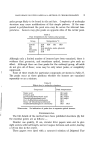
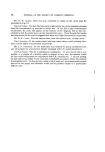
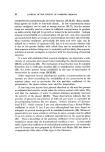
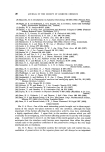
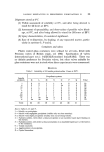
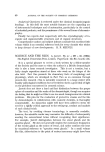
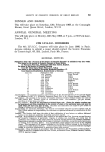
18 JOURNAL OF THE SOCIETY OF COSMETIC CHEMISTS Table I Partition coefficient at 25øC of some preservatives in liquid paraffin (S.G. 0.830 to 0.870) and arachis oil Preservative Phenol Chlorocresol Thymol Phenylmercuric acetate Partition coefficient Liquid paraffin/ water 0.067 1.53 0.23 Arachis oil/ water 5.6 116.7 447 systems. This is one reason why creams prepared with a vegetable oil are more difficult to preserve than those prepared with a mineral oil. The concept of the partition coefficient is universally understood. It is usually determined in a static system, and it is not always appreciated that it is the interaction between partition coefficient and phase-volume ratio which determines the concentration of a preservative in the two phases of an o/w system (Table II). Table II Influence of partition coefficient and phase-volume ratio on concentration of preservative in aqueous and oil phase of a two- )base system Køw at 25 ø Oil/water ratio 0.2 1.0 2.5 5.0 10.0 , 0.4% w/v phenol in liquid Preservative in oil % 0.031 0.050 0.080 0.080 0.176 paraffin/water dispersions 0.067 ,, ,, water % 0.474 0.750 1.199 1.799 2,636 -- 1% hypothetical .... oil % 1.000 1.000 1.000 1.000 1,000 preservative 1.000 ,, ,, water % 1.000 1.000 1.000 1.000 1.000 4.0% w/v chlorocresol in ,, ,, oil % 22.96 7.93 5.60 4.79 4.40 arachis oil/water dispersions 116.7 ,, ,, water % 0.197 0,068 0.048 0.0411 0.038 For any given overall concentration of preservative the concentration in the aqueous phase may be calculated from the expression cw =c (0+l) (Køw0 + 1) where C w = concentration in the aqueous phase % w/v C ---- overall concentration % w/v Køw = oil:water partition coefficient 0 -- oil:water ratio When the partition coefficient is less than 1.0, the majority of the preservative is in the aqueous phase and an increase in the oil:water ratio increases the aqueous phase concentration. When the partition coefficient is greater than 1.0, most of the preservative is in the oil, and an increase
Purchased for the exclusive use of nofirst nolast (unknown)
From: SCC Media Library & Resource Center (library.scconline.org)