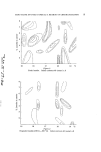
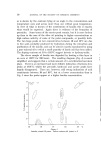
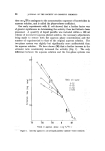
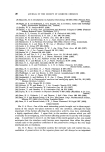
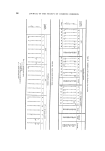
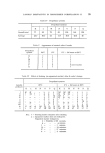
BAND SHAPE ON DYED PAPER AS A METHOD OF CHROMATOGRAPHY 1,1 The main change appears to be oxidation of secondary hydroxyl to ketonic groups as might be expected. Fig. 5 was obtained by using a sample of lanolin which had been in store for ten years. Here re-esterification has definitely taken place. The acid and hydroxyl peaks are markedly less in evidence, but no ketone has been produced. There is a small amount of peroxide showing at the top, left-hand corner of the diagram. The reappearance of peaks in the 17.8 to 18øC range suggests the reforming of the carrier peak, a phenomenon to be expected if the concentration of the polar groups had been very consider- ably reduced. CONCLUSION Outline/area index chromatography appears to be a useful and sensitive technique for the examination of mixtures the nature and complexity of which make other methods difficult to apply. At this stage it is presented as a potentially useful idea rather than as a completely developed method. There are still a number of points, particu- larly those associated with the influence of molecular structure, which are not clear, and, at the moment, no satisfactory theoretical explanation of the variation of the index can be put forward. The obvious disadvantage is the amount of work involved in the production of the diagrams, but against this must be set the simplicity of the apparatus and technique, and the rapidity with which the results may be obtained. While it is not suggested that the method would be used where other established techniques are satisfactory, except perhaps as a method of preliminary examination, it is of interest that an infra-red examination of the sample of lanolin did not yield anything like as much detailed information as the outline/area index diagrams. ACKNOW•.EDGE•ENTS The author wishes to thank Dr. G. F. Reynolds, Reader in Analytical Chemistry, and the Esso Petroleum Co. for the sample of mineral oil, and Dr. A. G. Briggs for advice and assistance with the I.R. examination of the lanolin. (Received ß 2nd September 1964) REFERENCES (1•) Rutter, L. Nature 161 435 (1948). (2) Poxon, D. W. J. Oil Colour Chemists Assoc. 41 291 (1958). (•l) Poxon, D. W. J. Oil Colour Chemists Assoc. 43 245 (1960). (4) Poxon, D. W., Agger, R. T., Beaumont, D. E. and Pugh, J. A. J. Oil Colour Chemists Assoc. 46 339 (1963). 3

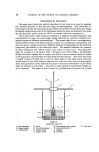
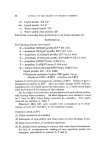
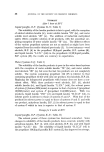
12 JOURNAL OF THE SOCIETY OF COSMETIC CHEMISTS Introduction by the lecturer The main point about the method described is that there is no need to separate the m•terials present in the mixture being chromatoglaphed. The alterations in band shape indicate the particular groups which are present because these give peaks at definite temperatures and in the substances which we have investigated, this peak, say the hydroxyl peak, occurs at 15.8øC no matter what the compound is. At the same time, if the results are plotted in a diagram having temperature and concentration as axes, the peak height being indicated by contours, different sub- stances appear at different concentrations. This means that if. one is investigating mixture about which very little is known, at least as a preliminary examination, one does not have to search around for different methods of separating out the hydroxyl compound, the ketone or the carboxylic acids. The method indicates the presence of these substances and, within reason, how many of them occur. The apparatus (.Fig. 6) consists of a 21 beaker with a Perspex cover which holds a thermometer fitting reasonably tightly into a copper cone which is never removed from the inside of the apparatus, and therefore provides good thermal contact. The cover also holds a length of glass rod bent into a circle at right angles to the stem which holds the actual paper by the tabs (between the sectors), which are bent down at right angles. After the application of the material the paper is held in an atmosphere of petroleum ether for between 1 and 2 min. This time i• quite critical if reproducible results are to be obtained. The paper is then lowered by pushing down the glass rod so that ß I.'•\\\\\\\ ß M Figure 6 Apparatus used (4) A. Thermometer D. Cork H. Chromatographic paper N. Lead shot B. Paper holder E. Two-litre beaker K. Crystallising dish C. Perspex,lid F. Paper lining L. Weight '" G. Copper cone M. Solv•nt
Purchased for the exclusive use of nofirst nolast (unknown)
From: SCC Media Library & Resource Center (library.scconline.org)