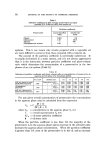
THE ACTIVITY OF ANTIBACTERIALS IN TWO-PHASE SYSTEMS 19 in the oil:water ratio reduces the concentration in the aqueous phase. It is only when the partition coefficient is exactly 1.0-and in practice this is only very rarely, if ever, the case-that changing the oil:water ratio has no effect on the preservative concentration in either phase, but as will be indicated later, this may still influence the antimicrobial activity of the system. When the partition coefficient is very close to 1.0 the inclusion of an amount of oil within a system with a given overall concentration of pre- servative has only a very small effect on the aqueous phase concentration, but when the coefficient is far removed from unity the inclusion of a similar volume of oil has a considerable effect on the aqueous phase concentration. For example, the concentration of phenol in the aqueous phase of a liquid paraffin/water dispersion (Køw = 0.067) having an oil:water ratio of 10.0:1.0 is 6.6 times that of an aqueous solution of phenol of the same overall con- centration. The concentration of chlorocresol in the aqueous phase of an arachis oil/water dispersion (Køw = 116.7) having the same oil:water ratio ' that of the aqueous solution with the same overall concentration. is only m For dispersion having an oil:water ratio of 0.2:1.0 the corresponding changes are 1.2-fold and 1/20.4-fold respectively. Thus when selecting a compound for study as a possible preservative for a product, both the partition coefficient, and the proportion of oil in the product must be considered. THE INTERF^CIAL F^CTOR The selection of a preservative for a two-phase system fixes one para- meter of the system, i.e. the partition coefficient. The antimicrobial activity of the preservative is then determined by the aqueous phase concentration which is controlled by the overall concentration and the oil:water ratio. The activity, expressed as the extinction time, is related to the oil:water ratio by the expression ogt = where t = extinction time : A = constant 0 = oil:water ratio p = slope of regression log extinction time on • Since the concentration of antibacterial in the aqueous phase is related to 0 and, therefore, to •½/O, the slope of p of the regression of log extinction

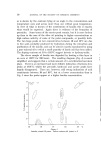
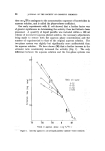
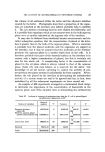
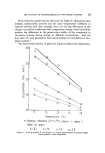
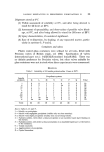
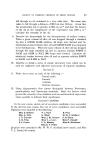
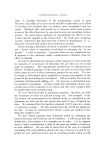
20 JOURNAL OF THE SOCIETY OF COSMETIC CHEMISTS time on q/• is analogous ,to the concentration exponent of bactericides aqueous solution, and is called the phase-volume coefficient. Our early experiments with E. coli showed that a further factor was of greater significance in determining the activity than had hitherto been presumed. A quantity of liquid paraffin was included within a 100 ml, volume of inoculated aqueous phenol solution, the necessary adjustments being made to restore both the aqueous phase concentration and ,the number of organisms/ml to that of the original aqueous solution. The. two-phase system was slightly but significantly more antibacterial than, the aqueous solution. We have shown (36) tl•at a further increase in the oil:water ratio considerably increased the activity (Fig. I). The only difference between the aqueous solution and the two-phase systems was 2.8 2.0 ' Figure 1. I I•atio oiL:water /•-0.2 n -1'0 o - 5'0 x-l,0.O X o 0 0.1 Pheno[ in aqueous 'phase, I Log ø/o w/v ) ' ß ACtivity against E. coli of liquid paraffin--phenol--water mixtures
Purchased for the exclusive use of nofirst nolast (unknown)
From: SCC Media Library & Resource Center (library.scconline.org)