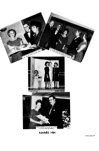
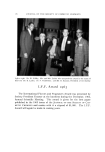
J. Soc. Uosmetic Uhemists, 16, 63-72(1965) The Fifteenth Medal Award December 2, 1964 Hotel Biltmore, New York City Mr. Harold D. Goulden, Scientific Director of The Toilet Goods Association, was honored by the Society of Cosmerle Chemists for his scientific achievements and for his services to the cosmetic industry. Mr. Goulden received the Medal of the Society during its annual Din- ner-Danee. Mr. Edward Morrish acted as toastmaster during the evening's festivities. Dr. Paul G. I. Lauffer, winner of the thirteenth Medal Award, was the eulogist, and Mr. Robert Kramer, as President of the Society, presented the medal with the following citation: HAROLD D. GOULDEN In recognition of your manifold and devoted services to the cos- merle industry In gratitude for your constant and effective influence in advancing the status of the cosmetic chemist In appreciation of your skillful presentation of scientific data In acknowledgment of your untiring campaign to enable the cos- merle industry to cooperate harmoniously with all regulatory agencies In remembrance of your vast contribution to the compilation of essential standards, handbooks and technical reports I present to you this Medal, our highest award for outstanding contri- butions to the art and science of cosmetics. 63

64 JOURNAL OF THE SOCIETY OF COSMETIC CHEMISTS Harold DeWitt Goulden EULOGY BY PAUL C•. I. LAUFFER, PH.D.* We are here this evening to honor Hal Goulden because he has made extraordinary and unique contributions to the welfare of the cosmetic industry and to the status of cosmetic chemists. He has done this by working hard and unselfishly and by applying to his tasks a keen in- telligence, implemented and buttressed by sound training and ex- perience. Hard work was never a stranger to Hal. As a high school boy he delivered papers and worked as a printer's devil and as a clerk in a haberdashery store. His first connection with the toilet goods industry may have been his ordertaking for the old Larkin Company. Or it may have been his job in the greenhouse of Mr. Palmer, president of E. R. Squibb & Sons, who had an estate at the end of the street in Stamford where Hal lived. Mr. Palmer took an interest in his young assistant and took him along on walks through his large garden. He presented to Hal over a hundred fine rose plants, and Hal used their flowers, under the encouragement of his chemistry teacher, to prepare rose absolutes by enfleurage and by solvent extraction. The same chemistry teacher, Dr. Parks, used to invite a small group of his students to spend evenings listening to his wireless set, using one of the first DeForest audiotrons. Hal has never forgotten the night when he watched Dr. Parks writing down the Morse Code message telling of the Titanic's sinking after she struck an iceberg. On another occasion, a lot of garbled code came in, and they did not know until the next day that the U. S. had attacked Vera Cruz. One of Hal's first loves was football, which he played well as a boy, account of his speed (he later ran the 100 yards in 10 seconds flat when at Rutgers). However, while still in grammar school he was indulging one afternoon in his favorite game, and, as he dove in for a tackle, he got kicked right between the eyes. The other lads carried him home and deposited him on a bed, and when Hal's father came home and saw Hal's condition the football career ended then and there. Hal also * Chesebrough-Pond's, Stamford, Conn.
Purchased for the exclusive use of nofirst nolast (unknown)
From: SCC Media Library & Resource Center (library.scconline.org)