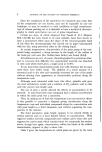
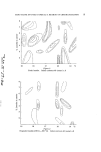
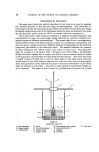
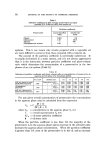
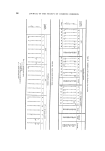
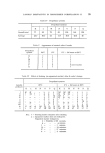
BAND SHAPE ON DYED PAPER AS A METHOD OF CHROMATOGRAPHY 5 polar groups likely to be found in oils and fats. Complexity of molecular structure may cause modifications of this simple pattern. If the com- pound is polyfunctional the peak area may lie across the relevant tem- peratures. Isomers may give peaks on opposite sides of the carrier peak. Table I Peak temperatures for various polar groups Group Temperature øC COOH CO OH Peroxides Carrier 15.6 16.9 18.1 18.8 16.4 15.8 (alcohols, enols, phenols) 15.0- 15.3 17.6 Although only a limited number of isomers have been examined, there is evidence that geometric, and sometimes optical, isomers give such an effect. Although there are four peaks for the carboxyl group, all acids do not give all of these some may be only minor peaks, or completely suppressed. Some of these results for particular compounds are shown in Table II. The peaks occur at these positions whether the isomers are examined separately or as a mixture. Table II Effects due to molecular structure Compound Peak temperature Maleic acid Fumaric acid Erythrodihydroxystearic acid Threodihydroxystearic acid Cis 1,2-dihydroxycyclohexane Trans 1,2-dihydroxycyclohexane Triphenylethyleneglycol (racemate) 16.9 only 18.8 only 18.1 only* 16.9 only* 15.8 18.5 15.8 19.5 *Racemates. No indication of peaks due to separate optical isomers. EXPERIMENTAL The full details of the method have been published elsewhere (4), but the essential points are as follows :w Number one quality, 11 cm, circular filter papers were cut to give eight sectors with half length, narrow tongues between each sector, leaving a 1.5 cm disc in the centre. These papers were dyed with a saturated solution of Dispersol Fast

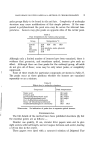
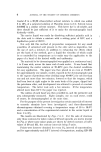
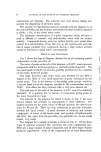
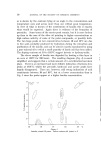
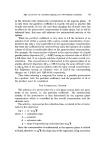
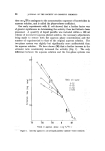
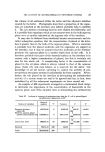
JOURNAL OF THE SOCIETY OF COSMETIC CHEMISTS Scarlet B in a 50/50 ethanol/ether solvent mixture to which was added 5 to 10% of a saturated solution of Waxoline Green G (C.I. Solvent Green 3.61565) in a similar solvent mixture. This latter dye is oil soluble, and there should be just sufficient of it to make the chromatographic band distinctly visible. The carrier liquid was made by dissolving sufficient palmitic acid in the oleic acid to obtain a mixture with a setting point of 18øC and a liquifaction point of 23.5øC. Not only did this method of preparation compensate for any small quantities of saturated acid present in the oleic acid as impurities, but the use of such a mixture, in addition to enhancing the effects which are the basis of the method, gave a liquid the viscosity of which could be so controlled by temperature as to make easy the application to the paper of a band of the desired width and urdformity. The material to be chromatographed was applied as a continuous band, 1 to 2 mm wide, across the inner end of each sector. It was found that maintaining the carrier solution at 70-80øC gave the desired conditions for easy application. The paper was then placed in an oven at 70-80øC for approximately one minute, cooled, exposed in the chromatograph tank to the vapour of petroleum ether (boiling range 40-60øC) for not less than one and not more than two minutes, lowered so that the tongues, which had been bent at right angles to the main body of the paper, dipped into the petroleum ether, and development was allowed to proceed at constant temperature. The latter took only a few minutes. If the temperature altered more than 0.1øC the paper was rejected. The outline of each band was then pencilled in, and the perimeter and area subsequently measured. Eight samples, one on each sector, could of course, be chromatographed at the same time. For the purpose of the present investigation certain materials of interest to cosmetic chemists have been investigated, and three-dimensional chromatograms obtained covering a temperature range of 15 to 19.5øC and a concentration of the experimental material in the carrier liquid of from 1 to 8%. The results are illustrated by Figs. 1 to 5. For the sake of clearness only those contours for index values of 40 and upwards are shown (except for Fig. 2, where some minor peaks are shown by dotted contours at index values of 30 and 35), the contour intervals being 5 units. Points were however obtained for every 1% interval of concentration, and for approximately each 0.3øC interval of temperature, making 125-135
Purchased for the exclusive use of nofirst nolast (unknown)
From: SCC Media Library & Resource Center (library.scconline.org)