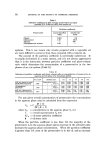
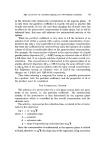
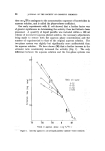
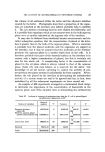
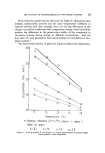
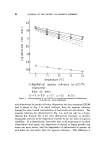
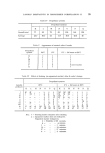
THE i•CTIVITY OF ANTIBACTERIALS IN TWO-PHASE SYSTEMS a manifestation of the partition coefficients (Table I). The slopes of the regression lines of log extinction time on temperature are log temperature coefficients, and as the oil:water ratio is increased the temperature co- efficients are decreased. That is, the activities of oil:water dispersions containing preservatives are influenced less by temperature changes than is an aqueous solution of the same preservative. The temperature co- efficient for a dispersion containing a given overall concentration of pre- servative is related to that of the aqueous reference solution of the same concentration by the expression log 0 •-- log o s K= 0 where 0 a = temperature coefficient of aqueous solution o s --: temperature coefficient of dispersion 0 ---- oil:water ratio K = constant for each preservative/oil/water system , Since the temperature coefficients of the dispersions decrease with increasing oil:water ratio, it is possible by using the constant K to calculate a ratio at which the temperature coefficient is 1.0, and the antibacterial activity of the dispersion is independent of temperature. For the very few. systems studied so far, this ratio has been of the order of $.0 to and in two cases it was possible to verify this value experimentally. The reason for this unique ratio is as yet uncertain but it is possibly determined by the concentration of preservative at the oil/water interface.' It,. is hoped that further experiments will help to establish this. The conclu•sion which must be drawn from the experiments is that' it is utterly futile to spend time and labour formulating a cream, and as a final gesture add an ad hoc concentration of a preservative. The formu- lation must be approached ab initio from th? points of view of both physical and microbiological stability. The two aspects cannot be divorced one from the other, and any attempt to do so is an invitation to failure. (Received: 2nd Septembe r 1'964) REFERENCES (1) Bennett, E. O. in Developments .in Industrial Microbiology III 273 {1969.) {Plenum Pres•s, New York). {2) Kostenbauder, H. B. in Develot•ments in Industrial Microbiology III 286 (i962) (Plenum Press, New York). '-' (3) De Navarre, M.G. The Chemistry and Manufacture of Cosmetics I 257 {1962) ('D. Van Nostrand Company, Inc., Princeton) {4) Wedderburn, D. L. in Advances in Pharmaceutical Sciences I 195 ,{1964) (Academic ß Press, London).

26 JOURNAL OF THE SOCIETY OF COSMETIC CHEMISTS (5) Manowitz, M. in Developments in Industrial Microbiology III 265 (1962) (Plenum Press, New York)'. (6) Rigler, N. E. and Schimmel, J. in E. Sagarin, Ed. in Cosmetics, Science a•d Technology (1957) (Interscience Publishers Ltd., London). (7) Stokoe, W. N. Analyst 49 577 (1924). (8),Brown, A. R. in Trop. Deft. of Equip•nt and Materials I Chapter 5 (1946) (National Defence Research Comm., Washington, D.C.). (9) Reese, E. T., Cravetz, H. and Mandels, G. R. Farlowia 4 409 (1955). (10) Castell, C. H. and Garrard, E. H. Can. J. Res. 19C 106 (1941). (11) Janot, M. M. and Ruoss, L. Pharm. Acta. Helv. 30 8 (1955). (12) Hugo, W. B. and Beveridge, E.G. J. Appl. Bacteriol. 25 72 {1962). (13) Beerstether, E. in Petroleum Microbiology 336 {1954) (Elsevier Press, Amsterdam). (14) Strawinski, R. J. and Stone, R. W. Can. J. Microbiol. I 206 (1954). (15) Ladd, J. N. Nature 177 939 (1956). (16) Sawyer, C. N. and Ryekmart, D. W. J. Am. Water Works Assoc. 49 480 (1957). {17) Baker, J. H. J. Soc. Cosmetic Chemists 10 133 0959). {!8) Bayliss, M. J. Bacterio1:51 489 {1936). (19) Barr, M. and Tice, L. F. J. Am. Pharm. Assoc. Sci. Ed. 46 442 (1957). (20) Bolle, A. and Mirrimanoff, A. J. Pharm. Pharmacol. 2 685 {1950). (21) Kostenbauder, H. B. Am. Perfumer Aromat. 75 28 (1960). {22) Mulley, B. A. and Metcalf, A.D. J. Pharm. Pharmacol. 8 774 {1956). (23) Dyer, D. L. Soap Chem. Specialties :54 53 139 (1958). (24) Alexander, A. E. and Tomlinson, A. J. H. in Surface Chemistry 317 {1949) {Butterworths, London). Bean, H. S. and Berry, H. J. Pharm. Pharmacol. :5 639 {1951). Bean, H. S. and Berry, H. J. Pharm. Pharmacol. 5 632 {1953). Wolffi•Iigel, G. and yon Knorre, G. Mitt. Kaiserl. Gesundheitsamt I 352 (1881). Clark, W. C. Am. J. Pharm. III 228 {1939). Gershenfeld, L. and Brillhart, R. E. Am. J. Pharm. III 430 (1939). Spalton, L. M. in Pharmaceutical emulsions and emuZsifying agents, 2rid Ed., 98 (1953) {Morgan Brothers, London). {31) Arkins, F. Mfg. Chemist 21 51 (1950). {32) Hibbott, H. W. and Monks, J. J. Soc. Cosmetic Chemists 12 2 {1961). (33) Pivnick, H. and Fotopoulos, K. Lubrication Eng. 1:5 151 (1957). {34) Carlson, V. and Bennett, E. O. Lubrication Eng. 16 572 {1960). (35) Taylor, H. S. in A treatise on Physical Chemistry I 363 (1924) (MacMillan & Co. Ltd., London). (36) Bean, H. S., Richards, J.P. and Thomas, J. Boll. Chim. Farm. 101 339 {1962). (37) Bean, H. S. and Heman-Ackah, S. M. Proc. oe3rd Intern. Congr. Pharmaceutical Sciences, Miinster 517 (1964) (Govi-Verlag, Frankfurt/Main). {38) Bean, H. S. and Heman-Ackah, S. M. J. Pharm. Pharmacol. 16 suppl. 58T (1964). DISCUSSION MR. S. A. H•LL: One of the most interesting points brought out in these experi- ments of the simple two-phase systems is that the interface, although the least important of the factors affecting the preservative activity, does have statistically a highly significant effect. I agree that, in the emulsion systems which you will eventually be investigating, other factors affecting preservative activity will certainly arise. I would like to know if, on the basis of the results gained so far, you would anticipate that the interface could become more important than either the phase• volume ratio or the partition coefficient of the preservative owing to the very large interfacial area in emulsions. DR. H. S. BEAN : In emulsified systems the oil/water ratio will control the con- centration of preservatives in the aqueo'us phase and will always be an important (25) (26) (27) (28) (29) ß '(30)
Purchased for the exclusive use of nofirst nolast (unknown)
From: SCC Media Library & Resource Center (library.scconline.org)