16 JOURNAL OF THE SOCIETY OF COSMETIC CHEMISTS the added advantage that a permanent record of the analysis is also obtained. (Received: 16th September 1965) REFERENCES (1) Puttham, N. A., Lee, S. and Baxter, B. H.J. Soc. Cosmetic Chemists 1õ 607 (1065). (2) Fahrenfort, J. Xth Colloquium Spectroscopicum Internationale, Maryland, 1062. ($) Fahrenfort, J. Spectrochim. Acta 17 608 (1061). (4) Wilhite, 1•. N. and Ellis, R. F. Appl. Spectry. 17 168 (1065). (5) Katlafsky, B. and Keller, R. E. Anal. Chem. 8õ 1665 (1065).

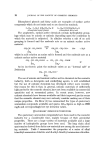
J. Soc. Cosmetic Chemists 17 17-27 (1966) ¸ 1900 Society of Cosmetic Chemists o.oe Greai Britain Cationic emulsifiers in cosmetics K. M. GODFREY* Presented at the Symposium on "Emulsions", organised by the Society of Cosmetic Chemists of Great Britain at Harrogate, Yorks, on 31st March 1965. Synopsis The use of cationic surface active chemicals as emulsifiers in cosmetic products has been a relatively recent development. Their properties are reviewed and methods of making use of them are discussed. The sensitizing of emulsions to "break" on contact with surfaces to which they are applied has particular interest to the formulatot of cosmetic products. INTRODUCTION Surface active chemicals are conveniently classified as anionic, nonionic, cationic or ampholytic depending upon their ionization properties in solution. Molecules, of surface active chemicals which ionize, are anionic or cationic according to which ion contains the hydrophobic grouping. Compounds such as soaps, alkyl sulphonates, alkyl aryl sulphonates, salts of sulphated alcohols, etc. are anionic as the negative ion contains the hydrophobic, long chain grouping, e.g. (CH a. (CH•)•6 COO)- Iqa + sodium soap of fatty acid (CH a. (CH2)•.• OSOa)- Na+ sodium cetyl sulphate When the ion containing the hydrophobic, long chain group, is positive the compounds are cationic, e.g. CH a + R--N--CH a X- (CH a. (CH•)•7.NHa)+ X- I CH a amine salt quaternary ammonium salt *Armour Hess Chemicals Ltd., Leeds, Yorks. 17
Purchased for the exclusive use of nofirst nolast (unknown)
From: SCC Media Library & Resource Center (library.scconline.org)