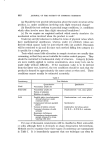
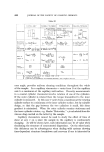
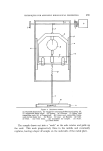
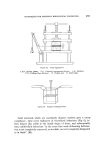
44O JOURNAL OF THE SOCIETY OF COSMETIC CHEMISTS (a) Should the test provide information about the static structure of the product, i.e. under conditions involving only slight structural change ? (b) Should the test conform to practical usage conditions, i.e. conditions which often involve more than slight structural breakdown ? (c) Do we require an empirical method which merely simulates the mechanical action involved when the product is used ? Under (a) and (b) behaviour is defined in terms of physical values which have mathematical significance, whereas under (c) arbitrary values are derived which cannot easily be inter-related with one another. Discussion will be restricted to (a) and (b) since each method falling into category (c) is specific for a single process. Tests which cause little alteration in sample structure are usually time consuming, so that they are not suitable for routine control purpose. They should be restricted to fundamental study of structure. Category (b)tests are more readily applied to routine examination, since many tests can be made daily without difficulty. If the maximum value is to be derived from the latter test, however, the test conditions should be such that the product is sheared to approximately the same extent as when used. These conditions cannot usually be estimated accurately. Table I Consistency Test Methods Quantitative Qualitative Fluid Viscometry {Tabl• II) Semi-solid Viscometry {Table II) Penetrometers- rod, cone, sphere Forces of cohesion Modulus of rigidity Solid Penetrometers- rod, cone, sphere Parallel plate viscoelastometer (Creep behaviour under constant stress) Compression between parallel plates Torsion of hollow cylinder Torsional vibration of solid cylinder Resonance techniques Weissenberg rheogoniometer sample response to stress varying with time Sectilometer Indentation by falling sphere BI.I.R.D. - B.F.M.R.A. extruder For ease of discussion consistencies will be classified as fluid, semi-solid, or solid, although there is obviously no sharp demarcation between them. Methods used to examine these three types of consistency are summarized in Table I. It is immediately apparent that one technique can often be

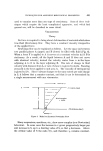
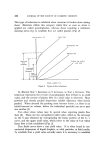
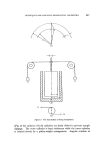
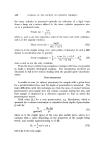
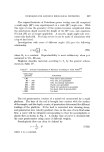
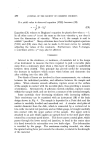
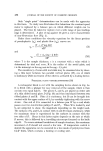
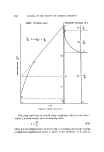
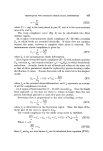
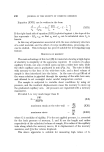
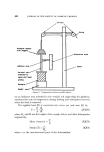
TECHNIQUES FOR ASSESSING RHEOLOGICAL PROPERTIES 441 used to examine more than one type of consistency. Some of these tech- niques which require the least complicated apparatus, and which find general use, will be described in some detail. VISCOMETERS Theory No force is required to bring about deformation of materials which show true fluid (Newtonian) flow. They have a constant viscosity irrespective of the applied force. Newtonian flow can be explained as follows. Let the space (x) between two parallel planes A (upper) and B (lower) be filled with fluid (Fig. 1). When a force F is applied to A it moves at a constant velocity (u) if B is stationary. As a result, all the liquid between A and B does not move with identical velocity instead the velocity varies from u in the layer adjoining A to 0 in the layer adjoining B. The rate of change in fluid velocity with distance from A, or rate of shear v, is given by du/dx. Shearing stress (S) is the force applied to unit area A. The viscosity of the liquid (•1) is given by S/v. Since v always changes to the same extent per unit change in S, it follows that •1 remains constant, and that it can be determined by a single measurement with any viscometer. *" V•loc/ty _-/u Figure I Model to illustrate NewtonJan Flow Many suspensions, emulsions, etc., show more complex (non-Newtonian) behaviour. In some cases the increase in v grows progressively larger per unit increase in S, up to a limiting value of S, so that •1 decreases. Above the critical value of S the ratio S/v, and therefore •1, remains constant.
Purchased for the exclusive use of nofirst nolast (unknown)
From: SCC Media Library & Resource Center (library.scconline.org)