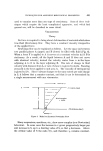
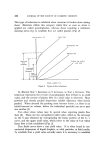
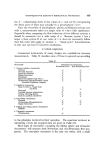
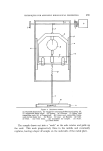
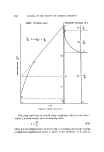
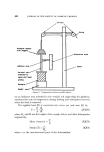
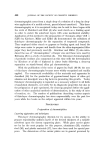
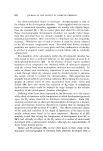
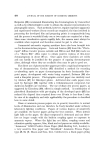
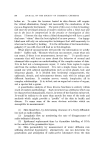
442 JOURNAL OF THE SOCIETY OF COSMETIC CHEMISTS This type of behaviour is exhibited when structure is broken down during shear. Materials within this category which flow as soon as stress is applied are called pseudoplastics, whereas those requiring a minimum shearing stress (So) to establish flow are called plastics (Fig. 2). 5htari•g strtJ, ($) t•l.•tic flow Pl•udoplo#tic flow Al•wtonf•n flow Dflot.•t flow without Figure oe Types of flow behaviour In dilatant flow v decreases as S increases, so that • increases. This behaviour represents the reverse of pseudoplastic flow if there is no yield value, and the reverse of plastic flow if a yield value is observed. Most powders and closely packed dispersions exhibit dilatancy when closely packed. When sheared the packing must become looser, i.e. there is an initial increase in volume, before the individual particles can move past one another (1). Two other stress values may be quoted when reporting plastic flow data (2). These are the extrapolated yield value, which is the intercept on the S axis obtained by extrapolating the linear portion of the S-v curve, and the upper yield value, which refers to the value of S at which linear flow is first established (Fig. 2). Pure fluids never show a true yield value. It is often found in con- centrated dispersions of liquid droplets, or solid particles, in fluid media. To establish that a yield value actually exists it is necessary to establish

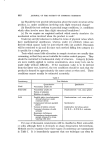
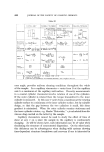
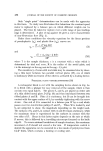
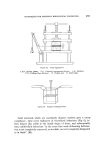
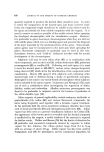
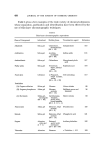
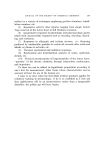
TECHNIQUES FOR ASSESSING RHEOLOGICAL PROPERTIES 443 the S - v relationship down to low values of v, and not by extrapolating the linear part of what may actually be a pseudoplastic curve. Since the viscosities of pseudoplastic, plastic, and dilatant systems vary with v, measurements taken at a single value of v have little significance. Especially when comparing the flow behaviour of two different systems •q should be measured over a wide range of v. Because system 1 has a larger •q than system B at one value of v it does not necessarily follow that this order will apply at another v. "Single point" determinations in this case can lead to incorrect conclusions. A critical comparison Commercial instruments of many designs are available for viscosity measurements. Table II classifies some of those in general use according Table II Viscometer Suitability for measuring . New'tonian Flow Non-Newtonian Flow 1. Coaxial cylinder viscometers Stormer Portable Ferranti Epprecht Rheomat Haake Rotovisko Brookfield Merrill-Brookfield High Shear Weissenberg Rheogoniometer (Farol Research Engineers, Bognor) 2. Capillary viscometers Glass U-tube (a', Single bulb (b) Multi Redwood Variable pressure plastometer Techne vibrating piston Insfrom capillary rheometer 3. Cone-Plate viscometers Ferranti Weissenberg Rheogoniometer Haake Rotovisko 4. Falling and rolling sphere viscometers H6ppler $. Ultrasonic viscometer Ultraviscoson to the principles involved in their operation. The equations involved in calculating •q from the acquired data are given in Table III. Most types of viscometer, excepting the falling sphere and ultrasonic viscometers, will measure both Newtonian and non-Newtonian flow pro- perties. The cone-plate viscometer is the only one which, with a small
Purchased for the exclusive use of nofirst nolast (unknown)
From: SCC Media Library & Resource Center (library.scconline.org)