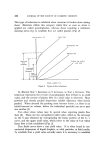
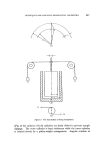
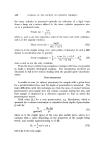
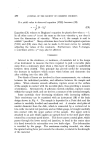
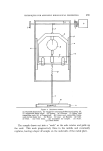
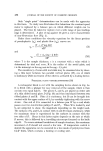
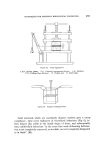
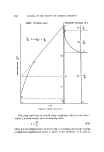
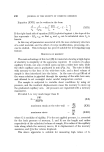
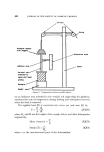
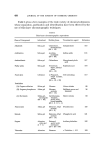
46O JOURNAL OF THE SOCIETY OF COSMETIC CHEMISTS Pulleys •c•/e Figure 9 Compression between parallel plates. on an indicator arm attached to the vertical rod supporting the platform, measures the rate of compression during loading and subsequent recovery when the load is removed. The applied load (F) is converted into stress per unit area (U) by F Ho (XXm) U-A. where H o and H are the height of the sample before and after deformation respectively. U Shear stress (a) -- (XXIV) e Strain (T) -- Ho where e is the non-recovered part of the deformation. (xxv)

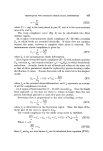
TECHNIQUES FOR ASSESSING RHEOLOGICAL PROPERTIES 461 The data can now be treated in the same way as creep compliance data (Section 4) by plotting T/, against t, but the calculation of viscosity has to be modified since compression produces viscous flow in more than one direction. An approximate correction can be achieved by multiplying the calculated viscosity by 2,:(Ho)•/A. Calculated parameters are lower than those derived from creep compliance since the compression technique causes more structural alteration to the sample. The weight required to give a reasonable compression should be determined by trial and error prior to carrying out the main tests. In a cruder form of the present test, the rate of compression is not determined, but only the total compression, and overall recovery, after a suitable time e.g. 3-5 min. OTHER RI-IEOLOGICAL TECHNIQUES The other, more sophisticated, procedures listed in Table I for assessing the consistency of solids require more complex equipment and are more time-consuming. They are suited only to basic research. Ferry (21•) reviews these methods in some detail. CONCLUSIONS It is often possible to use more than one technique to measure the consistency of any material. However, the techniques employed may not all measure the same component of texture, and this should be appreciated when attempting to correlate the various groups of data. For example, ease of spreadability arises from rapid deformation and structural break- down. Firmness depends on the ability to resist static, or virtually static, loads, so that it is related to very slow deformation. Thus, firmness and spreadability represent quite different attributes of the textural quality described broadly as consistency. Penetrometers, and shear or com- pression under small loads, measure firmness. Extrusion, and other methods involving appreciable structural breakdown, measure spread- ability. (Received: 1st september 1965) REFERENCES (1) Roscoe, R. in J. J. Hermans Ed. Flow .Properties of Disperse Systems 1 (1953) (North Holland Publishing Co., Amsterdam). (2) Houwink, R. Elasticity, Plasticity and Structure of Matter (1958) {Dover Publications Inc. New York). (3) Van Wazer, J. R., Lyons, J. W., Kim, K. Y. and Colwell, R. E. "Viscosity and Flow. Measurement" (1963) (Interscience Publishers, London). (4) Scott-Blair, G. W. and Oosthuizen, J. C. Brit. J. Appl. Phys. 11 332 (1960).
Purchased for the exclusive use of nofirst nolast (unknown)
From: SCC Media Library & Resource Center (library.scconline.org)