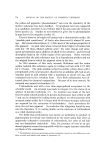
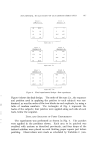
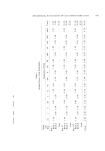
764 JOURNAL OF THE SOCIETY OF COSMETIC CHEMISTS presented not with single odorants but with pairs. They are asked to indicate simply how similar to one another or how different they find the members of a pair to be. If there are a total of three odors to be studied, this would make three pairs and three "distances" between odors (A-B, B-C, and A-C). If there are 25 odors, there are 300 dis- tances to be determined. There are various ways of getting estimates of magnitude of difference from respondents. Whatever method is used, judging these differences or distances is a difficult task, not unlike the lining up of different shapes in order of area which was discussed before. Again, we have to take a fairly large number of judges and calculate average judgments if we want to get reproducible results. By the time we complete the interviews and calculations on, say, 25 odorants, we will have 300 figures representing the pair-wise distances between 25 points (the odorants). Two points and a given distance be- tween them can be represented on a (one-dimensional) straight line three points, with three pair-wise distances between them, can be ac- curatdy represented by a triangle in a (two-dimensional) plane four points, with six interpoint distances, will be represented by a pyramid in a three-dimensional space. To represent 25 points accuratdy, when the 300 pair-wise distances between them are given, takes a 24-dimen- sional space. In multidimensional analysis we actually start out with such a space, but through mathematical techniques, too complex to de- scribe here but similar in principle to the techniques a cartographer uses in depicting a three-dimensional reality on a two-dimensional map, we simplify it down to a space with maybe four or five dimensions. In this process we inevitably introduce some distortion but we make our infor- mation much easier to understand and to handle. By the t/me we get down to three dimensions, we may have introduced some fairly severe distortions but we have something we can look at. Such a three-dimensional representation is, in many ways, similar to the "odor-space" we discussed before, the end-result of the semantic differential. There is one important difference: while the meaning of the dimensions of the space obtained in the semantic differential can be understood by reference to the adjectives or word pairs that are closely related to these dimensions, the space model obtained by multidimen- sional scaling has dimensions which are unlabded and which may have no meaning. In a way this limits its usefulness but in another way, it is the direct result of a fundamental advantage which the multidi- mensional scaling technique has over the semantic differential. In the semantic differential, the respondent has to give his answers in terms

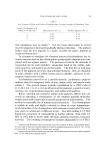
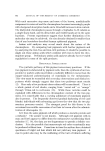
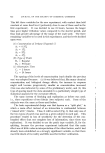
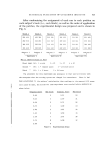
MEASURING THE MEANING OF FRAGRANCE 765 of the adjectives the experimenter has provided. The experimenter will make every effort to select adjectives which will cover all aspects and all dimensions of the odor which may be relevant to the respondent, but he can never be sure that he has succeeded in this. Also, the adjectives or word-pairs used in the questionnaire may introduce distortions by in- fluencing the respondent, e.g., by suggesting that certain things are rele- vant which are actually of no importance to him. In the multidimen- sional scaling technique, the respondent is given no words. He judges differences and similarities between odors along dimensions which he may not even consciously formulate but which are, ipso facto, the most relevant to him. It is for this reason that those who have set out to ex- plore olfaction without preconceived ideas, in search of primary odor qualities, have preferred to use multidimensional scaling.* Woskow (11) used odorants and described them in a nine-dimensional space of which the first three dimensions were the most important. Al- though the dimensions are not labeled, their meaning can be interpreted by looking at what odorants lie close to the ends of the space along each of the dimensions. Woskow's first and mathematically most important dimension (it accounted for a large portion of the differences between the odorants) was clearly an evaluative one. It had vanillin, safrol, methyl salicylate, and benzaldehyde at one end and butyric acid, pyri- dine, and scatol at the other. The second dimension has camphor, guaiacol, and menthol at one end and aliphatic alcohols (C2-C•) and vanillin at the other. Woskow suggests the label cooling, woodsy for this axis but prickling-medicinal vs. soothing-unctuous might be prefer- able. The third and following dimensions are difficult to interpret. In fact, in interpreting a multidimensional model, a good case can be made for not assigning any meaning to dimensions but only to interpoint dis- tances. Schutz, also trying to uncover primary odors, measured the quality of 30 odorants using both a semantic differential technique and multidi- mensional scaling (12). From the multidimensional scaling experiment he derived nine main factors which he labeled: fragrant, etherish, sweet, burnt, rancid, oily, metallic, spicy, and sulfurous or goaty. On the basis of this work, Schutz proposed a nonverbal method of describing odors: choose some standard odors which are distinctly dif- ferent from one another for each odor to be described, have respondents * Even using this technique the experimenter cannot help influencing the outcome of his experiment: he is the one who selects the odorants to be tested, and he has to interpret the results.
Purchased for the exclusive use of nofirst nolast (unknown)
From: SCC Media Library & Resource Center (library.scconline.org)