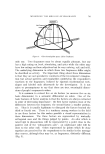
766 JOURNAL OF THE SOCIETY OF COSMETIC CHEMISTS judge the pair-wise distances (degrees of difference) between this odor and each of the standard odors use a group of respondents and average their judgments to get reproducible values. The set of average distance judgments of the new odor with respect to the standard odor describes, and in a sense, defines the new odor. Schutz used nine odorants, one for each of his factors, as standards, but other standards may also be used with this method which Schutz called the "matching standards method." Amoore (13) has applied the matching standards method to test his own theory about primary odors. Yoshida (14) also examined a divergent group of odorants by the multidimensional scaling technique in an attempt to ascertain whether earlier proposed schemes for odor classification had any objective basis. He also investigated a group of modern luxury perfumes and a group of spices and herbs by the same technique. In each case, he extracted four or five factors, of which the evaluative one was the most important one. So far, then, attempts to find primary odors as the underlying dimen- sions in a multidimensional space model of odor have only been moder- ately successful. They have, however, shown that multidimensional scaling can be used to construct space models of odors. We can then use these models for different purposes, i.e., to measure how consumers at large react to given fragrances, in what way and in what direction a change in a fragrance affects the consumers' perception of it, or to get guidance in the development of new fragrances for a specific purpose.* True, the lack of words in the model to guide us can become a handicap, but there are ways of overcoming this difficulty. A research group at General Foods is currently using a modified multidimensional scaling technique in flavor work with very promising results. PRODUCT TESTING The new techniques for measuring the relations between, and the meaning of things and concepts in general, and of fragrances in particu- lar, can be of real value not only to the perfumer, but also to those in the perfumery and cosmetic industry who are concerned with the con- sumer testing of new or improved products. As Randebrock (8) pointed out, the use of a questionnaire containing many different scales (29 in his case), rather than only questions about degree of liking or preference has the advantage of yielding stable, reproducible results with panels of as few as 30 respondents whereas the traditional tests require several * A novel technique of new product development which makes extensive use of multi- dimensional scaling is described by Barnett (15).

MEASURING THE MEANING OF FRAGRANCE 767 hundred respondents to give stable findings. That is a practical ad- vantage. A more significant, fundamental difference lies in the fact that the traditional tests, by centering only on the questions, "How much do you like this sample?" or "Which do you prefer?", have, in effect, assumed that the evaluative dimension, the question of pleasing- ness, is the only relevant one, the only one which determines consumer behavior toward the product. We know that this is not true. One cannot help wondering how far beer, cigarettes or coffee would have gone in the marketplace if at their first exposure to the consuming public they would have been accompanied by a questionnaire asking, "How much do you like this new product ?" Since aspects other than pleasant- ness do influence consumer acceptance of a product, new techniques to measure these other aspects can and will lead to important advances in acceptance prediction. CONCLUSION The techniques for measuring the meaning of fragrance discussed in this paper, namely, profiling, the semantic differential, and multidimen- sional scaling, are new and we still have to learn a lot about how to use them. We have to learn, among other things, how to choose those ad- jectives for our questionnaires which will give the most useful informa- tion how best to select the samples or concepts to be included in a test (for what we learn about one sample depends on what other samples are tested alongside with it) and how to interpret the space models ob- tained in multidimensional scaling. We shall learn these things, and in so doing we shall be forging powerful tools for the perfumer and for the marketing expert. To the perfumer, these techniques will provide a more direct and clear means of communication with the consumer than he has had up to now. By setting up, through the kinds of tests we have discussed, a feedback system and a continuing dialogue with his public, the perfumer will learn more and more precisely what it is about a fragrance that makes the public perceive it as sexy, as refreshing, as dull, or as masculine. If the marketing group has determined that the new baby powder that is being developed should be perceived by the public as being more cool, gentle, and wholesome than those currently available, the perfumer can use his dialogue with the public to guide him towards a fragrance which is cool, gentle, wholesome, and baby-like. Also, the dialogue makes possible a creative rather than slavish imitation of competitors' successful prod- ucts. To the marketing expert, these testing methods will provide
Purchased for the exclusive use of nofirst nolast (unknown)
From: SCC Media Library & Resource Center (library.scconline.org)